
How Long Does an Accident Stay on Your Insurance
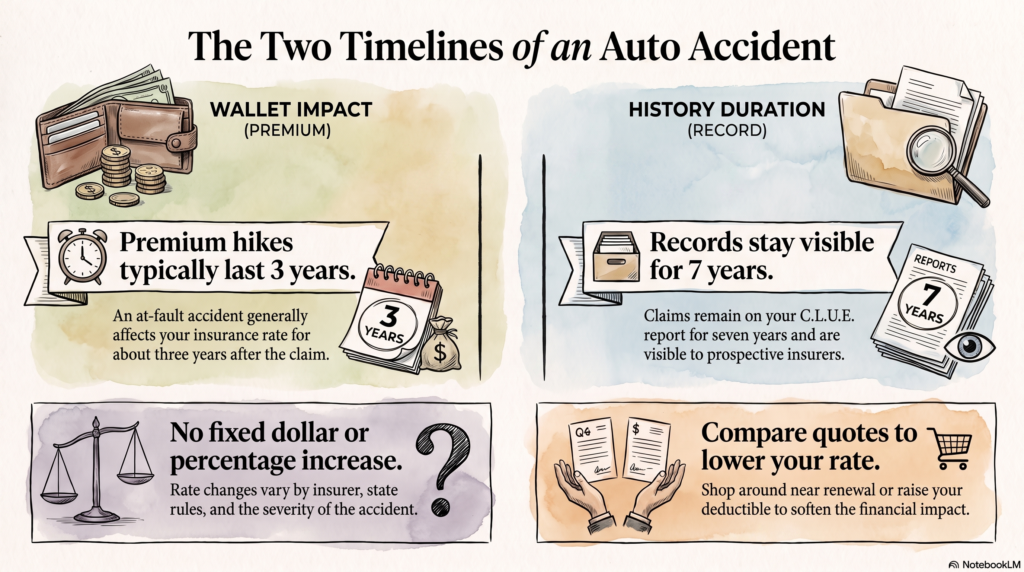
How long does an accident stay on your insurance? An at-fault accident usually affects your car insurance premium for about three years, though the exact period varies by insurer and state. Separately, a reported claim can stay on your claims-history report for up to seven years. These are two different timelines: how long your price is affected, and how long the record exists.
Quick answer: An at-fault insurance claim may affect your premium for approximately three years, although the exact period varies by insurer and state. A reported claim may remain on your Comprehensive Loss Underwriting Exchange (C.L.U.E.) claims-history report for up to seven years, and prospective insurers may obtain it. Your state driving record follows a separate timeline.
Key takeaways
- An at-fault accident generally affects your premium for about three years, according to the Insurance Information Institute. The exact amount and length vary by insurer.
- A reported claim can stay on your C.L.U.E. claims report for up to seven years, which prospective insurers may obtain (CFPB).
- There is no fixed dollar or percentage increase. How much your insurance goes up depends on your insurer, your state, the accident, and your record.
- A not-at-fault accident (someone hits you) may affect your rate less, but this depends on your insurer and state rules.
- When you switch insurers, the new company may check your claims history and driving record, so recent claims can surface whether or not you mention them.
How long does an accident stay on your insurance? The two timelines
It helps to separate two different questions people mix up.
1. How long your premium is affected. When you file a claim for an accident that is mostly your fault, your insurer can raise your premium. The Insurance Information Institute explains that these increases generally stay on your premium for three years following the claim. The exact percentage and how long it lasts vary from company to company.
2. How long the accident stays on your record. Separately, an insurance claim may be reported to a national claims-history database called the Comprehensive Loss Underwriting Exchange (C.L.U.E.), operated by LexisNexis. According to the CFPB, C.L.U.E. collects and reports up to seven years of auto insurance claims. Insurers use it to set your price. So a claim may still be visible to a new insurer even after your old premium surcharge has ended.
In short: the accident-related surcharge usually stops affecting your rate after about three years, although your total premium may not return to its previous amount, while the record can exist for up to seven.
How much does your insurance go up after an accident?
There is no single number. No honest guide can promise an exact figure, because the increase depends on your insurer, your state, how serious the accident was, who was at fault, and your past record. The Insurance Information Institute confirms that after an at-fault claim, insurers raise premiums “by a certain percentage,” and the amounts, percentages, and ceilings vary from company to company.
Things that tend to push the increase higher:
- You were at fault in the accident.
- The claim was large or involved injuries.
- You already have other accidents or violations on your record.
- You live in a location or insurance-rating territory with higher claim costs.
Because the increase is not fixed, the best way to know your number is to ask your insurer, and to compare quotes from a few others before you renew.
When do accidents fall off your insurance?
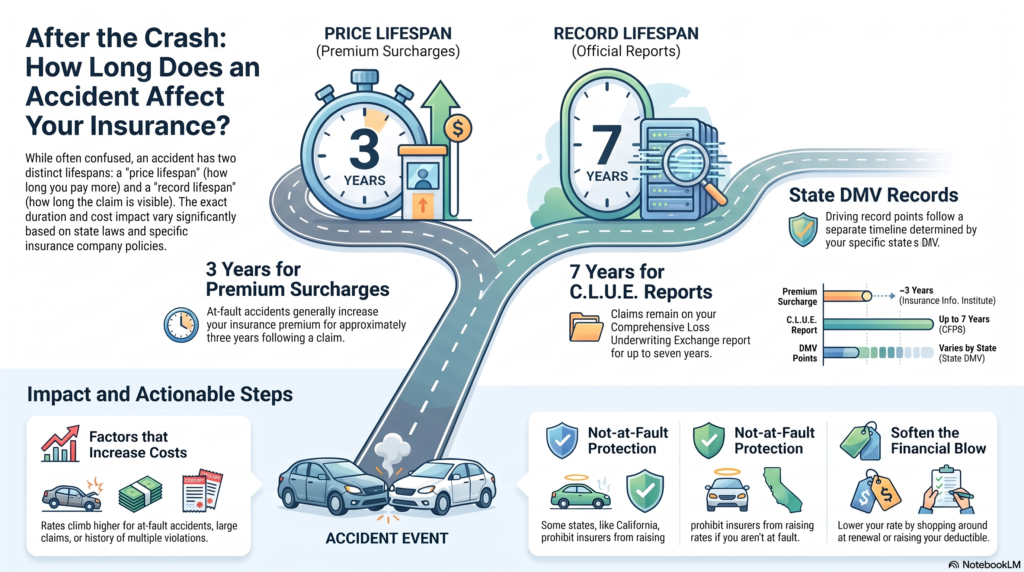
In practice, an at-fault accident stops affecting your premium after about three years, while a reported claim may remain on your C.L.U.E. claims report for up to seven years. These are two separate timelines, and the exact timing depends on your insurer and state.
| What | Typical timeline | Source |
| Premium surcharge (higher price) | About 3 years after the claim | Insurance Information Institute |
| Accident visible on C.L.U.E. claims report | Up to 7 years | CFPB |
| Points on your driving record (varies widely) | Set by your state DMV | Your state DMV |
You can check what is on your own claims record. The CFPB notes you can request one free C.L.U.E. report every 12 months from LexisNexis, and you have the right to dispute anything that looks wrong under the Fair Credit Reporting Act.
Can your insurance go up if someone hits you?
Sometimes, but not always. A not-at-fault accident does not automatically raise your rate, and some states prevent a surcharge when you are not at fault. Official guidance ties premium increases mainly to accidents that are “primarily your fault,” so how a not-at-fault claim affects your price depends on your insurer and your state.
A few points to keep in mind:
- If you or your insurer reports a claim, it may appear in your C.L.U.E. claims history even when you were not primarily at fault. An accident that never becomes an insurance claim may not appear in a standard C.L.U.E. report.
- State rules differ. For example, the California Department of Insurance says an insurer does not charge more when an accident is not your fault, while other states and insurers apply their own rating rules. Your state insurance department can confirm the rule where you live.
- Even a not-at-fault claim can matter if you have several claims in a short time, because insurers look at your overall pattern.
If another driver is clearly at fault, their liability insurance is generally responsible for your damage. Ask your insurer how a not-at-fault claim will be treated before you assume your rate is safe.
Do you have to report accidents when you switch insurance companies?
Yes, answer honestly. A new insurer can check your recent driving and claims history, so it is best not to leave anything off. It may verify your answers using a motor vehicle report, a C.L.U.E. report, or another consumer report. An accident may appear in one or more of these records depending on how it was reported.
There are two good reasons to be upfront:
- Accuracy. Your quote is based on your record. If you leave out an accident, the price can change once the insurer sees your C.L.U.E. report.
- Coverage protection. Incorrect or incomplete information can cause the insurer to revise your quote and may create cancellation, nonrenewal, rescission, or coverage issues, depending on state law and the policy. Answer all application questions accurately.
It is also wise to always tell your current insurer about an accident when it happens. The Insurance Information Institute warns that failing to report an accident promptly can put your coverage at risk if the other party makes a claim or sues you later.
How to lower your rate after an accident
You cannot erase an accident, but you can soften the cost while it is on your record.
- Shop around near renewal. Insurers weigh accidents differently, so a company that is harsher on your record today may be cheaper than the one that is easy on it. Compare at least three quotes.
- Ask about a safe-driver or accident-forgiveness program. Some insurers offer these; ask what your company has.
- Raise your deductible if you can afford the higher out-of-pocket cost, which usually lowers your premium.
- Keep the rest of your record clean. Time and safe driving are what bring your price back down.
- Check your discounts. Bundling, low mileage, safety features, and paying in full can all reduce the bill.
If your car is financed or leased, remember your lender may require full coverage on a financed car, so dropping coverage to save money may not be an option.
Frequently asked questions
How long does an accident stay on your insurance?
An at-fault accident usually affects your premium for about three years, according to the Insurance Information Institute. Separately, the claim can stay on your C.L.U.E. claims report for up to seven years, which a new insurer may obtain. Exact timing varies by insurer and state.
When do accidents fall off your insurance?
The accident-related surcharge typically ends after about three years, while a reported claim may remain on your C.L.U.E. report for up to seven years. Points on your driving record follow separate rules set by your state DMV.
How much will my insurance go up after an accident?
There is no fixed amount. The increase depends on your insurer, your state, the size of the claim, who was at fault, and your record. The Insurance Information Institute confirms the percentage and ceiling vary by company, so ask your insurer and compare quotes.
Can my insurance go up if someone hits me?
Not always. A not-at-fault accident does not automatically raise your rate, and some states prevent a surcharge when you are not at fault. For example, California says an insurer does not charge more for a not-at-fault accident. Rules vary by state and insurer, so check with your state insurance department.
Do I have to report recent accidents when switching insurance companies?
Yes, answer honestly. A new insurer can check your C.L.U.E. claims history and driving record, so recent claims can surface. Leaving them off can change your quote later and, depending on state law and the policy, create coverage problems.
How can I see what accidents are on my record?
You can request one free C.L.U.E. report every 12 months from LexisNexis, per the CFPB. If something is wrong, you have the right to dispute it under the Fair Credit Reporting Act.
Educational disclaimer
This article is for general education only. It is not financial, legal, or insurance advice, and it is not reviewed by a licensed insurance agent. Surcharge periods, not-at-fault rules, and driving-record points vary by state and by insurer. The examples above are general guidance, not nationwide rules. Before you make a decision, confirm the details with a licensed insurer or your own state insurance department. You can find yours through the NAIC state insurance department directory.
Reviewed against sources:
Insurance Information Institute, Consumer Financial Protection Bureau, National Association of Insurance Commissioners, and applicable state insurance department guidance. Author: Nimra Saleem, MoneyMentorDesk. This guide is written in plain English and fact-checked line by line against official and authoritative consumer-insurance sources, including the Insurance Information Institute, the Consumer Financial Protection Bureau, and state insurance department guidance. It is educational only, and is not a substitute for advice from a licensed insurance agent or your state insurance department.
Sources
- Insurance Information Institute – Do auto insurance premiums go up after a claim? (at-fault surcharges generally last three years; amounts vary by company; always report an accident)
- Consumer Financial Protection Bureau – LexisNexis C.L.U.E. (C.L.U.E. reports up to seven years of auto claims; one free report a year; right to dispute)
- Insurance Information Institute – What determines the price of an auto insurance policy? (driving record, location, and other rating factors; state limits on certain factors)
- NAIC – State Insurance Department directory (find your state regulator to confirm local not-at-fault and surcharge rules)
- California Department of Insurance – Automobile Insurance guide (example of a state rule: no surcharge for a not-at-fault accident; a surcharge can apply when a driver is at least 51% at fault)