
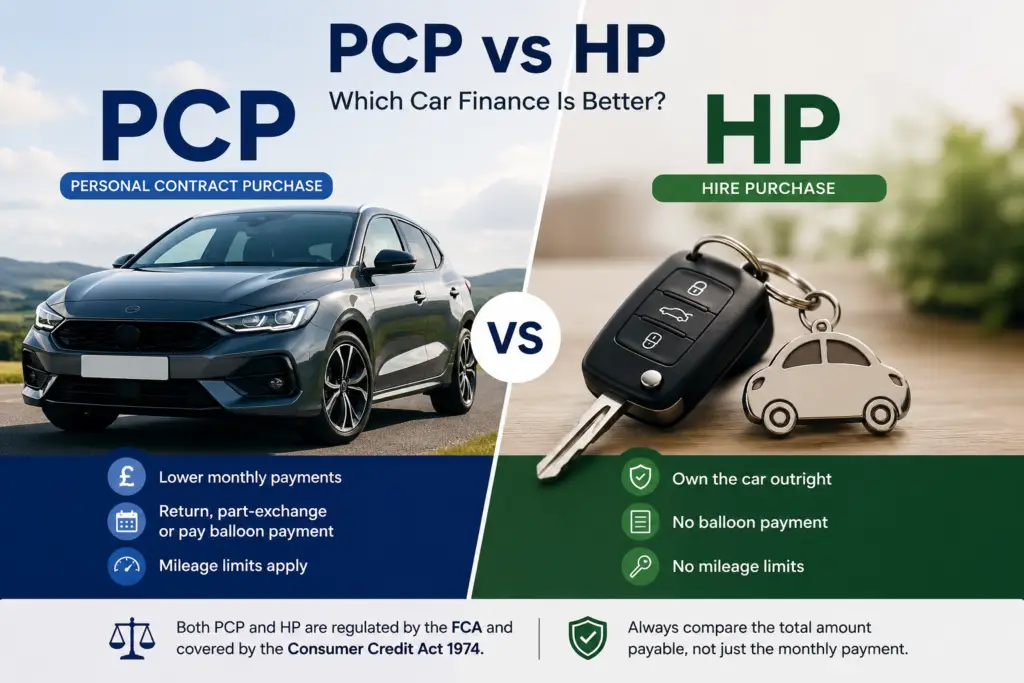
PCP vs HP: Which Car Finance Is Better? The answer depends on whether you want lower monthly payments or full car ownership. PCP usually gives lower monthly costs and more flexibility at the end of the agreement, while HP often suits buyers who want to own the car outright with no balloon payment. In this guide, we compare PCP and HP in simple UK terms so you can understand the costs, risks, legal rights, and which option may suit your situation.
Quick Answer
PCP (Personal Contract Purchase) gives you lower monthly payments but you do not automatically own the car at the end. You pay a large final “balloon payment” to keep it, return it, or use any equity to part-exchange.
HP (Hire Purchase) gives you higher monthly payments but you own the car outright once all payments are made. There is no balloon payment.
Which is better? It depends on whether you want to own the car, your monthly budget, how many miles you drive, and how long you plan to keep the vehicle.
Key Takeaways
- PCP monthly payments are usually lower than HP because you do not repay the full car value.
- HP builds full ownership automatically — no balloon payment is needed.
- PCP suits drivers who like changing cars every 2–4 years and drive within a set mileage limit.
- HP suits drivers who want to own the car outright and keep it long-term.
- Both are regulated by the Financial Conduct Authority (FCA) and covered by the Consumer Credit Act 1974.
- Always compare the total amount payable, not just the monthly payment.
- On both PCP and HP you may have the right to voluntarily terminate your agreement once you have paid 50% of the total amount payable (Section 99, Consumer Credit Act).
PCP vs HP at a Glance
| PCP | HP | |
| Car price | £25,000 | £25,000 |
| Deposit | £2,500 | £2,500 |
| Amount financed | £22,500 | £22,500 |
| GMFV / Balloon payment | £8,500 (assumed) | N/A |
| Monthly payment (approx.) | £380 | £560 |
| Number of payments | 48 | 48 |
| Total of monthly payments | £18,240 | £26,880 |
| Balloon payment | £8,500 | £0 |
| Total amount payable | £29,240 | £29,380 |
| Total interest paid | ~£4,240 | ~£4,380 |
Interest is the total you pay back minus the amount financed. PCP: (£18,240 + £8,500) − £22,500 = £4,240. HP: £26,880 − £22,500 = £4,380.
What Is PCP (Personal Contract Purchase)?
PCP stands for Personal Contract Purchase. It is a type of car finance where you pay a deposit, make fixed monthly payments for a set term (usually 2 to 4 years), and then choose what to do with the car at the end. You do not own the car during the agreement. The finance company owns it until you make the final optional balloon payment — which can be thousands of pounds. PCP is currently one of the most popular ways to finance a new car in the UK, according to the Finance & Leasing Association (FLA). Source: Finance & Leasing Association
How PCP Works — Step by Step
How PCP Finance Works — Step by Step
Personal Contract Purchase · MoneyMentorDesk.com
MoneyMentorDesk.com is not a lender or financial adviser. This infographic is for educational purposes only. Always confirm terms with your finance provider.
What Happens If the Car Is Worth Less Than the GMFV?
If the car’s market value at the end of the agreement falls below the GMFV, you are not affected if you simply return the car. The lender carries that risk — it is “guaranteed” in the GMFV figure. This is one of the main benefits of PCP.
However, if you want to buy the car, you would still pay the GMFV regardless of the car’s actual market value.
What Happens If the Car Is Worth More Than the GMFV?
If the car is worth more than the GMFV at the end of the term, you have built up positive equity. You can use this as a deposit on your next car — making PCP attractive for drivers who like upgrading regularly.
Pros and Cons of PCP
Pros:
- Lower monthly payments compared to HP on the same car
- Flexibility to return, buy, or upgrade at the end
- GMFV protects you from depreciation risk if you return the car
- Often available on new cars with manufacturer deposit contributions
- Access to newer, higher-specification cars for lower monthly cost
Cons:
- You do not own the car unless you pay the balloon payment
- Strict mileage limits — excess mileage charges apply
- The car must be returned in acceptable condition (fair wear and tear)
- Total amount payable can be higher than HP if you ultimately buy the car
- You cannot modify the car freely
- Missing payments can affect your credit score and the car may be repossessed
What Is HP (Hire Purchase)?
HP stands for Hire Purchase. It is a straightforward car finance arrangement where you pay a deposit and fixed monthly payments over a set term. At the end of the term, when all payments are made, you own the car outright.
There is no balloon payment and no mileage limits. You are essentially “hiring” the car until you have paid for it in full.
How HP Works — Step by Step
How HP Finance Works — Step by Step
Hire Purchase · MoneyMentorDesk.com
No mileage limits. No condition charges. No balloon payment.
MoneyMentorDesk.com is not a lender or financial adviser. This infographic is for educational purposes only. Always confirm terms with your finance provider.
HP and Used Cars
HP is widely available on used cars, including older models from dealerships and some independent sellers. PCP is less commonly offered on older used cars because calculating a reliable GMFV is harder on high-mileage or older vehicles.
This makes HP a more practical route for buyers looking at used car finance.
Pros and Cons of HP
Pros:
- You own the car once all payments are made
- No mileage restrictions
- Simpler structure — no balloon payment to worry about
- Often lower total interest cost than PCP if you want to keep the car
- Widely available on used and older vehicles
- Easier to understand for first-time finance users
Cons:
- Higher monthly payments than PCP on the same car
- Less flexibility at end of term — you own it and that’s it
- You cannot sell the car freely while finance is outstanding without settling the agreement
- May not be the most efficient route if you plan to change cars regularly
PCP vs HP — Key Differences Explained
The most important differences between PCP and HP come down to ownership, monthly cost, flexibility, and total amount payable.
| Feature | PCP | HP |
| Who owns the car during the agreement? | Finance company | Finance company |
| Who owns the car at end? | You (only if balloon is paid) | You (automatically) |
| Monthly payments | Lower | Higher |
| Deposit required | Usually 10%+ | Usually 10%+ |
| Mileage limits | Yes — set at start of agreement | No |
| Balloon payment (GMFV) | Yes | No |
| Can you return the car? | Yes, at end of term | Only via voluntary termination |
| Can you modify the car? | Not usually (finance company owns it) | Yes, once fully paid |
| Early settlement | Yes, subject to settlement fee | Yes, subject to settlement fee |
| Total cost if keeping car | Often higher (balloon adds total interest) | Often lower |
| Flexibility | High (3 options at end) | Low (you keep it) |
| Best for | Drivers who change cars regularly | Drivers who want long-term ownership |
| Used car availability | Limited on older cars | Widely available |
PCP vs HP Cost Comparison — Real-World Numbers
Numbers help make this clearer. Here is a realistic UK example based on a £25,000 car with a 9% APR over 48 months.
Note: These are illustrative figures only. Your actual payments will depend on your lender, credit profile, deposit size, APR offered, and the specific vehicle. Always use the lender’s official finance calculator and check the total amount payable in your finance agreement.
Example: £25,000 Car, 9% APR, 48-Month Term, £2,500 Deposit (10%)
| PCP | HP | |
| Car price | £25,000 | £25,000 |
| Deposit | £2,500 | £2,500 |
| Amount financed | £22,500 | £22,500 |
| GMFV / Balloon payment | £8,500 (assumed) | N/A |
| Monthly payment (approx.) | £380 | £560 |
| Number of payments | 48 | 48 |
| Total of monthly payments | £18,240 | £26,880 |
| Balloon payment | £8,500 | £0 |
| Total amount payable | £29,240 | £29,380 |
| Total interest paid | ~£6,740 | ~£6,880 |
What this shows:
- PCP monthly payments appear significantly lower (£380 vs £560).
- If you pay the PCP balloon payment to buy the car, the total costs are broadly similar or slightly higher than HP.
- If you return the PCP car at the end, you pay less in total — but you have nothing to show for it.
- HP builds ownership automatically. By the end of the agreement, the car is yours.
PCP vs HP — Cost Comparison
Section 4 · MoneyMentorDesk.com
*PCP total includes the £8,500 balloon payment · MoneyMentorDesk.com is not a lender or financial adviser · For information only
Why PCP Looks Cheaper Monthly — But May Not Be
With PCP, you only finance the depreciation portion of the car’s value, not the full amount. The GMFV sits at the end as a lump sum. This makes monthly payments lower.
But if you keep the car on PCP, you pay the balloon payment on top — and you have been paying interest on that balloon amount throughout the agreement even though you deferred the payment. The total interest cost can be similar or higher than HP.
The key rule: Always compare the total amount payable across the full agreement, not just the monthly figure.
Your Legal Rights on PCP and HP Finance
Both PCP and HP are regulated credit agreements in the UK. This gives you important legal protections.
Section 75, Consumer Credit Act 1974
Under Section 75 of the Consumer Credit Act 1974, if you use a credit agreement to buy a car priced between £100 and £30,000, the lender shares equal liability with the dealer if the car is faulty, misrepresented, or the dealer goes out of business.
This is a powerful protection. If the dealer cannot resolve a fault, you may be able to claim from the finance company instead.
Source: Citizens Advice — Section 75
Note: Section 75 applies to credit agreements where the credit is directly linked to the purchase. Confirm with your lender whether your specific agreement qualifies.
Voluntary Termination — Section 99, Consumer Credit Act 1974
Under Section 99 of the Consumer Credit Act 1974, you have the right to voluntarily terminate a regulated HP or PCP agreement once you have paid at least 50% of the total amount payable (including the balloon payment on PCP).
If you have paid less than 50%, you can still terminate but must pay the difference up to 50%.
If the car has excessive damage beyond fair wear and tear, the lender may charge for repairs.
This is a legal right — it does not negatively affect your credit score by itself, though the terminated agreement will appear on your credit file.
Source: GOV.UK — Consumer Credit Act
Early Settlement
You can usually settle your agreement early by paying the outstanding balance minus a statutory rebate of interest (under the Consumer Credit Act). Ask your lender for a settlement figure at any time.
Missed Payments
Missing payments on PCP or HP can result in:
- Late payment charges
- Damage to your credit score
- The lender issuing a Default Notice
- Repossession of the vehicle (subject to court order if you have paid more than one-third of the total amount payable — Section 90, Consumer Credit Act)
If you are struggling with payments, contact your lender as early as possible. Lenders are required to treat customers fairly under FCA guidelines.
Source: FCA — Consumer Credit guidance
Complaints Process
If you have a complaint about your car finance:
- Contact your lender’s complaints department first.
- Allow up to 8 weeks for a formal response.
- If unsatisfied, refer the complaint to the Financial Ombudsman Service (FOS) — free for consumers.
Source: Financial Ombudsman Service
Note on FCA car finance review: The FCA has been reviewing historical commission arrangements in car finance. If you took out a car finance agreement before January 2021, you may be affected. Check the FCA website for the latest updates. Source: FCA car finance review
PCP vs HP for Electric Cars
EV Depreciation and PCP
Electric vehicles (EVs) have historically depreciated faster than some petrol and diesel equivalents, though this varies by model and market conditions. With PCP, the GMFV is set at the start of your agreement, meaning you are protected from unexpected depreciation if you return the car.
This makes PCP a popular choice for EV buyers who want to manage the risk of rapid technological change. If a better EV comes along, you can simply return the car and move on.
Battery Health and Residual Value
Battery degradation affects EV residual values. Finance providers factor this into the GMFV when setting PCP terms. If battery health declines faster than expected, this could affect the car’s value — though the GMFV itself remains fixed in your agreement.
When HP May Still Be Better for an EV
HP may suit EV buyers who:
- Plan to keep the car long-term and are not concerned about changing to a newer model
- Want to own the vehicle outright without a balloon payment
- Drive more than typical PCP mileage allowances
HP gives full ownership, which allows buyers to benefit if battery technology holds up well and the car retains good value.
PCP Mileage Limits and EVs
PCP mileage allowances on EVs work the same way as petrol cars. Exceeding the agreed annual mileage results in excess mileage charges at a set pence-per-mile rate. This is particularly important for EV drivers using their car for longer commutes.
GAP Insurance on PCP or HP
What Is GAP Insurance?
GAP stands for Guaranteed Asset Protection. It is an optional insurance product that covers the difference (the “gap”) between what your standard car insurance pays out in a total loss claim and what you still owe on your finance agreement — or the original price you paid for the car.
Why GAP Insurance Matters on Financed Cars
If your car is written off or stolen, your standard comprehensive car insurance typically pays the current market value of the vehicle — not what you originally paid or what you owe on finance.
Cars depreciate quickly. In the early months of a PCP or HP agreement, you may owe more than the car is worth. Without GAP insurance, you could be left owing money to your finance company even after the insurance payout.
Types of GAP Insurance
Return-to-Invoice GAP: Pays the difference between the insurance payout and the original invoice price you paid for the car.
Finance GAP: Pays the difference between the insurance payout and the outstanding finance balance.
For PCP agreements where the balloon payment forms a large part of the total amount owed, Finance GAP can be particularly relevant.
Do You Need GAP Insurance?
GAP insurance is optional, not a legal requirement. You do not have to buy it from the dealership (and dealership prices are often higher). You can buy it independently from FCA-regulated insurers, usually for less.
Whether you need it depends on your deposit size, the car’s expected depreciation, and how comfortable you are with the risk of a gap in coverage. Seek independent advice if unsure.
Source: MoneyHelper — GAP insurance
Negative Equity on PCP and HP
What Is Negative Equity in Car Finance?
Negative equity means you owe more on your finance agreement than the car is currently worth. This can happen when a car depreciates faster than you are repaying the loan.
When Are You Most at Risk?
Negative equity is most common:
- In the early months of a long-term agreement with a small deposit
- When the car depreciates sharply (common with some new models or EVs)
- When interest charges are high relative to capital repayment in the early term
PCP vs HP — Negative Equity Risk
With PCP, the GMFV provides a form of protection. Because you are only financing the depreciation portion, and the GMFV is set to reflect expected future value, you are less likely to fall deeply into negative equity if the car is returned — but if you try to sell the car mid-agreement, you may still owe more than the car is worth.
With HP, because you are repaying the full value, equity builds more steadily over time. However, in the early months of a long HP term, negative equity can still occur.
Selling or Trading In a Car With Finance
You cannot sell a car on PCP or HP without settling the finance agreement first, because the finance company is the legal owner until the agreement ends. If you want to part-exchange or sell the car privately, you must:
- Get a settlement figure from your lender.
- Confirm whether the car’s value covers the settlement figure.
- If not, you will need to pay the shortfall from your own funds or roll negative equity into a new agreement (which is risky and increases total borrowing).
How to Reduce the Risk of Negative Equity
- Pay a larger deposit to reduce the amount financed.
- Choose a shorter agreement term.
- Choose a car with strong residual values.
- Avoid rolling negative equity from one agreement into the next.
PCP vs HP by Buyer Type
The right finance type depends on your circumstances. Here is a clear guide.
Which Car Finance Suits Which Buyer?
Section 9 · PCP vs HP by Buyer Type · MoneyMentorDesk.com
| Buyer Type | Best Option | Key Reason | |
|---|---|---|---|
| 🛣️ |
Low-mileage driver
Under 8,000 miles per year
|
PCP | Easily stays within PCP mileage limits. Lower monthly payments suit infrequent drivers who want to keep costs down. |
| 🚗 |
High-mileage commuter
15,000+ miles per year
|
HP | HP has no mileage restrictions. Avoids costly excess mileage charges that apply at the end of a PCP agreement. |
| 🆕 |
First-time buyer
No car finance experience
|
HP | Simpler structure with no balloon payment or GMFV to manage. Ownership builds automatically — easier to understand for new finance users. |
| 💰 |
Buyer with small deposit
Limited upfront funds
|
PCP | PCP’s lower monthly payments help manage cash flow when the upfront deposit is limited. Often available with manufacturer deposit contributions. |
| 📅 |
Long-term keeper
Keeping the car 5+ years
|
HP | Ownership transfers automatically once all payments are made. No balloon payment required. The car is fully yours to keep, sell, or modify. |
| 💼 |
Self-employed buyer
Variable or business income
|
Depends | Tax treatment varies. Consult an accountant before choosing. Both PCP and HP may be available depending on lender criteria and business structure. |
| ⚡ |
EV buyer
Electric vehicle purchase
|
PCP | The GMFV protects the buyer against rapid EV depreciation. Flexibility to return and upgrade as battery technology improves is a key advantage. |
| 📉 |
Bad credit buyer
Non-standard credit profile
|
Depends | Some lenders offer HP on used cars with more flexibility for lower-credit applicants. PCP on new cars typically requires a stronger credit profile. Use a soft search tool first. |
Eligibility and terms vary by lender and individual circumstances. Neither PCP nor HP approval is guaranteed.
MoneyMentorDesk.com is not a lender or financial adviser. This infographic is for educational purposes only.
Note: Credit eligibility varies by lender. Neither PCP nor HP approval is guaranteed regardless of credit profile. Speak to an FCA-regulated broker if you have concerns about your credit history.
PCP vs HP vs Leasing (PCH)
What Is PCH (Personal Contract Hire)?
PCH stands for Personal Contract Hire — commonly called car leasing. You pay a fixed monthly rental over a set term and simply return the car at the end. You never own the car and there is no option to buy.
PCH is not a credit agreement in the same way as PCP and HP — it is a lease, which means some of the Consumer Credit Act protections (such as voluntary termination under Section 99) do not apply in the same way.
Three-Way Comparison: PCP vs HP vs PCH
| Feature | PCP | HP | PCH (Leasing) |
| Own the car? | Optional (balloon payment) | Yes (end of term) | No |
| Monthly payments | Medium | Higher | Usually lowest |
| Mileage limits | Yes | No | Yes |
| Balloon payment | Yes | No | No |
| Maintenance included? | No (usually) | No | Sometimes (with maintenance contract) |
| Can you modify the car? | No | Yes (once owned) | No |
| Section 75 protection | Yes | Yes | No (not a credit agreement) |
| Voluntary termination right? | Yes (50% rule) | Yes (50% rule) | No (different contract terms) |
| Best for | Regular upgraders | Long-term owners | Drivers who only want to drive, not own |
When a Personal Loan May Be Better
A personal (unsecured) loan to buy a car outright means:
- You own the car immediately
- No mileage limits
- No balloon payment
- Freedom to modify and sell at any time
- Interest rates may be higher or lower than PCP/HP depending on your credit profile
Compare personal loan rates alongside PCP and HP before deciding. Check MoneyHelper’s loan comparison guidance for more information.
How to Get the Best PCP or HP Deal
Dealer vs Broker vs Direct Lender
Dealer finance is convenient but the dealer’s in-house lender may not offer the most competitive rate. You may have less room to negotiate.
Brokers compare multiple lenders and may find better rates, especially if your credit profile is complex. Ensure any broker is FCA-authorised before proceeding.
Direct lenders (banks, credit unions, specialist car finance lenders) allow you to arrange finance before visiting a dealership, giving you more negotiating power.
Check the FCA register before using any lender or broker: FCA Register
Credit Score Impact
Applying for car finance leaves a hard search on your credit file, which can slightly reduce your credit score temporarily. Multiple applications in a short period can have a greater effect.
Use eligibility checkers (soft search tools) where available before applying.
0% APR Deals
0% APR deals are sometimes offered by manufacturers on new cars. They are genuine — no interest is charged — but the car price is usually non-negotiable, and the saving on interest may be less than the discount you could negotiate on a cash or personal loan purchase. Compare the total amount payable carefully.
Deposit Contributions
Manufacturers sometimes offer deposit contributions to reduce the amount financed on PCP deals. This reduces monthly payments. Always check whether the contribution is applied to the car price itself or only to the deposit, as this affects total cost.
Hidden Fees to Watch For
- Excess mileage charges (PCP)
- End-of-contract condition charges (PCP)
- Documentation or admin fees
- Early settlement fees
- Option to purchase fee (HP)
Always read the full finance agreement before signing. MoneyHelper provides free, independent guidance on understanding finance agreements: MoneyHelper
Reading the Finance Agreement
Key figures to check in any finance agreement:
- Total amount of credit — the amount you are borrowing
- Total amount payable — the full cost including all interest and charges
- APR — the annual percentage rate (allows fair comparison between lenders)
- Fixed interest rate — what interest rate applies to your loan
- GMFV — the balloon payment amount (PCP only)
- Optional final payment — how much to buy the car at end (PCP only)
- Annual mileage allowance — and the excess mileage charge rate (PCP only)
PCP vs HP FAQs
Is PCP or HP better for bad credit?
Neither is guaranteed for bad credit applicants. Some lenders specialise in near-prime or non-standard credit car finance and may offer HP on used cars with more flexibility. PCP on new cars typically requires a stronger credit profile because the lender carries residual value risk. Always check your eligibility using a soft search tool first and consult an FCA-regulated broker if you have concerns about your credit history. Improving your credit score before applying can broaden your options.
Can I get PCP on a used car?
Yes, PCP is available on some used cars, but it is less common than on new cars. Lenders need to set a reliable GMFV, which is harder for older or higher-mileage vehicles. Many used car PCP offers are on approved used cars from franchise dealers where the manufacturer’s finance arm can still assess residual values confidently. HP is generally more widely available on used cars across a broader age and mileage range.
Can I sell a car that is still on PCP or HP finance?
Not freely. During a PCP or HP agreement, the finance company legally owns the car. You cannot sell it without first settling the finance. To sell, request a settlement figure from your lender, confirm the car’s value covers this figure, and pay off the finance. If the car’s value is less than the settlement figure (negative equity), you must cover the shortfall. Selling a car with outstanding finance without settling it first is potentially fraudulent.
Does PCP or HP affect my credit score differently?
Both PCP and HP are recorded as credit agreements on your credit file. Making payments on time helps build a positive credit history. Missing payments harms your score on both. A voluntary termination under Section 99 will appear on your credit file but is not the same as a default. The type of agreement (PCP vs HP) itself does not directly cause different credit score effects — your payment behaviour is what matters most.
What counts as fair wear and tear on PCP?
Fair wear and tear refers to normal deterioration from everyday use. The British Vehicle Rental and Leasing Association (BVRLA) publishes a Fair Wear and Tear Guide used by many lenders. Generally, minor surface scratches, light scuffs, and small chips may be acceptable. Dents, large scratches, damaged alloys, interior stains, and missing trim are usually considered beyond fair wear and tear and attract charges. Check your specific agreement and the BVRLA guide. Source: BVRLA Fair Wear and Tear Guide
What happens if my PCP or HP car is stolen or written off?
If the car is a total loss, your comprehensive car insurance pays out the current market value. If this is less than your outstanding finance balance, you are responsible for the shortfall — unless you have GAP insurance in place. Contact your finance company and insurer immediately. You will not be released from the finance agreement automatically just because the car is gone. This is one reason GAP insurance is worth considering on financed vehicles.
Can I modify a car on PCP or HP?
On PCP, the car belongs to the finance company. Modifications are generally not permitted and could result in end-of-contract charges or a requirement to restore the car to its original condition. On HP, the same restriction applies during the agreement. Once you have made your final HP payment and legally own the car, you may modify it as you wish (subject to legal road requirements). Always check your specific agreement terms before making any changes.
Where can I get HP or PCP finance?
HP and PCP are available from manufacturer-backed finance arms (e.g., Volkswagen Financial Services, Ford Credit), banks, specialist car finance lenders, and brokers. You can also arrange HP through some credit unions. Always check any lender or broker is authorised on the FCA Register before proceeding. Source: FCA Register
Can I end my car finance early?
Yes. You can settle a PCP or HP agreement early at any time by requesting a settlement figure. The lender will apply a statutory interest rebate under the Consumer Credit Act, meaning you pay less interest than if you ran the full term. Separately, if you have paid 50% of the total amount payable, you may be eligible for voluntary termination under Section 99 of the Consumer Credit Act 1974. Seek independent advice from Citizens Advice or MoneyHelper if you are unsure of your options. Source: Citizens Advice — ending a hire purchase agreement
Is PCP better than leasing?
PCP gives you the option to own the car at the end by paying the balloon payment, offers Section 75 protection, and allows voluntary termination rights. Leasing (PCH) is often cheaper monthly and simpler but you never own the car and some consumer protections do not apply in the same way. PCP is generally more flexible. Leasing may suit drivers who always want a new car and never intend to own. The right choice depends on your ownership goals, budget, and mileage.
Is HP cheaper than PCP?
HP monthly payments are higher than PCP. However, if you intend to keep the car, HP can work out to a similar or slightly lower total cost overall, because the balloon payment on PCP adds to the total interest paid. PCP is cheaper month to month, but HP may be cheaper in total if you buy the car. Always compare the total amount payable on both options, not just the monthly figure.
What happens if I cannot afford the PCP balloon payment?
At the end of your PCP agreement, you are not obliged to pay the balloon payment. You can simply return the car — provided it is within mileage and in acceptable condition. Alternatively, you can part-exchange the car: if it is worth more than the GMFV, you keep the equity. You could also refinance the balloon payment, though this means paying additional interest over a new term. Do not panic if you cannot pay the balloon — returning the car is a built-in option of PCP by design.
The Verdict — PCP vs HP, Which Is Better?
Neither PCP nor HP is universally better. The right choice depends on your individual circumstances.
Decision Checklist
PCP vs HP — Decision Flowchart
Section 13 · The Verdict · MoneyMentorDesk.com
- You want lower monthly payments
- You drive moderate mileage
- You want 3 options at end of term
- You’re buying new or approved used
- You want EV depreciation protection
- You want to own the car outright
- You drive high mileage
- You want no balloon payment
- You’re buying an older used car
- You plan to keep the car 5+ years
- You never want to own the car
- You always want a brand-new car
- You want the lowest possible monthly
- You are comfortable with no ownership rights
- You want to own the car immediately
- You need freedom to sell anytime
- You can access a competitive loan rate
- You want no mileage or condition limits
MoneyMentorDesk.com is not a lender or financial adviser. This infographic is for educational purposes only. Always read your full finance agreement before signing.
Choose PCP If…
- You want lower monthly payments
- You like upgrading your car every 2 to 4 years
- You drive a predictable, moderate annual mileage
- You want flexibility at the end (return, buy, or upgrade)
- You are buying a new or approved used car
- You want some protection against depreciation risk
Choose HP If…
- You want to own the car outright at the end of the agreement
- You drive high mileage and cannot commit to a mileage cap
- You prefer a straightforward repayment structure with no balloon payment
- You are buying an older or used car
- You plan to keep the car for many years after the agreement ends
- You want to modify the car once it is paid off
Consider Leasing (PCH) If…
- You never want to own the car
- You always want a new car every 2 to 3 years
- You want the lowest possible monthly payment
- You are comfortable with no option to buy and no consumer credit protections around ownership
Consider a Personal Loan If…
- You want to own the car immediately with no finance company involved
- You can access a competitive personal loan rate
- You want total freedom to sell or modify the car at any time
- You want to avoid mileage limits and condition charges
Final Warning
Always compare the total amount payable across the full agreement — not just the monthly payment figure. A lower monthly payment does not mean a cheaper deal. The GMFV, balloon payment, APR, total interest, and optional fees all determine the true cost.
Use the MoneyHelper free comparison tools and seek regulated financial advice if you are unsure. Source: MoneyHelper — car finance explained
Author Note: Written by the MoneyMentorDesk editorial team. MoneyMentorDesk.com is a finance education website. We are not a lender, broker, or financial adviser. This article is for information only. Always confirm details with your finance provider and seek regulated financial advice before signing any agreement.
Financial Disclaimer: This article is for general information only. MoneyMentorDesk.com is not a lender, financial adviser, or credit broker. Nothing in this article constitutes personal financial advice. Car finance agreements vary by lender and individual circumstances. Always read your full finance agreement before signing. If you need financial advice, speak to an FCA-regulated adviser. MoneyMentorDesk.com is an independent finance education website. We are not a lender, broker, or financial adviser. This article is for educational purposes only. Always read the full terms of any finance agreement before signing. Seek regulated advice for your individual circumstances.
Sources and Further Reading
The following official sources were used or referenced in this article. We recommend reading these directly for up-to-date guidance:
- Financial Conduct Authority (FCA) — Car Finance
- FCA Register — Check a firm is authorised
- MoneyHelper — Car finance
- Citizens Advice — Hire Purchase agreements
- Citizens Advice — Section 75 protection
- Financial Ombudsman Service
- GOV.UK — Consumer Credit Act 1974
- Finance & Leasing Association
- BVRLA Fair Wear and Tear Guide
- MoneyHelper — GAP insurance
- MoneyHelper — Personal loans