
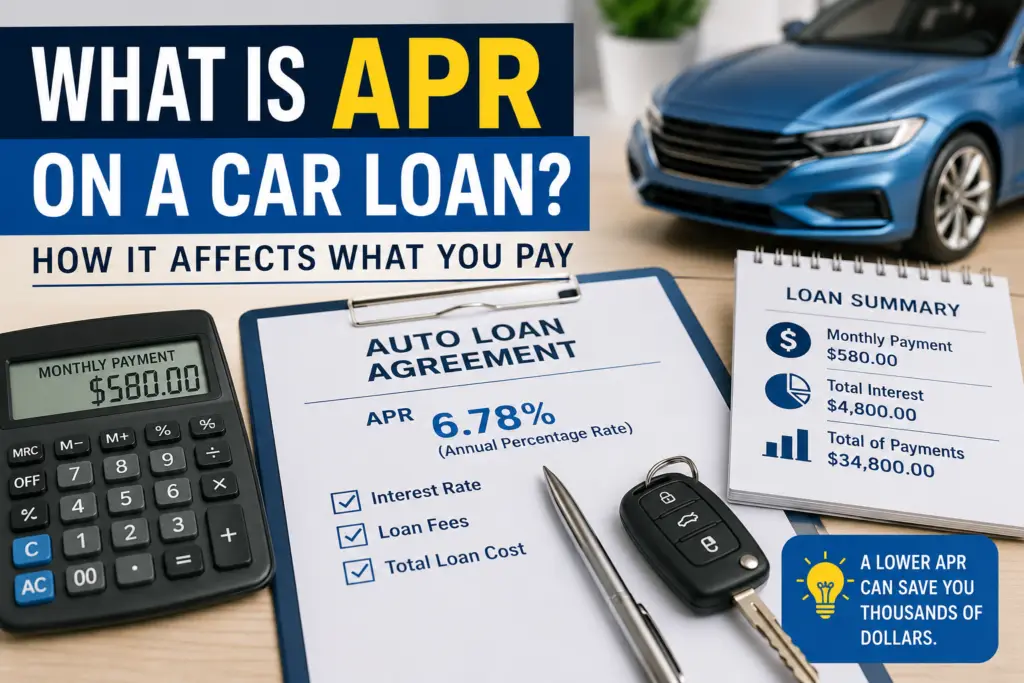
What Is APR on a Car Loan?
Reviewed against CFPB, FTC, and Experian sources.
Key takeaways
- APR (annual percentage rate) is the yearly cost of a car loan, shown as a percentage — it combines your interest rate with certain lender fees, so it reflects the loan’s true cost (CFPB).
- APR is the number to compare between offers, because federal law (TILA) requires every lender to disclose it (CFPB).
- Your APR depends mostly on your credit score: Experian’s data shows average new-car APR ranging from about 5.18% (top credit) to 15.81% (lowest credit) (Experian).
- On a $20,000, 60-month loan, the gap between a 6.70% and a 13.22% APR is about $64 a month and roughly $3,847 in extra interest.
- A lower APR isn’t automatically the best deal — always weigh the loan term, total amount repaid, and any rebate you’d give up.
APR on a car loan is the annual percentage rate — the yearly cost of borrowing money for the car, shown as a single percentage. It includes your interest rate plus certain fees the lender charges, which is why the federal government calls it the best figure for comparing loan offers. When you compare two car loans, the APR tells you which one actually costs more, even when the monthly payments look similar.
Many buyers focus first on the monthly payment. But two loans with nearly identical payments can cost very different amounts over time. That’s what makes APR worth understanding before you sign.
How to calculate APR on a car loan?
Car Loan APR Cost Calculator
See how your APR affects your monthly payment, total interest, and total repayment.
Estimates only, for education. Actual figures depend on your lender, credit, fees, and exact terms. Always confirm your APR and total cost with your lender before signing. MoneyMentorDesk.com is not a lender or financial adviser.
What is APR on a car loan?
APR (annual percentage rate) on a car loan is the cost of borrowing shown as a yearly percentage. According to the CFPB, it is the interest rate plus any additional fees the lender charges, such as origination charges. Because it bundles interest and fees into one number, APR reflects the true yearly cost of your loan.
The federal Truth in Lending Act (TILA) requires every lender to tell you the APR before you finalize the loan, so you can use it to compare offers on equal footing (CFPB). The FTC adds that your APR is based on several things, including your credit rating, the amount you borrow, the interest rate, and the length of your loan (FTC).
APR vs. interest rate: what's the difference?
The interest rate is the cost of borrowing the principal, shown as a percentage. The APR is that interest rate plus the lender's fees. Because APR includes more of the real cost, it's usually equal to or higher than the interest rate — and it's the number you should compare between offers (CFPB).
| Interest rate | APR | |
| What it covers | Cost of borrowing the principal | Interest rate plus lender fees |
| Includes fees? | No | Yes (e.g., origination charges) |
| Best used for | Understanding base borrowing cost | Comparing total loan offers |
If a loan has no add-on lender fees, the interest rate and APR can be the same. When the lender charges fees, the APR rises above the interest rate. One rule from the CFPB: when you shop, compare APR to APR — never an APR against an interest rate, because the two aren't measuring the same thing.
What is a good APR for a car loan?
A good car loan APR is one at or below the average for your credit score range. Experian's data shows average new-car APRs run from about 5.18% for the highest-credit borrowers to 15.81% for the lowest, with used-car rates a few points higher (Experian). If your offer beats the average for your score, it's competitive; if it's higher, shop another lender.
Average car loan APR by credit score range:
| Tier | Credit score range (VantageScore 4.0) | Avg. new-car APR | Avg. used-car APR |
| Superprime | 781–850 | 5.18% | 6.82% |
| Prime | 661–780 | 6.70% | 9.06% |
| Nonprime | 601–660 | 9.83% | 13.74% |
| Subprime | 501–600 | 13.22% | 18.99% |
| Deep subprime | 300–500 | 15.81% | 21.58% |
Across all buyers, Experian put the average at 6.73% for new cars and 11.87% for used cars. Used-car APRs sit higher than new-car APRs in every tier, because lenders treat used vehicles as higher risk.
Source: Experian, State of the Automotive Finance Market (Q1 2025). These tiers use VantageScore 4.0 credit score ranges, not FICO scores. Rates shift each quarter, so confirm the current figures before relying on them.
How does APR affect your monthly payment?
APR directly changes both your monthly payment and the total interest you pay. The higher the APR, the more of each payment goes to interest instead of paying down the car. On a $20,000 loan over 60 months, moving from a 6.70% APR to a 13.22% APR adds about $64 to the monthly payment and roughly $3,847 in total interest.
Here's the same $20,000 loan over 60 months at each tier's average new-car APR. The monthly payment and total interest are calculated from the standard loan formula:
| APR | Tier | Monthly payment | Total interest | Total repaid |
| 5.18% | Superprime | $379 | $2,745 | $22,745 |
| 6.70% | Prime | $393 | $3,592 | $23,592 |
| 9.83% | Nonprime | $423 | $5,396 | $25,396 |
| 13.22% | Subprime | $457 | $7,439 | $27,439 |
| 15.81% | Deep subprime | $484 | $9,061 | $29,061 |
The takeaway: the same car, financed at a higher APR, can cost thousands more over five years. That's why even a small drop in your APR is worth chasing before you sign.
What affects your car loan APR?
Lenders set your APR based on how much risk you represent and what rates the market is charging. The biggest factor is your credit score, but several others matter too. According to the FTC and CFPB, these include:
- Your credit score and history — the single biggest driver; higher scores generally earn lower APRs.
- The amount you borrow and your down payment — borrowing less can reduce your total financing cost.
- The loan term — longer terms (72 or 84 months) often carry higher rates and cost more overall.
- New vs. used vehicle — used cars usually carry higher APRs.
- The lender and current market rates — banks, credit unions, and dealers price risk differently.
How to get a lower APR on a car loan
The most effective step is to get pre-approved by a bank or credit union before you visit the dealer, so you walk in with a rate to beat. From there, comparison shopping and a stronger credit profile do the most to lower your APR (FTC). Practical moves:
- Get pre-approved first. With direct lending, you learn your APR, term, and borrowing limit in advance and can use them to negotiate (FTC).
- Compare several lenders. Dealers and lenders aren't required to offer you their best rate, so the CFPB recommends shopping around (CFPB).
- Strengthen your credit before applying. A higher score can move you into a better rate tier.
- Consider a shorter term or larger down payment. Both can reduce your rate or your total interest.
- Negotiate the APR. The FTC notes the dealer's APR often includes a markup, and you can negotiate it like the price of the car (FTC).
Does a 0% APR offer beat a cash rebate?
Not always. A 0% APR deal means qualified buyers pay no interest, but manufacturers often make you choose between 0% financing or a cash rebate — not both. Whether 0% or the rebate wins depends on the loan amount, the rebate size, and the term. For a full walkthrough, see our guide on 0% APR vs. a cash rebate and how 0% financing actually works.
How to compare two car loan offers
Put both offers side by side and compare the APR, the loan term, the monthly payment, the total amount repaid, and any rebate or discount attached. The lowest monthly payment isn't always the cheapest loan — a longer term can lower the payment while raising the total cost (FTC). To see how the full cost adds up, use our guide on calculating the total cost of a car loan.
FAQs
Is APR the same as the interest rate on a car loan?
No. The interest rate is the cost of borrowing the principal, while APR is the interest rate plus the lender's fees. The CFPB notes the APR is usually equal to or higher than the interest rate, and it's the figure to use when comparing loan offers because it reflects more of the true cost.
What is a good APR for a car loan?
A good APR is one at or below the average for your credit score range. Experian's data shows average new-car APRs from about 5.18% (superprime) to 15.81% (deep subprime), with used-car rates higher. If your offer beats the average for your tier, it's competitive; if not, shop another lender.
Does a higher APR raise my monthly payment?
Yes. A higher APR increases both your monthly payment and the total interest you pay. On a $20,000, 60-month loan, a 13.22% APR costs about $457 a month versus $393 at 6.70% — roughly $3,847 more in interest over five years.
Why is APR higher than the interest rate?
APR is higher whenever the lender charges fees, because APR includes the interest rate plus those fees, such as origination charges. If a loan has no added lender fees, the APR and interest rate can be identical.
Can I negotiate the APR on a car loan?
Often, yes. The FTC says the dealer's APR usually includes a markup, and you can negotiate it like the car's price. The strongest move is to arrive with a pre-approved offer from a bank or credit union so the dealer has a rate to beat.
Is APR different for new and used cars?
Yes. Used-car APRs run higher than new-car APRs in every credit tier, because lenders see used vehicles as higher risk. Experian's data shows used rates are typically a few percentage points above new rates for the same credit score.
Written by Nimra Saleem for MoneyMentorDesk.com. Reviewed against CFPB, FTC, and Experian sources. This article is educational only and is not financial advice. Confirm loan terms, APR details, and lender disclosures directly with the dealership, lender, or official financing documents.