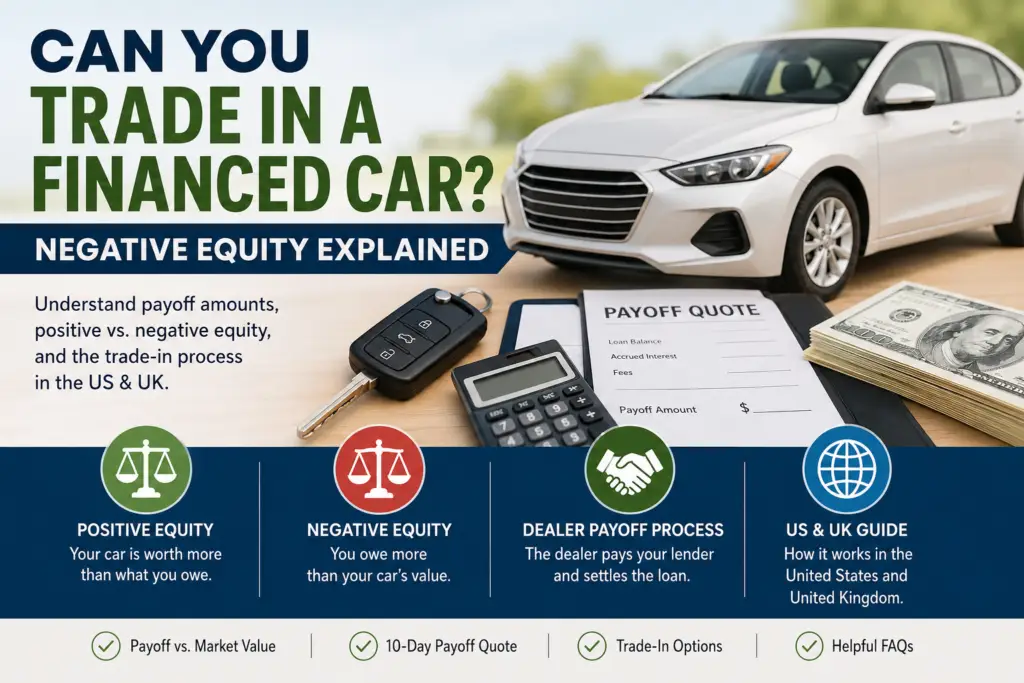
Negative equity — often called being “upside down” or “underwater” on your loan — happens when the amount you still owe on a car loan is greater than the car’s current market value. In plain terms: if your payoff is $18,000 but a dealer will only pay $15,000, you have $3,000 in negative equity. That gap shapes whether trading in, refinancing, or selling privately makes sense.
Why negative equity happens
- Fast depreciation: cars lose value quickly in the first few years.
- Small down payment: financing most of the vehicle leaves little initial equity.
- Long loan terms: long terms (72–84 months) slow principal payoff, so early payments are mostly interest.
- High-interest loans: higher APRs mean slower principal reduction.
Real risks to watch for
- Rolling negative equity into a new loan increases the financed amount and total interest paid.
- Combining negative equity with a higher APR or longer term can produce a lower monthly payment but much higher lifetime cost.
- If you lose GAP insurance coverage, a total loss could leave you owing the rolled-over balance.
Practical options and quick decisions
- Keep the car and pay it down: accelerating payments or making a one-time principal payment reduces the gap.
- Private sale: often yields a higher price than dealer trade-in and can shrink or eliminate negative equity.
- Refinance (carefully): if your credit improved or market rates dropped, refinancing to a lower APR without extending the term can help — but watch refinancing fees.
- Trade cautiously: only roll negative equity into a new loan if you can afford the increased balance and the new APR/term combination is reasonable.
- Delay major moves: if possible, wait until more principal is paid or the car’s value stabilizes.
Quick checklist before any trade or sale
- Request a written payoff quote (includes daily interest).
- Get 2–3 trade or private sale estimates.
- Calculate total financed amount after any rollover (not just monthly payment).
- Check GAP insurance status and refund rules.
- Compare total interest across options (refinance vs new loan vs keep).
Negative equity is common — but controllable. Treat it as a numbers problem: run the math, compare private sale vs trade-in vs refinance, and prioritize minimizing total cost (not just the monthly payment).