Part of our guide: Motorcycle Courier Insurance 2026: Honest Costs & Best Cover
Cherry vs CareCredit both help you spread the cost of dental treatment, but they work very differently – and the difference can cost or save you hundreds of dollars. Cherry is a point-of-care installment plan that uses only a soft credit check and never charges deferred interest. CareCredit is a reusable health-and-wellness credit card with a bigger network, but the full application can trigger a hard credit check and its deferred-interest promotions can charge interest back to the purchase date if you miss the payoff.
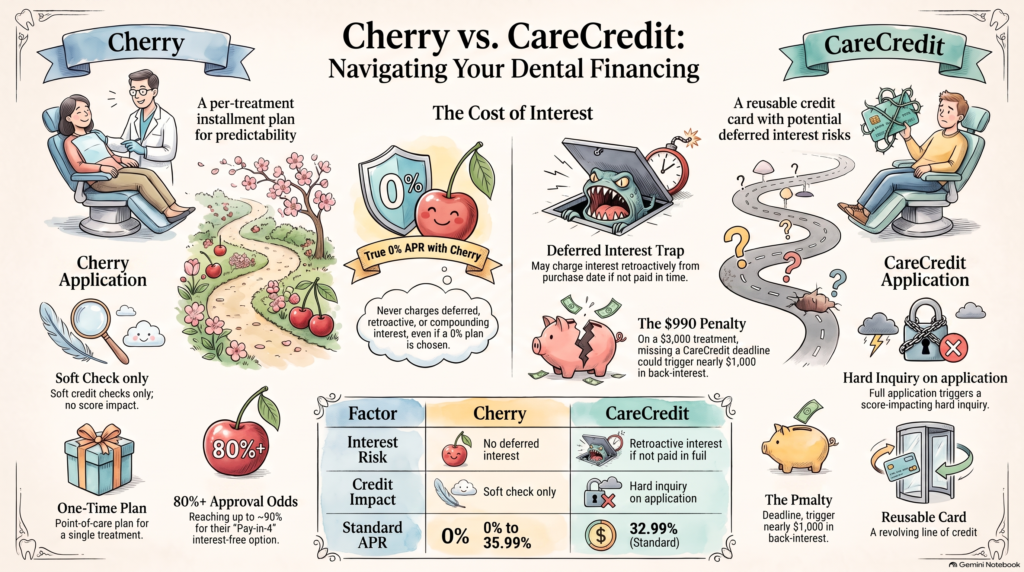
Quick verdict (Cherry vs CareCredit): Choose Cherry if you want to avoid a hard credit inquiry, finance one treatment with predictable payments, and never risk deferred interest. Choose CareCredit if you want a reusable card and a wider network and you are confident you can clear any promotional balance before it ends.
Independent comparison – no affiliate links. This guide is not sponsored by Cherry or CareCredit and earns no commission from either. The facts below come from each provider’s own disclosures and the CFPB.
Last updated: 25 July 2026 Reviewed against sources: Cherry (withcherry.com), CareCredit (carecredit.com), and the Consumer Financial Protection Bureau (CFPB). Author: Nimra Saleem, MoneyMentorDesk. Educational only; not financial advice. Terms change – confirm the current offer with the provider before you apply.
Cherry vs CareCredit at a glance
| Factor | Cherry | CareCredit |
| Product type | Point-of-care installment plan for one treatment | Reusable health & wellness credit card (Synchrony Bank) |
| Credit check to apply | Soft check only; applying does not affect your score (Cherry) | Prequalify = soft; full application = hard inquiry that may affect your score (CareCredit) |
| APR / interest | 0%-35.99% APR by eligibility; every approved user gets a 0% Pay-in-4; interest-bearing plans advertised from 5.99% (Cherry) | Standard purchase APR 32.99% (disclosure dated 5/30/24); promotional options available (CareCredit) |
| Deferred interest | None – no deferred, retroactive, or compounding interest (Cherry) | Yes on “no interest if paid in full” promos – interest accrues from the purchase date and is charged if not paid off in time (CareCredit) |
| Promotional terms | Pay-in-4 (interest-free); monthly plans 1-60 months | No interest if paid in full in 6/12/18/24 months on $200+; reduced-APR 24-60 months on larger purchases |
| Loan amount | Dental page advertises up to $50,000; general disclosures show some arrangements to $65,000 (varies by provider, product, eligibility) (Cherry) | Revolving credit limit assigned on approval |
| Approval odds | Cherry advertises 80%+ overall and up to ~90% for Pay-in-4 (provider-reported marketing figures) | Not disclosed; subject to credit approval |
| Fees | No origination fee or prepayment penalty; a down payment may be required; late/returned-payment fees may apply; 2.99% fee if you pay by credit card (Cherry) | No annual fee; a late-payment fee may apply (CareCredit) |
| Where accepted | Only at providers that offer Cherry | Large national network of enrolled providers (CareCredit) |
| Reusable? | No – per treatment | Yes – reuse the card for future care |
| Best for | Fair credit, avoiding a hard check, true 0% APR, no deferred interest | Wanting a reusable revolving account and comfortable with a full credit application; can clear a promo on time |
Best choice by situation
| Situation | Better fit |
| Want to avoid a hard inquiry when checking eligibility | Cherry |
| Want a reusable healthcare credit account | CareCredit |
| Worried about deferred interest | Cherry |
| Your provider accepts only one option | Whichever is available |
| You can definitely clear a CareCredit promo on time | CareCredit can be competitive |
Cherry vs CareCredit: the short answer
Cherry eliminates retroactive deferred-interest risk, while CareCredit offers a reusable credit line and broader provider acceptance. Which is preferable depends on the actual APR, payment deadline, provider availability, and whether you expect to reuse the account. The one difference that matters most is how each handles interest. Cherry uses a soft credit check and never charges deferred interest. CareCredit can trigger a hard inquiry and, on its “no interest if paid in full” promotions, can charge interest back to the purchase date if you do not clear the balance in time – at a standard purchase APR of 32.99% (disclosure dated 5/30/24).
So “better” depends on you: a soft application with a clear, fixed payoff (Cherry), or a reusable card across a wider network (CareCredit) with more promotional rules to watch.
Difference Between Cherry and CareCredit
If you only remember four things, remember these. Everything else on this page is detail hanging off them.
- Product type. Cherry is an installment plan arranged at the practice for one treatment. CareCredit is a revolving credit card issued by Synchrony Bank that you keep and reuse.
- Credit check. Cherry uses a soft check to see what you qualify for. CareCredit lets you prequalify with a soft check, but the full application is a hard inquiry that can affect your score.
- How interest works. This is the one that costs money. Cherry charges no deferred, retroactive or compounding interest. CareCredit promotions of the “no interest if paid in full” type are deferred-interest offers: interest accrues from the purchase date and is charged in full if the balance is not cleared in time.
- Reusability. Cherry covers the treatment you applied for. CareCredit stays open for future care at any provider in its network.
Neither is universally better. The deciding factor is usually whether you are certain you can clear a promotional balance before it ends, and whether your provider accepts one, the other, or both.
How Does Cherry Dental Financing Work?
Cherry keeps the process fast, simple, and stress-free for patients. Here’s precisely how it works from start to finish:
Step-by-step process:
Apply Online or at the Clinic
- The patient starts an application either on Cherry’s website or through a link provided by the dental office.
- The application takes about 60 seconds.
Soft Credit Check
- Cherry typically uses a soft credit inquiry for prequalification, which usually doesn’t impact your credit score
- Approval depends on multiple factors and varies by applicant.
Instant Approval Decision
- Many applicants receive a quick decision, though timing can vary.
- If approved, Cherry shows multiple payment plan options to choose from.
Choose a Payment Plan
- Patients can select from short-term or long-term plans:
- Pay in 4 (four equal payments, often with 0% interest)
- 0% APR for several months (for qualified borrowers)
- Extended payment plans are available for up to 60 months, although interest may apply.
Treatment Starts Immediately
- Once the patient selects a plan, the dentist can start the treatment right away without waiting for full payment.
The patient pays Cherry over time.
- The patient makes regular payments directly to Cherry via their online account.
- Cherry provides tools to:
- View balance and payment history
- Change due dates (in some cases)
- Early payoff may be available depending on plan terms—check your disclosures.
Example:
Maria needs a $1,500 dental crown.
- Without Cherry: She would have to pay $1,500 upfront.
- Example only: if eligible, she may be offered an installment plan such as payments every two weeks, potentially with 0% APR.
Eligibility and Requirements
Cherry Dental Financing is designed to be simple and accessible, but there are still a few requirements you need to meet to get approved.
Who Can Apply?
- Age: You must be 18 years or older.
- Residency: You must have a valid address in the United States.
- Identification: A government-issued photo ID (e.g., driver’s licence, state ID, passport).
- Contact Information: Valid mobile phone number and email address.
Credit Requirements
- Approval isn’t just based on credit score; Cherry may also consider other factors like income or repayment history.
- Approval depends on multiple factors and varies by applicant.
Income & Ability to Pay
- In some cases, Cherry may ask for proof of income to ensure you can make the monthly payments.
- Having a stable source of income improves your chances of approval.
The one difference that matters most: deferred interest vs true 0%
A qualifying Cherry 0% APR plan charges no interest while you follow the agreed payment schedule. CareCredit’s offer is a deferred-interest promotion – interest accrues from the purchase date and is charged if you do not pay the full balance before the promotional period ends. This is where people get hurt, so here is what it looks like in real dollars.
The CFPB warns that with deferred-interest offers you can owe all the built-up interest at once if the balance is not paid in full and on time.
Illustrative example – a $3,000 crown (12-month plan):
- CareCredit, paid off in time: about $250/month clears it in 12 months, and you pay $0 interest. That is the deal working as intended.
- CareCredit, deferred interest triggered: if a qualifying balance remains at the end of the 12 months, interest is charged from the purchase date at 32.99%. Illustration only: assuming a $3,000 balance stayed largely unpaid for about 12 months at 32.99% APR, accrued interest could approach $990, added on top of the $3,000. Actual deferred interest is calculated from the balance carried during each billing period and may be lower or higher depending on your payments and account terms.
- Cherry, 0% plan: on a qualifying 0% plan you pay $0 interest provided you make the required payments on time. Cherry says it does not impose retroactive deferred interest, although if the account becomes delinquent, fees or prospective interest may apply.
Illustrative example – $6,000 in implants (24-month plan):
- CareCredit, paid off in time: about $250/month, $0 interest.
- CareCredit, deferred interest triggered: if the balance is not cleared by the deadline, interest from the purchase date at 32.99% can run into four figures – a large, avoidable cost.
- Cherry, 0% plan: $0 interest on a qualifying plan when payments are made on time; if you do not qualify for 0%, Cherry advertises interest-bearing plans from 5.99% APR, below CareCredit’s standard 32.99%.
The takeaway: if you are 100% sure you can clear a CareCredit promo on time, it can be free. If there is any doubt, Cherry removes the deferred-interest risk entirely.
Credit check: soft vs hard
Cherry uses only a soft credit check, so applying never affects your score. CareCredit lets you prequalify with a soft check, but the full application triggers a hard inquiry that may lower your score by a few points. For anyone protecting their credit, this is a real difference.
The CFPB explains that soft inquiries do not affect your score, while hard inquiries can appear on your credit report and may lower it slightly. For more on Cherry’s check, see our guide on whether Cherry dental financing checks your credit score.
What credit score do you need for Cherry vs CareCredit?
Neither provider publishes a guaranteed minimum credit score. Cherry uses a soft inquiry, so checking eligibility does not affect your credit score. CareCredit also offers prequalification without affecting your score, but completing the full credit-card application can produce a hard inquiry. Approval and terms depend on the applicant’s overall credit profile – Cherry says its decision considers credit score, credit history, income, and debt-to-income ratio, and approval is not guaranteed. CareCredit also allows joint applicants, which can help borderline cases.
A hard inquiry may affect a credit score, but the effect varies by person and scoring model.
Does Cherry Report to Credit Bureaus?
Yes. Cherry’s Help Center says it reports payment activity and payment-plan status to the three major credit bureaus: Equifax, Experian, and TransUnion. Cherry also says confirmed payment plans typically begin reporting after 30 days, and its consumer page says payment activity is reported on a weekly basis based on your due date.
This is different from the application check. Cherry says the application uses a soft credit check, which does not impact your credit score. Reporting to credit bureaus happens after you open and use the plan, so the application stage and the ongoing account stage are not the same thing.
Can a Cherry Payment Plan Affect Your Credit Later?
Yes, it can. Cherry says it reports payment activity, including late or missed payments, to the credit bureaus. Cherry also says that missing a payment could negatively impact your credit.
Cherry’s public wording supports two practical takeaways:
- On-time account activity may become part of your credit file once reporting starts
- Late or missed payments can hurt your credit later, even if the initial application did not
Cherry’s consumer page also says late payments are reported once an account is 30 days past due, with additional late-payment reporting at 60 days past due, 90 days past due, and upon charge-off if the balance remains unpaid.
Prequalification vs Full Application
Cherry says it uses a soft credit check to prequalify patients. That means prequalification is the early stage where Cherry checks whether you may be eligible without using a hard inquiry.
But prequalification is not always the same as final approval. Cherry’s Help Center says that once your payment plan is confirmed, reporting begins later, and Cherry’s dental page frames prequalification as the step before the patient commits to treatment. That means you should treat prequalification as an early decision stage, not assume it means every later term is fully locked without further review.
Before continuing, confirm:
- whether you are prequalified or fully approved
- whether the credit check is soft or hard
- when reporting to bureaus begins
- what happens if you miss a payment
Approval odds and speed
Cherry advertises approval rates of 80%+ overall, and up to ~90% for its Pay-in-4 plan specifically; CareCredit does not publish an approval rate. These are provider-reported marketing figures and do not predict an individual applicant’s result. Both give near-instant decisions. Because Cherry never runs a hard pull, you can check your real offer without a hard-inquiry impact on your credit score; CareCredit also decides quickly, but the full application’s hard inquiry is the trade-off.
If checking your options without a hard-inquiry impact matters to you, Cherry’s soft-only check lets you compare an offer without affecting your credit score. If you want a reusable card and are comfortable with a full credit application, CareCredit’s hard pull may matter less.
APR, fees, and the fine print
Cherry’s APR runs from 0% to 35.99% depending on eligibility, with no deferred interest and no prepayment penalty. CareCredit’s standard purchase APR is 32.99% (disclosure dated 5/30/24), with promotional options. The fees to know:
- Cherry: no origination fee and no prepayment penalty. A down payment may be required (often about one monthly payment). Late or returned-payment fees may apply, and paying with a credit card adds a 2.99% processing fee (a debit card generally does not). Cherry says it reports payment history to the credit bureaus, typically within about 30 days.
- CareCredit: no annual fee. The main cost risks are the deferred-interest promotions above and a late-payment fee if you miss a due date. Outside a promotion, CareCredit currently displays a 32.99% purchase APR for new accounts in its disclosure dated May 30, 2024; check the agreement for the rate offered to you. For larger purchases it also offers reduced-APR plans (for example, 17.90% for 24 months, 18.90% for 36 months, 19.90% for 48 months).
Cherry vs CareCredit for dental implants and big treatments
For large bills like implants or full-mouth work, the deferred-interest risk gets bigger, so the payoff plan matters more. A missed CareCredit deadline on a $10,000 implant case can add thousands in back-interest at 32.99%, while Cherry’s plans carry no retroactive deferred interest. Which fits depends on your credit, the APR you are offered, and whether you can clear a promotional balance on time.
- Cherry’s dental page currently advertises financing up to $50,000, and its general disclosures show some arrangements may reach $65,000, depending on the provider, product, and eligibility – enough for many implant and full-arch cases, with a 0% or low-APR plan keeping a big balance predictable. For how Cherry works end to end, see our Cherry dental financing guide.
- CareCredit can work well for a large case if you have strong credit and can clear the promotional balance in full and on time. If you cannot, the deferred interest makes it an expensive way to borrow for a big procedure.
Always ask your dental office which lender’s real terms you qualify for before committing to a large plan.
Cherry or CareCredit: Which Is Better?
Pick Cherry if you want to:
- avoid a hard credit inquiry at application,
- finance one dental treatment with predictable, fixed payments,
- avoid deferred-interest surprises,
- or you want to compare an offer using a soft credit check only.
Pick CareCredit if you want to:
- reuse one account for future dental or healthcare costs,
- use the widest provider network,
- and you have strong credit and can pay off any promotional balance before it ends.
There is no single “best” for everyone. Compare the exact credit-check type, APR, promotional deadline, fees, and monthly payment on the offer in front of you, then choose the option whose numbers – and rules – you are comfortable with. When available, check Cherry’s eligibility and CareCredit’s prequalification first, since these use soft inquiries, and compare the offers before completing any application that requires a hard credit inquiry.
Cherry vs CareCredit vs Other Dental Financing Options
Cherry and CareCredit are the two options most dental practices present, but they are not the only ones. Readers arriving at this page also compare Affirm, LendingClub Patient Solutions, PatientFi and Proceed Finance. The table below sets out what each provider states in its own published terms. Where we could not verify a provider’s current terms from its own disclosures, we say so rather than repeating figures published elsewhere.
| Provider | Product type | Checking eligibility | Deferred interest | Terms stated by the provider |
|---|---|---|---|---|
| Cherry | Point-of-care installment plan for one treatment | Soft check only | None | 0%–35.99% APR by eligibility; Pay-in-4 at 0% |
| CareCredit | Reusable health & wellness credit card (Synchrony Bank) | Prequalify soft; full application is a hard inquiry | Yes, on “no interest if paid in full” promotions | Standard purchase APR 32.99% (disclosure dated 5/30/24) |
| Affirm | General-purpose installment / pay-over-time | Eligibility check | Installment structure — no deferred-interest promotion advertised | “Your rate will be 0–36% APR based on credit”; Pay in 4 is 0% APR; advertises no fees |
| LendingClub Patient Solutions | Patient installment loan; dentistry named explicitly | Prequalify with no credit-score impact until you accept | Installment loan — deferred interest does not apply | $500–$65,000 over 6–144 months; APR 3.99%–30.99% with 0% financing also available; no prepayment penalties |
| PatientFi | Provider-network patient financing | Not independently verified | Not independently verified | We could not access PatientFi’s current published terms. Confirm directly with the provider |
| Proceed Finance | Provider-network patient financing, typically larger treatment plans | Not independently verified | Not independently verified | We could not access Proceed Finance’s current published terms. Confirm directly with the provider |
The pattern worth noticing: of these, only CareCredit runs deferred-interest promotions. The others are installment products, where the interest you are quoted is the interest you pay. That single structural difference matters more than a percentage point on the headline rate.
Not every provider offers every option, and availability is decided by your practice rather than by you. If you are pricing orthodontic work specifically, our guide to how much braces cost without insurance covers the treatment costs these plans are most often used to spread.
How to compare dental financing plans step by step
Ask for the written terms
Do not compare plans from memory or based on what was said verbally. Get the written disclosures or agreement for each option.
Put the key terms side by side
For each option, list:
- APR
- interest rate
- fees
- repayment term
- monthly payment
- total amount financed
- total repayment if shown
- credit-check type
- missed-payment consequences
- early payoff terms
- provider restrictions
The goal is to compare like with like. If one plan gives only a monthly payment but not the full borrowing cost, it is not giving you enough to compare properly.
Look past the promotional headline
If a plan says “0%,” “low payment,” or “special financing,” read the conditions. Ask whether the offer is true no-interest financing or deferred interest, whether fees apply, and what happens if you are late. The CFPB has specifically warned consumers about medical financing products with terms that may not be fully understood at the point of care.
Decide what matters most for your situation
If cash flow is tight, the monthly payment matters. If you can pay faster, the total repayment may matter more. If you are protecting your credit, the inquiry type and delinquency rules matter more. A plan that is acceptable for one person may be risky for another.
Read the default and late-payment section
This is where many bad surprises live. Check the exact consequences of being late, missing a payment, or failing to repay a promotional balance on time.
Red Flags to Watch in Either Offer
The biggest red flag is a plan that looks affordable only because the monthly payment is low. A longer term can make the payment easier while increasing the total cost.
Another red flag is unclear promotional language. If the plan mentions “special financing,” “promotional financing,” or similar wording, check whether that means true no-interest financing or deferred interest. The CFPB has warned that deferred interest in medical financing is commonly misunderstood and can lead to retroactive interest charges if the full balance is not repaid in time.
Be careful if the provider or lender cannot clearly answer these questions:
- Is the credit check hard or soft?
- What is the APR?
- What fees apply?
- What happens if I miss one payment?
- Can I pay early without a penalty?
- Is this plan limited to this office or provider network?
If you do not get clear written answers, slow down.
What the CFPB found about medical financing
This is not a niche concern. In its report on Medical Credit Cards and Financing Plans, the Consumer Financial Protection Bureau found that consumers used specialty medical credit cards and loans carrying deferred-interest periods to pay for roughly $23 billion in healthcare expenses, across more than 17 million consumers. In 2020 the total cost of deferred interest, for those who ended up being charged it, came to about 23% of the original purchase volume that incurred it.
The finding most worth knowing before you sit in the chair is about who these products are sold to. The CFPB reported that financing companies market directly to healthcare providers, supplying them with training and promotional material to use when offering the products to patients — and that providers “may be disincentivized to explain legally mandated financial assistance programs or zero-interest repayment options before offering these products to patients.”
In practice that means one question is worth asking before you accept any plan: does this practice offer an in-house payment plan, a discount for paying up front, or any financial assistance? You may not be told unless you ask.
Frequently asked questions
Cherry vs CareCredit: which is better for dental financing?
Cherry is usually better if you want a soft credit check, one clear treatment plan, and no deferred interest. CareCredit is better if you want a reusable card and a wider network and can pay off promotional balances in time. The right choice depends on the exact offer you receive.
What is the difference between Cherry and Care Credit?
Cherry is a point-of-care installment plan for a single treatment that uses a soft credit check and no deferred interest. Care Credit is a reusable health-and-wellness credit card whose full application can trigger a hard inquiry and whose promotions may charge deferred interest if not paid in full on time.
Does Cherry do a hard credit check?
No. Cherry says its prequalification and application use a soft credit check only, so applying does not affect your credit score, whether you are approved or not.
Does CareCredit affect your credit score?
Prequalifying does not (soft inquiry). But accepting an offer and completing the full application triggers a hard inquiry that may lower your score by a few points, according to CareCredit.
What credit score do you need for Cherry or CareCredit?
Neither publishes a minimum. Cherry advertises 80%+ approval overall (and up to ~90% for Pay-in-4) using a soft check, which tends to help fair or thin credit. CareCredit uses a standard credit-card approval with a hard inquiry. Your result depends on your credit, income, and debt.
Is Cherry cheaper than CareCredit?
It can be, mainly because Cherry offers 0% APR to qualified applicants and never charges deferred interest. CareCredit can be free too if you clear its deferred-interest promotion in time – but if you miss the deadline, interest is charged back to the purchase date at up to 32.99% APR (disclosure dated 5/30/24).
Is Cherry or CareCredit better for dental implants?
For large implant bills, Cherry avoids retroactive deferred interest, so a 0% or low-APR plan stays predictable. CareCredit can work for implants if you have strong credit and can pay the promotional balance in full on time; if not, the 32.99% back-interest makes it costly. The better fit depends on your credit and payoff plan.
Independent disclosure and educational disclaimer
This is an independent comparison. MoneyMentorDesk is not sponsored by Cherry or CareCredit and earns no commission from either. This article is for general education only and is not financial advice. Cherry and CareCredit set their own rates, fees, and terms, and these change over time and vary by borrower and provider. The APRs and terms above were checked on the providers’ official pages on the date shown; the dollar examples are illustrations, not quotes. Always confirm the current terms of your specific offer before you apply, and see the CFPB for neutral guidance on credit inquiries and deferred interest.
Sources
- Cherry – Apply for Cherry Financing (consumers) (soft credit check; 0% Pay-in-4; approval rate; loan amounts; reporting to bureaus)
- Cherry – Disclosures and loan definitions (APR 0%-35.99%; terms 1-60 months; amounts to $65,000; 2.99% credit-card processing fee; late/returned-payment fees; no prepayment penalty)
- Cherry – Dental financing (dental financing advertised up to $50,000; approval up to ~90% – provider marketing figures)
- CareCredit – Understanding promotional financing (deferred-interest and reduced-APR promotions; how “no interest if paid in full” works)
- CareCredit – Deferred interest vs 0% APR (true 0% APR vs deferred interest; standard purchase APR)
- CFPB – What is a credit inquiry? (soft vs hard inquiries)
- CFPB – What is deferred interest? (how deferred-interest offers can charge back-interest)
- CFPB — The Buy Now, Pay Later Market
- CFPB — What is the difference between a loan interest rate and the APR?
- CFPB — Enforcement action on deferred-interest medical credit card enrollment