
Does Car Insurance Follow the Car or the Driver?
Does car insurance follow the car or the driver? In the United States, car insurance mostly follows the car, not the driver. That means if you lend your car to a licensed friend and they cause a crash; your policy usually pays first. But some parts of your coverage follow you as a person, even into someone else’s car.
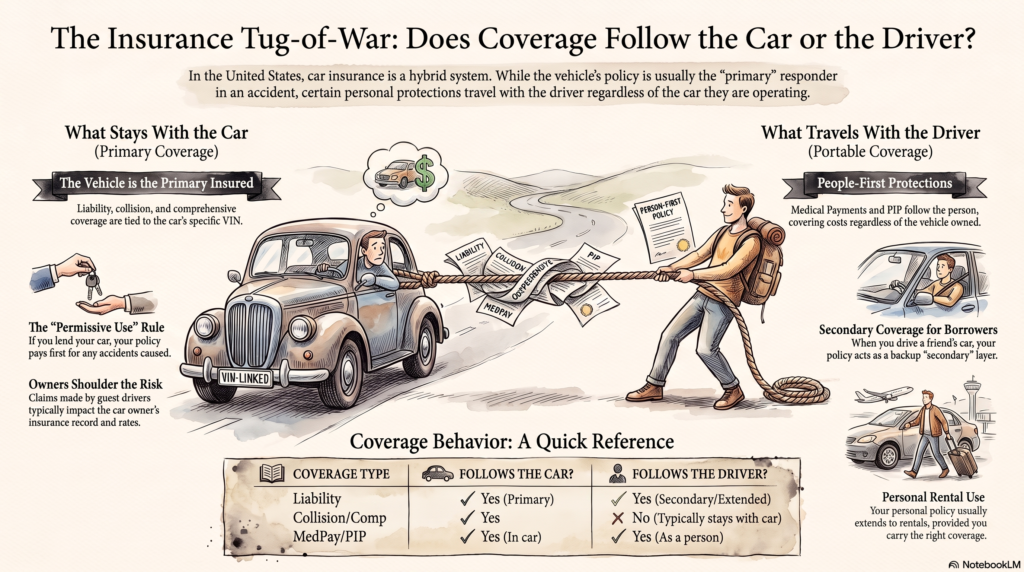
Quick answer: Most auto coverage (liability, collision, and comprehensive) follows the car, so your policy is normally primary when a permitted driver uses it. Some coverage follows the driver, such as you and family members driving another car with permission, medical payments, and non-owner policies. Exclusions and household-driver rules can change this.
Key takeaways
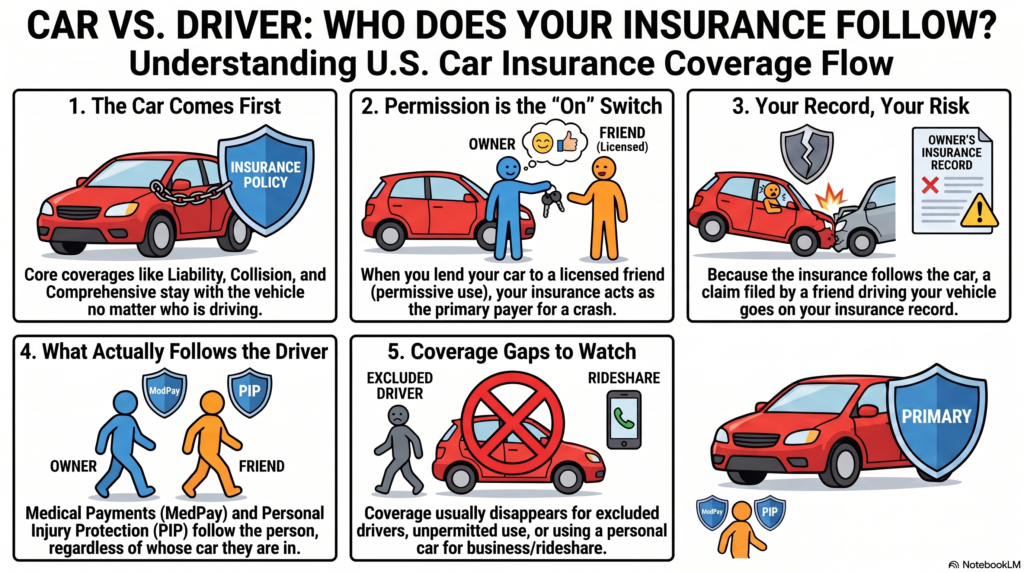
- Car insurance mostly follows the car. Liability, collision, and comprehensive coverage go with the vehicle, so your policy is usually primary when someone drives your car with permission.
- Some coverage follows the driver. You and family members on your policy are generally covered when driving someone else’s car with permission, and a non-owner policy follows the person.
- Permissive use is key. A licensed friend who borrows your car with your consent is usually covered by your policy (Insurance Information Institute).
- Your policy usually follows you into a rental car for personal use, if you carry the coverage (Insurance Information Institute).
- It is not covered everywhere. Excluded drivers, driving without permission, commercial use, and rideshare are common gaps.
Does car insurance follow the car or the driver? The short answer
In the US, car insurance is tied mainly to the vehicle, so it “follows the car.” If a friend borrows your car with your permission and has an accident, your auto policy is generally the first to pay, up to your limits. The Insurance Information Institute confirms your policy “provides coverage if someone not on your policy is driving your car with your consent.”
But the answer is not only about the car. A few important protections follow you as a driver instead, which is why people get confused. The rest of this guide breaks down which parts follow the car, which follow the driver, and where the coverage can disappear.
What “follows the car” means
These core coverages stay with the vehicle, no matter who is driving it (as long as they are allowed to). If a permitted driver crashes your car, these pay based on your policy:
- Liability (bodily injury and property damage). Covers injuries and damage that you or another driver of your car causes to other people. The Insurance Information Institute notes liability covers costs “that you or another driver causes while driving your car.”
- Collision. Pays to repair your car after an at-fault crash.
- Comprehensive. Pays for non-crash damage to your car, such as theft, fire, hail, or hitting an animal.
Because these follow the car, your policy is usually primary when someone borrows your vehicle. If your limits are not enough to cover a serious crash, the borrowing driver’s own policy may then act as secondary coverage.
What follows the driver instead
Some protection travels with you as a person, even when you drive a car you do not own. This is the part that makes people think insurance follows the driver:
- You and family members on your policy are generally covered when driving someone else’s car with permission (Insurance Information Institute).
- Medical Payments (MedPay) and Personal Injury Protection (PIP) follow covered people. They pay medical costs for you, your passengers, or family members after a crash, no matter who was at fault.
- A non-owner car insurance policy follows the driver. It is bought by someone who does not own a car but sometimes drives one, and it provides liability coverage as they move between borrowed or rented cars.
So, the honest answer to “does car insurance follow the car or the driver” is: mostly the car, but partly the driver. Both are true at the same time, depending on the coverage.
What happens when someone borrows your car?
If you lend your car to a licensed person with your permission and they crash, your policy generally pays first. This is called permissive use. Your liability, collision, and comprehensive coverage apply as if you were driving, up to your limits.
A few things to keep in mind before you hand over the keys:
- The claim goes on your policy. Because your insurance pays, the accident can affect your record and price, not just the driver’s. Here is how long an accident stays on your insurance.
- Their policy may be secondary. If the damage is bigger than your limits, the borrowing driver’s own insurance may help cover the rest.
- The owner and the driver can be different people. Insurance can cover a car even when the owner is not the main driver. See how insuring a car that is not in your name works.
Real examples: who pays after a crash?
Here are two plain-English examples that show how “following the car” plays out. They are illustrations only; your own policy and state rules decide the real outcome.
Example 1: You lend your car. Maria lets her neighbor Sam, a licensed driver, borrow her car for the afternoon. Sam rear-ends another vehicle. Because coverage follows the car, Maria’s liability and collision are primary and pay up to her limits. If the other driver’s injuries cost more than Maria’s limits, Sam’s own policy may act as secondary. The claim goes on Maria’s record.
Example 2: You drive someone else’s car. Leo borrows his brother’s car with permission and scrapes a parked car. His brother’s policy (the car’s policy) pays first. Leo’s own liability may act as secondary only if the damage is above his brother’s limits.
Use this quick guide to see whose policy is usually primary:
| Situation | Whose policy is usually primary? |
| You lend your car to a licensed friend who then causes a crash | Your policy (permissive use), up to your limits; their policy may be secondary |
| You drive a friend’s car with permission and cause a crash | The car owner’s policy first; yours may be secondary |
| An excluded driver on your policy crashes your car | Usually none – the claim can be denied |
| Someone takes your car without your permission and crashes | Generally not your responsibility; their insurer or the driver may be liable |
| You rent a car for personal use and crash it | Your own policy generally applies, if you carry that coverage, up to your limits |
| Another driver hits you and is at fault | The at-fault driver’s liability policy |
What about rental cars?
Your own car insurance usually follows you into a rental car for personal use. The Insurance Information Institute says that “in most cases, whatever auto insurance and deductibles you have on your own car would apply when you rent a car,” as long as you are using it for recreation and not for business.
Two things to check before you pay extra at the counter:
- You need collision and comprehensive to cover damage to the rental. If you dropped those coverages on your own car to save money, you may not be covered if the rental is damaged or stolen (Insurance Information Institute).
- A credit card may add coverage, but it is usually secondary. It often kicks in only after your own policy or the rental company’s coverage is used, and it may only cover the deductible.
So for a rental used personally, coverage tends to follow you through your existing policy, rather than the rental car itself.
When your car insurance will not cover a driver
Following the car has limits. Some drivers and uses are not covered, even in your own vehicle. Watch out for these gaps:
- Excluded drivers. Some policies name a driver who is specifically not covered. If they drive your car and crash, the claim can be denied (NAIC).
- Driving without permission. If someone takes your car without your consent (non-permissive use), your policy generally does not treat it the same as permissive use, and the driver may be responsible for the damage.
- Household drivers who are not listed. Anyone who lives with you and regularly drives your car, such as a spouse, teen, or roommate, should be listed on your policy (NAIC). Leaving them off can cause coverage problems.
- Unlicensed drivers. Lending your car to someone without a valid license is risky. Learn more about car insurance without a license.
- Commercial use and rideshare. A personal auto policy generally will not cover you if you use the car for deliveries or drive for a service like Uber or Lyft, unless you add special coverage (Insurance Information Institute).
Quick reference: what follows the car vs the driver
| Coverage | Follows the car | Follows the driver |
| Liability (bodily injury, property damage) | Yes (primary on your car) | Extends to you/family in another car |
| Collision | Yes | No |
| Comprehensive | Yes | No |
| Medical Payments (MedPay) | Covers people in your car | Follows covered persons |
| Personal Injury Protection (PIP) | Covers people in your car | Follows covered persons |
| Non-owner policy | No | Yes (follows the driver) |
This is a general guide. Your own policy wording and your state’s rules control what is actually covered, so check your declarations page or call your insurer.
Frequently asked questions
Does car insurance follow the car or the driver?
In the US, car insurance mostly follows the car. Liability, collision, and comprehensive coverage go with the vehicle, so your policy is usually primary when a permitted driver uses your car. Some coverage follows the driver, such as you and family members driving another car with permission, MedPay, PIP, and non-owner policies.
If someone borrows my car and crashes, whose insurance pays?
Usually, yours. Because coverage follows the car, your policy is generally primary for a permitted driver, up to your limits. If the damage is larger than your limits, the borrowing driver’s own policy may act as secondary coverage.
Am I covered when I drive someone else’s car?
Often yes, if you have permission. You and family members on your policy are generally covered when driving another person’s car with their permission, though that owner’s policy is usually primary first.
Does my car insurance cover a rental car?
Usually yes for personal use. The Insurance Information Institute says the auto insurance and deductibles on your own car generally apply to a rental, as long as it is not for business. You need collision and comprehensive to cover damage to the rental itself.
What if someone drives my car without permission?
That is called non-permissive use. Your policy generally does not treat it the same as lending your car, and the person who took it may be responsible for the damage. Report it to your insurer and, if needed, the police.
Will my insurance cover a friend who is an excluded driver?
No. If your policy names someone as an excluded driver, the insurer can deny a claim if that person drives your car and has an accident. Check your policy before lending your car.
Do I need to add household members to my policy?
Usually yes. Anyone who lives with you and regularly drives your car, such as a spouse, teen, or roommate, should be listed. Leaving a regular driver off can create coverage problems.
Educational disclaimer
This article is for general education only. It is not financial, legal, or insurance advice, and it is not reviewed by a licensed insurance agent. Coverage rules, exclusions, rental-car terms, and primary-versus-secondary order can vary by state and by insurer, and your own policy wording controls what is covered. Before you lend, borrow, or rent a car, confirm the details with a licensed insurer or your own state insurance department. You can find yours through the NAIC state insurance department directory.
Last updated: 21 July 2026 Reviewed against sources: Insurance Information Institute and National Association of Insurance Commissioners (NAIC). Author: Nimra Saleem, MoneyMentorDesk. This guide is written in plain English and fact-checked line by line against official and authoritative consumer-insurance sources. It is educational only, and is not a substitute for advice from a licensed insurance agent or your state insurance department.
Sources
- Insurance Information Institute – Auto insurance basics: understanding your coverage (who is covered and when; permissive use; personal-use vs commercial/rideshare; coverage types)
- Insurance Information Institute – What is auto insurance? (liability, MedPay, PIP, collision, comprehensive; family members covered in another car with permission)
- Insurance Information Institute – Rental car insurance (your own auto coverage and deductibles generally apply to a personal-use rental; credit-card coverage is usually secondary)
- NAIC – Auto Insurance (listing household drivers; policy exclusions; consumer guidance)
- NAIC – State Insurance Department directory (find your state regulator to confirm local rules)