
Is Driving Without Insurance a Crime?
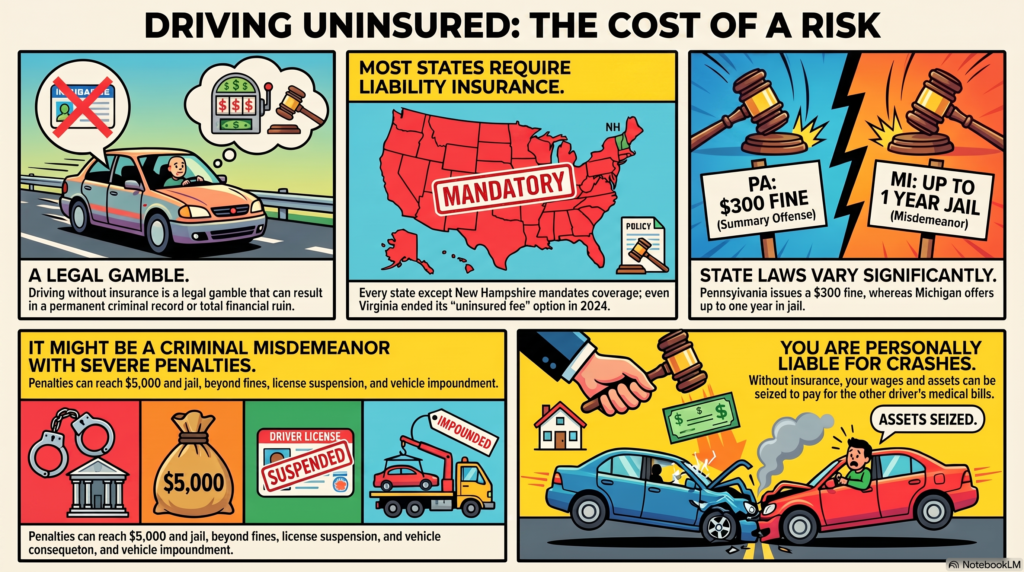
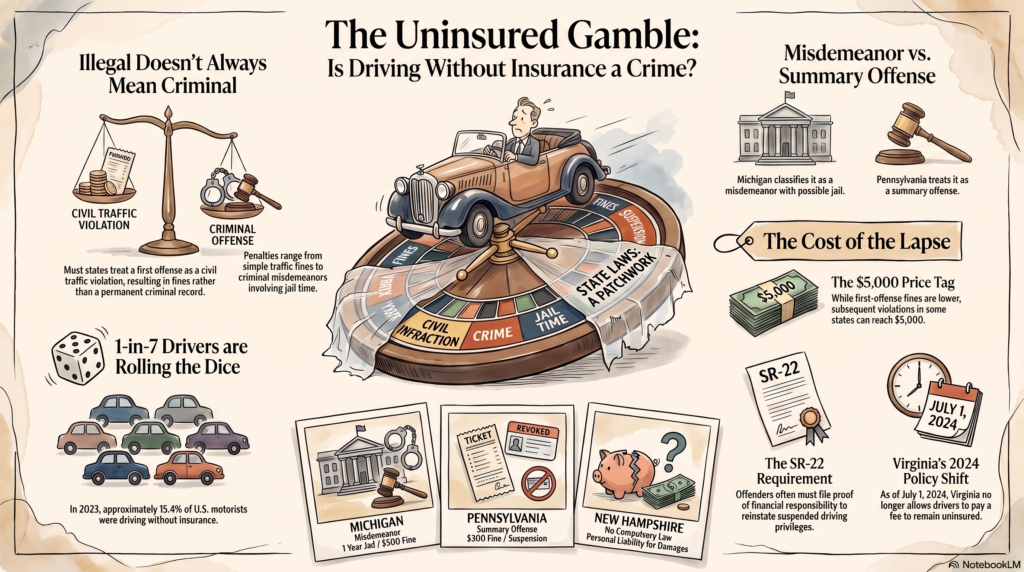
Is driving without insurance a crime? Driving without required auto insurance is illegal in most US states, but it is not automatically a criminal offense everywhere. Some states handle it as a civil or traffic violation (a fine, not a criminal record), while others classify certain violations as misdemeanors that can carry fines or even jail. The result depends on your state, the circumstances, and your prior record.
New Hampshire is the main exception to general compulsory auto-insurance laws, though financial-responsibility rules can still apply there. Virginia no longer lets drivers pay an uninsured-vehicle fee instead of buying coverage – that option ended on 1 July 2024.
Quick answer: Most vehicle owners must carry liability insurance (or another state-approved form of financial responsibility) in every state except New Hampshire. Driving uninsured can bring fines, license and registration suspension, an SR-22 filing, vehicle impound, and, in some states, jail. Whether it is a civil violation or a criminal misdemeanor depends on the state.
Key takeaways
- Most drivers must carry liability insurance (or another approved form of financial responsibility) in every state except New Hampshire.
- Driving uninsured is at least a traffic violation; some states treat certain violations as a misdemeanor (a crime). Classifications differ by state.
- Penalties can include fines, license and registration suspension, an SR-22 filing, vehicle impound, and jail in some states.
- Virginia’s uninsured-vehicle fee ended on 1 July 2024 – registered vehicles there must now carry insurance.
- About 15.4% of US motorists – more than one in seven – were uninsured in 2023 (Insurance Research Council, via III).
Is driving without insurance a crime? The short answer
It is illegal in most states, but whether it is a “crime” depends on how your state classifies it. Something can be illegal without being criminal. A traffic infraction or violation is illegal but usually not a crime – you pay a fine and it does not create a criminal record. A misdemeanor is a criminal offense that can carry larger fines and, in some states, jail.
State classifications differ a lot, and real state laws prove the point:
- Michigan treats operating a vehicle without the required insurance security as a misdemeanor, punishable by a fine of $200 to $500, up to one year in jail, or both (Michigan Compiled Laws 500.3102).
- Pennsylvania classifies operating without the required financial responsibility as a summary offense with a $300 fine, plus license and registration suspension (75 Pa.C.S. 1786) – not a misdemeanor.
So, the same act can be a simple fine in one state and a criminal misdemeanor in another. Check your state’s DMV or insurance department for how it is treated where you live.
Penalties for driving without insurance
The exact penalty depends on your state and whether it is a first or repeat offense, but the common consequences are similar across the country. Here is what you can face:
| Penalty | What it means |
| Fine | Varies widely by state; in some states, fines for subsequent offenses can reach around $5,000, while first-offense fines are much lower |
| License suspension or revocation | Your driving privilege can be suspended or revoked |
| Registration suspension | Your vehicle’s registration can be suspended (III) |
| SR-22 filing | You may have to file proof of insurance (an SR-22) for a period to reinstate your driving privilege |
| Vehicle impound / plate confiscation | Some states impound the car or take the license plates (III) |
| Jail | Some states can impose jail time, usually for repeat or serious cases (III) |
| Reinstatement fees | Extra fees to restore your license and registration |
The Insurance Information Institute notes that penalties range from fines – as high as about $5,000 for a subsequent offense in some states – to license or registration suspension, and that some states can impose jail time, confiscate plates, and impound vehicles.
How different states treat it (examples)
Because there is no single national rule, here are real examples of how states handle driving without required coverage. These are examples only, not a complete 50-state guide:
| State (example) | How it is treated |
| New Hampshire | No general compulsory-insurance requirement; financial-responsibility rules can apply after certain crashes or violations |
| Virginia | Insurance required; the uninsured-vehicle fee option ended 1 July 2024. Reinstating an uninsured vehicle requires a $600 non-compliance fee and a three-year SR-22 (Virginia DMV) |
| Michigan | A misdemeanor; fine of $200-$500, up to one year in jail, or both (MCL 500.3102) |
| Pennsylvania | A summary offense; $300 fine plus license and registration suspension (75 Pa.C.S. 1786) |
| California | An uninsured collision can lead to a driving-privilege suspension of up to four years; the driver may regain the privilege during the final three years by filing and maintaining an SR-22 (California DMV) |
Always confirm the exact rule with your own state DMV or insurance department.
Which states require car insurance?
Most vehicle owners must maintain liability insurance or another state-approved form of financial responsibility, such as an approved bond, deposit, or self-insurance certificate for those who qualify. New Hampshire is the only state without a general compulsory auto-liability-insurance requirement for all drivers – but even there, financial-responsibility rules can apply after certain crashes or violations, and you remain personally responsible for the damage you cause.
Virginia used to allow owners to pay an uninsured-motor-vehicle fee instead of insuring, but the Virginia DMV confirms that option ended on 1 July 2024; registered vehicles must now carry qualifying insurance.
Everywhere insurance is required, you generally must keep proof in the vehicle and show it when a police officer stops you, when you are in a crash, and often when you register the vehicle. Many states now verify insurance electronically, so assuming “they will not check” is a risky bet.
What happens if you cause an accident while uninsured?
If you cause a crash without insurance, you can be held personally responsible for the other person’s medical bills and vehicle damage – money that would normally come from your policy. Your savings, wages, or assets can be on the line.
It can get worse. About a dozen states have “no pay, no play” laws that stop uninsured drivers from suing for noneconomic damages like pain and suffering, even if the other driver was at fault (III). So driving uninsured does not just risk a ticket – it strips away the financial protection insurance is designed to provide. This is one reason to understand how long an accident stays on your insurance and to keep coverage in place.
What to do if you cannot afford insurance
Do not drive uninsured – there are cheaper, legal ways to stay covered. A lapse can cost far more in fines and higher future premiums than a basic policy.
- Ask about a state low-cost program. Some states, such as California, run a low-cost auto insurance program for drivers who qualify.
- Buy at least your state’s minimum liability. It is the legal floor and keeps you street-legal.
- Keep coverage continuous. A gap can raise your future rates, and after a suspension you may need an SR-22.
- If you do not own a car but sometimes drive, a non-owner policy can keep you covered. And if you are not licensed yet, see our guide on car insurance without a license.
For a related question about who is covered when you borrow or lend a vehicle, see does car insurance follow the car or the driver.
Frequently asked questions
Is driving without insurance a crime?
It is illegal in most US states, but it is not automatically a crime everywhere. Many states treat a first offense as a civil or traffic violation with a fine, while others classify certain violations as a misdemeanor – a criminal offense that can carry fines or jail. It depends on your state and your record.
Is driving without insurance a misdemeanor?
In some states, yes. Michigan, for example, treats operating without required insurance security as a misdemeanor (a fine of $200-$500, up to a year in jail, or both). Other states, like Pennsylvania, treat it as a summary offense with a fine rather than a misdemeanor. Check your state’s law.
Can you go to jail for driving without insurance?
In some states, yes – the Insurance Information Institute notes some states can impose jail time, usually for repeat or serious cases, and states like Michigan allow up to a year for a conviction. A typical first offense is more likely to bring a fine and possible license suspension than jail.
What happens if you get caught driving without insurance for the first time?
Usually, a fine and possibly a license or registration suspension, plus reinstatement fees and, in many cases, an SR-22 filing to restore your driving privilege. The exact penalty and classification depend on your state.
Which states do not require car insurance?
New Hampshire is the only state without a general compulsory auto-liability-insurance law, though drivers there must still be able to cover the damage they cause and may face financial-responsibility rules after a crash or violation. Virginia no longer offers an uninsured-vehicle fee option – as of 1 July 2024, registered vehicles must carry insurance.
How much is the fine for driving without insurance?
It varies a lot by state and by whether it is a first or repeat offense – from a few hundred dollars (for example, $300 in Pennsylvania) to as much as about $5,000 for a subsequent offense in some states, according to the Insurance Information Institute. Check your state DMV for the exact amount.
Educational disclaimer
This article is for general education only. It is not legal, financial, or insurance advice. Whether driving without insurance is treated as an infraction or a crime, and the exact fines and penalties, vary by state and by the details of your case, and laws change over time. The state examples above are examples only, not a complete 50-state guide. Confirm the current law where you live with your state DMV or insurance department, or a licensed attorney. You can find your state regulator through the NAIC state insurance department directory.
Sources
- Virginia DMV – Insurance Requirements (insurance required; uninsured-vehicle fee ended 1 July 2024; $600 non-compliance fee + three-year SR-22 to reinstate)
- Michigan Legislature – MCL 500.3102 (operating without required insurance security is a misdemeanor; $200-$500 fine, up to one year, or both)
- Pennsylvania General Assembly – 75 Pa.C.S. 1786 (required financial responsibility; summary offense; $300 fine)
- California DMV – Financial Responsibility, Insurance Requirements, and Collisions (uninsured-collision suspension up to four years; SR-22 to drive during the final three years)
- Insurance Information Institute – Background on: Compulsory Auto / Uninsured Motorists (national penalty categories; “no pay, no play”; ~15.4% uninsured in 2023)
- NAIC – State Insurance Department directory (find your state regulator)