
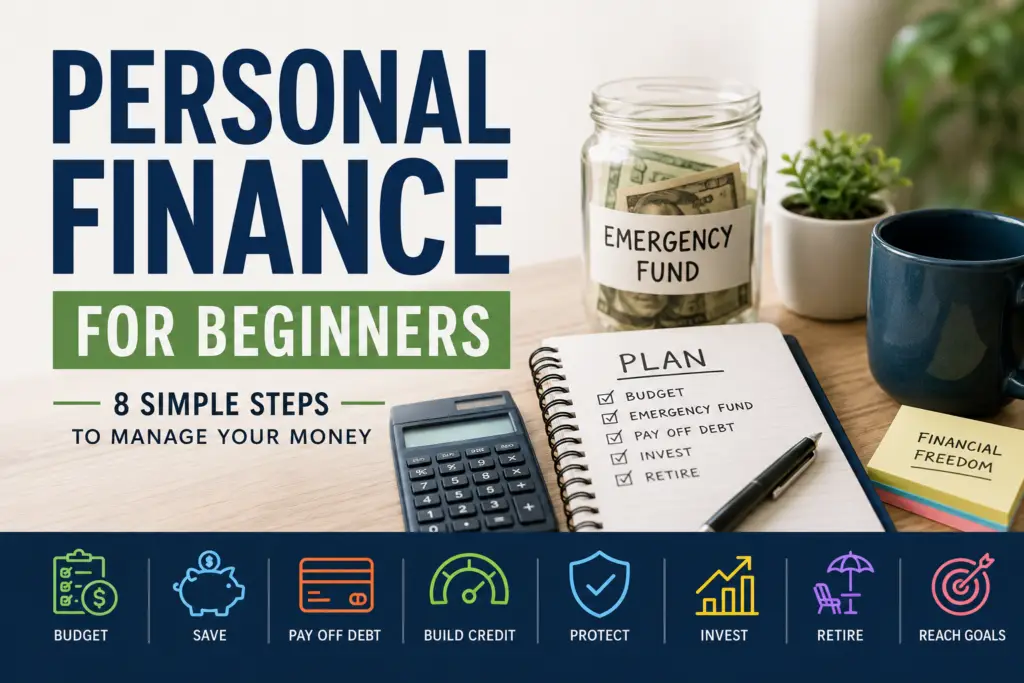
Personal Finance for Beginners: 8 Simple Steps to Manage Your Money
Personal finance is simply how you manage your money: what comes in, what goes out, what you save, and what you owe. You do not need to be good at math or earn a lot to get started. You just need a simple plan and a few habits. This beginner guide walks you through the basics in plain English, step by step, with a 30-day starter plan you can begin today.
(Looking for a “personal finance for dummies” style guide? This is that – a jargon-free walkthrough of the essentials, built from official U.S. sources.)
Key takeaways
- Start with your numbers. Track your income and spending for a month so you can see where your money goes before you change anything.
- Build a small emergency fund first. The CFPB says even a small amount helps; start small and make saving automatic, then grow it.
- Kill high-interest debt next. Credit-card interest usually costs more than any savings account earns, so paying it down is a guaranteed return.
- Protect your credit. On-time payments are the biggest factor in your score, and keeping card balances low helps too (CFPB).
- Invest for the long term and grab free money. If your job offers a 401(k) match, contribute enough to get all of it – it is part of your pay.
What is personal finance?
Personal finance is the way you handle your own money across five areas: earning, spending, saving, borrowing, and protecting what you have. It covers everyday choices like making a budget, as well as bigger ones like paying off debt, building credit, buying insurance, investing, and planning for retirement.
Think of it as a set of habits, not a test. Good personal finance is mostly about spending less than you earn, keeping a cushion for surprises, and slowly building toward goals. The steps below put those habits in a simple order.
Educational only: This is general information, not financial or investment advice. Your best choices depend on your income, goals, and situation. For decisions about specific products or investments, consider a licensed professional.
Why personal finance matters
Managing your money well lowers stress and gives you options. With a cushion and a plan, a surprise bill becomes an inconvenience instead of a crisis. Without one, the CFPB notes, a single financial shock can push people toward high-cost credit and debt that is hard to escape.
The payoff compounds over time. Small, steady habits – saving a little each payday, paying bills on time, avoiding needless interest – add up to real security and freedom later. You do not need a big income to start; you need to start.
Step 1: Track your income and expenses
Before you change anything, watch your money for one month. Write down everything that comes in (income) and everything that goes out (bills, subscriptions, food, fun). You can use a notebook, a free app, or a simple spreadsheet. The goal is to see the truth, not to judge it.
Most people are surprised by where the money actually goes – small, repeated purchases usually add up more than the occasional big one. Once you can see your spending, you can decide what to keep and what to cut.
Step 2: Build a simple budget
A budget is just a plan for your money before the month starts. A popular beginner framework is 50/30/20: about 50% of your take-home pay for needs (housing, food, transport), 30% for wants, and 20% for saving and paying off debt. Adjust the numbers to fit your life – the split is a starting point, not a rule.
The point of a budget is to give every dollar a job so saving happens on purpose, not by accident. Pick one method and keep it simple; a budget you actually use beats a perfect one you abandon.
Step 3: Start an emergency fund
An emergency fund is cash set aside for surprises like a car repair, a medical bill, or a drop in income. The CFPB’s advice is to start small and make it automatic – even a small amount provides real security, and you can grow it over time. Many people aim for 3 to 6 months of expenses as a longer goal, but the right amount depends on your situation.
The easiest way to build it, per the CFPB, is to set up an automatic transfer to a separate savings account each payday so you “pay yourself first.” Keep the money somewhere safe and separate, like a bank or credit union account, so you are not tempted to spend it. And if you use it, do not feel bad – just build it back.
Step 4: Pay down high-interest debt
After a starter emergency fund, attack high-interest debt – usually credit cards. Paying off a balance that charges 20%+ interest is like earning that rate risk-free, which beats almost any savings or investment. List your debts, keep paying the minimum on all of them, then throw extra money at the one with the highest interest rate first (the “avalanche” method saves the most). Some people prefer to clear the smallest balance first for a motivation boost.
Understanding what a loan really costs helps you avoid expensive debt in the first place. See our guides on what APR on a car loan means, how many personal loans you can have at once, and, for student debt, the benefits of refinancing private student loans.
Step 5: Understand credit scores
Your credit score is a number lenders use to decide whether to lend to you and at what rate. According to the CFPB, the biggest factor is paying your bills on time. It also helps to keep your credit-card balances low – under about 30% of each card’s limit – and to check your credit reports for errors.
You can get your credit reports for free at AnnualCreditReport.com and dispute any mistakes. A stronger score saves you real money because it lowers the interest you pay on everything from credit cards to car loans – see what credit score you need for good car financing for how that plays out on a big purchase.
Step 6: Protect yourself with insurance
Insurance protects your finances from big, rare losses you could not easily pay for yourself. The core types for most people are health insurance, auto insurance (required in most states if you drive), renters or homeowners insurance, and, if others depend on your income, life and disability insurance.
The goal is not to insure everything – it is to cover the losses that would be financially devastating. Skipping essential coverage to save a little each month is one of the most expensive mistakes a beginner can make, because one uncovered emergency can wipe out years of savings.
Step 7: Start investing slowly
Investing is how your money grows faster than inflation over the long run. You do not need to pick individual stocks. The SEC’s Investor.gov teaches a few beginner principles: start early so your money has time to grow, diversify so you are not relying on one investment, keep costs low, and think long term instead of trying to time the market.
A simple, common starting point is a low-cost, diversified fund inside a retirement account (below). Only invest money you will not need soon, and understand that investments can go down as well as up. This guide does not recommend specific investments – focus on the habit of investing regularly.
Step 8: Plan for retirement
Retirement saving works best when you start early and use tax-advantaged accounts. If your employer offers a 401(k) with a match, contribute at least enough to get the full match – that match is free money and part of your pay. For 2026, the IRS lets you contribute up to $24,500 to a 401(k), and up to $7,500 to an IRA (with extra “catch-up” amounts if you are 50 or older).
Two common account types: a Traditional account gives you a tax break now and is taxed when you withdraw in retirement; a Roth account is funded with after-tax money and grows tax-free. Social Security will likely cover only part of your needs, so your own savings matter. Start with whatever you can, and increase it a little each year.
Personal finance basics at a glance
| Area | Beginner action |
| Budgeting | Track income and spending, then plan it |
| Saving | Build a small emergency fund, automatically |
| Debt | Pay high-interest debt first |
| Credit | Pay on time and keep balances low |
| Insurance | Protect against big, rare losses |
| Investing | Start small, diversify, think long term |
| Retirement | Get the full employer 401(k) match |
Your first 30 days: a simple money plan
You do not have to do everything at once. This four-week plan gets you started without overwhelm.
| Week | Task |
| Week 1 | Track every dollar in and out |
| Week 2 | Build a simple budget (try 50/30/20) |
| Week 3 | Open a savings account and automate a small transfer |
| Week 4 | List your debts and check your free credit report |
By the end of the month you will have a budget, the start of an emergency fund, and a clear picture of your debt and credit – the foundation everything else builds on.
Personal finance checklist
- I know my monthly income and spending.
- I have a simple budget.
- I have started an emergency fund and automated saving.
- I am paying more than the minimum on high-interest debt.
- I pay every bill on time.
- I have checked my free credit report for errors.
- I have the essential insurance for my situation.
- I contribute enough to get my full 401(k) match (if offered).
Common beginner mistakes to avoid
- Budgeting for a “perfect” month. Plan for real life, including fun and surprises, or you will quit.
- Investing before clearing high-interest debt. Paying off a 20% card usually beats an uncertain market return.
- Skipping the emergency fund. Without a cushion, every surprise becomes new debt.
- Chasing hot tips. Ignore anyone promising guaranteed or fast returns – that is a red flag.
- Only paying the minimum. Minimum payments keep you in debt for years and multiply the interest you pay.
Frequently asked questions
What is the best way to start personal finance as a beginner?
Start by tracking your income and spending for one month so you can see where your money goes. Then build a simple budget, start a small automatic emergency fund, and pay down high-interest debt. These first steps create a foundation before you move on to credit, insurance, investing, and retirement.
How much should I have in an emergency fund?
The CFPB says the right amount depends on your situation, and that even a small amount helps – so start small. A common longer-term goal is 3 to 6 months of essential expenses. The key is to make saving automatic and to keep the money separate so you are not tempted to spend it.
Should I pay off debt or save first?
Do a little of both. Build a small starter emergency fund so a surprise does not create new debt, then focus on paying off high-interest debt like credit cards. Because that debt often costs 20% or more, paying it down usually beats what you could earn by saving or investing.
How do I improve my credit score as a beginner?
Pay every bill on time – the CFPB says that is the biggest factor. Keep credit-card balances low, ideally under about 30% of your limit, and check your free credit reports for errors to dispute. Building credit takes a few months of steady, on-time habits.
How much can I put in a 401(k) or IRA in 2026?
For 2026, the IRS limit is up to $24,500 for a 401(k) and up to $7,500 for an IRA. People age 50 and older can add catch-up contributions on top. If your employer offers a 401(k) match, aim to contribute at least enough to get the full match first.
Do I need a lot of money to start investing?
No. You can start small, and the most important thing is starting early so your money has time to grow. The SEC’s Investor.gov suggests diversifying, keeping costs low, and investing for the long term rather than trying to time the market. Only invest money you will not need soon.
Is “personal finance for dummies” the same as this guide?
This is a free, plain-English beginner guide to the same basics that broad personal-finance books cover – budgeting, saving, debt, credit, insurance, investing, and retirement. It is written for people starting today, with a 30-day plan and links to official U.S. sources.
About the author
Nimra Saleem is a personal-finance writer at MoneyMentorDesk.com. She turns money topics into plain-English guides that help everyday readers take practical steps with confidence. She writes each guide directly from primary sources, including the CFPB, the IRS, and the SEC’s Investor.gov.
Disclosure
This guide was written by Nimra Saleem for MoneyMentorDesk.com and reviewed against Consumer Financial Protection Bureau (CFPB), Internal Revenue Service (IRS), and U.S. Securities and Exchange Commission (Investor.gov) guidance. It is educational only and is not financial or investment advice. Rules, limits, and rates change – confirm current details with the official sources below and, for personal decisions, consider a licensed professional.
Last updated: July 3, 2026.