
Your car insurance deductible is the amount you pay out of your own pocket on a claim before the insurer pays anything. The National Association of Insurance Commissioners defines it as “the amount of money you agree to pay prior to the insurance company making any payment on a loss”, and Wisconsin’s insurance regulator adds the detail most people miss: it is “the dollar amount you must pay out-of-pocket for each covered claim”.
Choosing it is one of the few parts of your premium you control. Six rules decide what it actually costs you.
Which coverages have a deductible?
Deductibles attach to the coverages that pay for damage to your own car:
- Collision — damage from hitting another vehicle or an object, or overturning
- Comprehensive — theft, fire, hail, flood, vandalism, animal strikes and glass damage
Liability coverage, which pays for other people’s property and injuries, does not carry one. Wisconsin’s consumer guide notes the deductible choice “usually only applies to comprehensive or collision coverage”. Uninsured motorist coverage can carry its own separate deductible in some states, so check your declarations page rather than assuming.
Rule 1: you pay it on every claim, not once a year
Health insurance deductibles reset annually. Car insurance deductibles do not work that way: they apply per claim, every time.
Wisconsin’s regulator spells out how far that goes. If a comprehensive loss and a collision loss happen on the same day — a deer strike in the morning, a shopping cart into your door that afternoon — “your policy allows the insurer to apply two different deductibles”. Three claims in a year means paying it three times.
Rule 2: it comes out of the payout, not on top of it
The insurer subtracts your deductible from what it owes. You do not write a separate cheque to the insurance company; you simply receive less, and usually settle the difference with the repair shop.
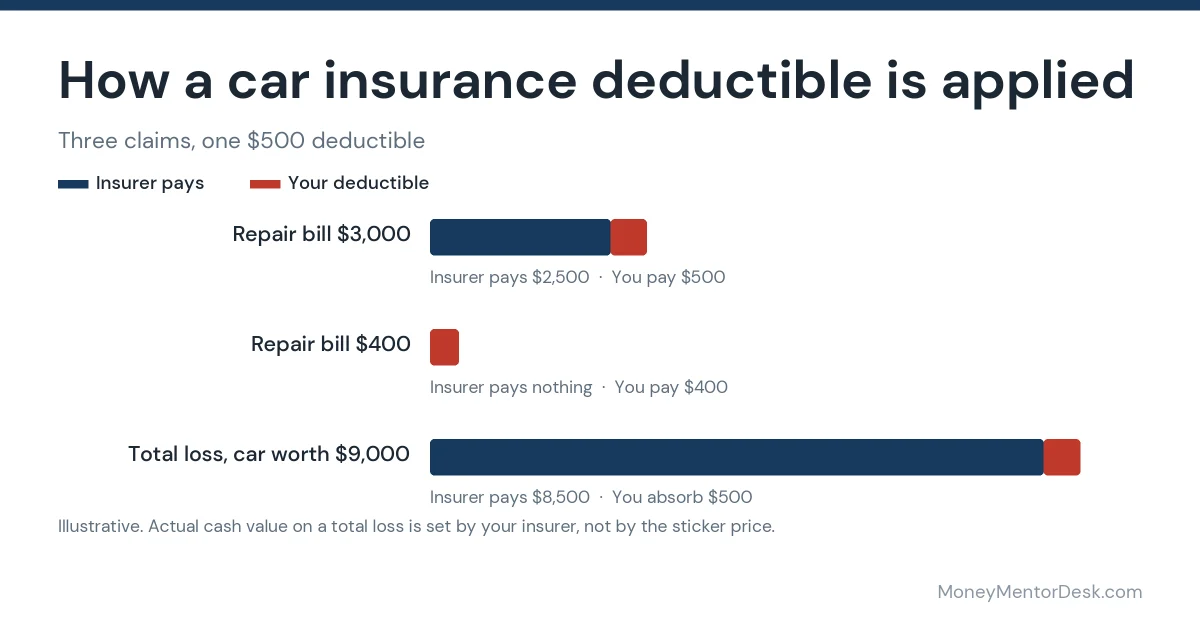
A repairable car. Repairs come to $3,000 and your deductible is $500. The insurer pays $2,500 and you pay $500.
A small loss. Wisconsin’s guide gives the plain version: “if a loss of $500 occurs and you have a deductible of $250, you pay $250 (your deductible) and you collect $250 from your insurer. If a loss of less than $250 occurs, you pay for all of it yourself.”
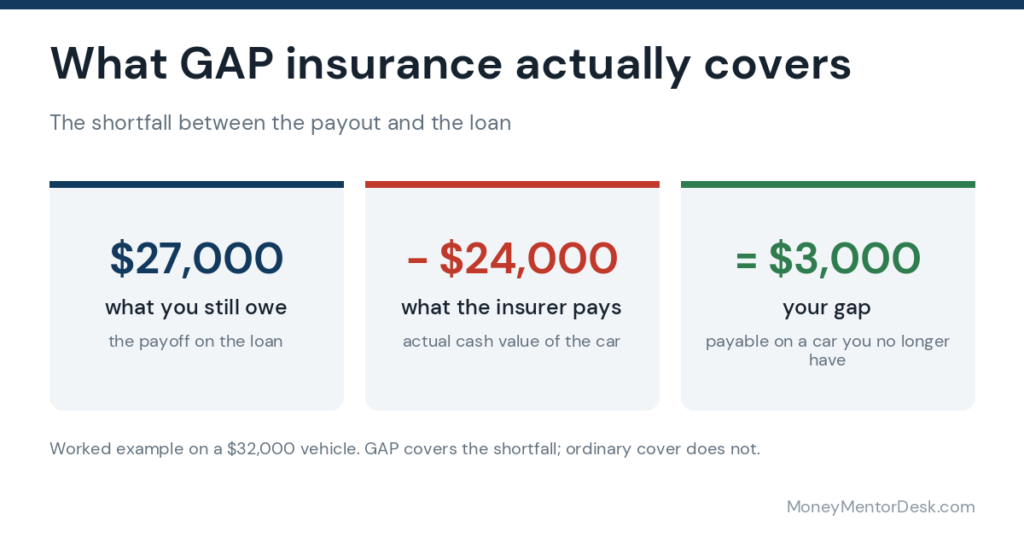
A totaled car. When repairs cost more than the car is worth, the insurer settles at actual cash value, which Wisconsin describes as based on “the value of your vehicle at the time of the accident, considering its current market value”. On a car valued at $9,000 with a $500 deductible, you receive $8,500 — and if the loan balance is higher than that, the shortfall is what GAP insurance exists to cover.
Figures are illustrative. Your settlement letter shows the real numbers.
Rule 3: a higher deductible means a lower premium — here is the break-even test
This is the trade the deductible exists to make. The NAIC puts it simply: “Higher policy deductibles mean lower policy premiums. A policy with a $1,000 deductible has a lower premium than the same policy with a $500 deductible.” Wisconsin agrees: “If you increase your deductible and pay for small losses yourself, your insurer can charge you less. This way you can cut your insurance premium costs and still be protected against large losses.”
Nobody can tell you in advance how much you would save, because it depends on your car, your state and your record. So ask your insurer to quote both, then do this arithmetic: moving from a $500 to a $1,000 deductible puts an extra $500 of risk on you, and the annual saving is what pays for it.
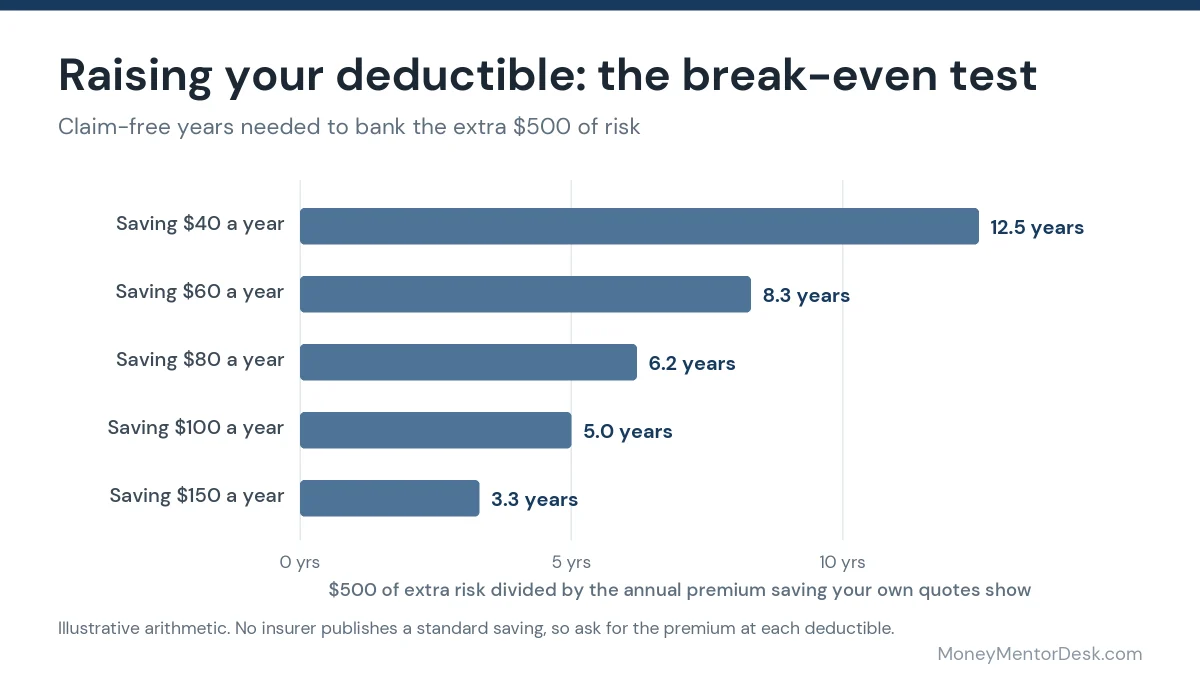
| If moving to the $1,000 deductible saves you | You need this many claim-free years to bank the extra $500 |
|---|---|
| $40 a year | 12.5 |
| $60 a year | 8.3 |
| $80 a year | 6.2 |
| $100 a year | 5.0 |
| $150 a year | 3.3 |
Illustrative arithmetic: $500 of extra risk divided by the annual saving your own quotes show. Ask for the premium at each deductible before deciding.
A saving of $40 a year is not worth $500 of exposure unless you genuinely never claim. A saving of $150 pays for itself in a little over three years. The NAIC attaches one condition to all of it: “be sure you can afford the deductible in case you have a loss.”
Rule 4: typical amounts, and the cap your lender sets
The NAIC says “typical deductible amounts are $250, $500 and $1000”. Wisconsin’s guide gives the wider ranges insurers actually offer: “Deductibles on collision coverage can range from $100 to $1,000. With comprehensive coverage, they can range from $100 to $500 or higher.”
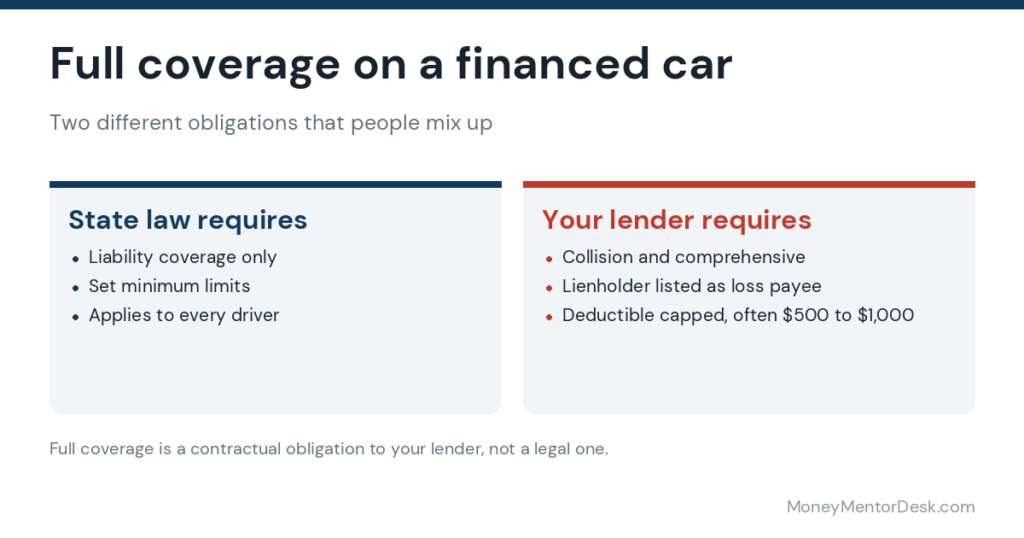
One limit is not yours to choose. If the car is financed, the loan agreement usually sets a maximum deductible, because a deductible you cannot pay is a car that does not get repaired. Our guide to full coverage on a financed car covers the caps lenders commonly set and what to do if yours is higher.
Rule 5: damage below your deductible is not worth claiming
If the repair costs less than your deductible, the insurer pays nothing and you have still reported a claim. The NAIC’s advice is blunt: “If the cost to repair the damage is not much more than your deductible, you may want to pay for the repairs without filing a claim,” because “how often you file a claim and the types of claims you file often affect your premium and whether your insurer will renew your policy.”
Get an estimate before you call it in. A $700 repair against a $500 deductible buys you $200 and a claim on your record.
One exception worth knowing: the NAIC notes that “some companies won’t charge you a deductible for windshield repairs”, so a chip repair may cost you nothing. Check your own policy — this varies by insurer and by state.
Rule 6: if the other driver was at fault, you may get it back
Claiming on your own coverage is often faster than waiting for the other driver’s insurer, and you are not meant to be left carrying the deductible.
Washington State’s insurance regulator describes the mechanism: “When you file a claim, your insurer can try to recover costs from the person responsible for your injury or property damage. This is known as subrogation.” And: “If you paid a deductible, your company must include your deductible in its subrogation demand to the at-fault party.”
Two conditions. If you share the blame, “you’ll only recover a percentage of your deductible”. And if you intend to settle directly with the other driver, tell your insurer first, because a private settlement can cut across its right to recover. Recovery also takes months, not days.
“Is car insurance tax deductible?” — a different question
This trips up a lot of searches. A policy deductible and a tax deduction are unrelated ideas.
For a personal car, premiums are not deductible. The IRS allows car expenses only for business use, and lists what counts: “gas, oil, repairs, tires, insurance, registration fees, licenses, and depreciation (or lease payments)” — for the business-use portion of the vehicle. If you use a car for both, “you may deduct only the cost of its business use”, and commuting to a regular workplace counts as personal use.
That is the general rule, not advice on your return. Ask a tax professional about your own circumstances.
FAQs
What is a car insurance deductible in simple terms?
It is the amount you pay yourself on a claim before your insurer pays the rest. The NAIC describes it as the money you agree to pay before the insurance company makes any payment on a loss. It applies to collision and comprehensive coverage, not to liability.
How does a car insurance deductible work?
It is subtracted from your payout on each covered claim. On a $3,000 repair with a $500 deductible, the insurer pays $2,500 and you pay $500. If the damage costs less than the deductible, the insurer pays nothing.
Is a car insurance deductible per claim or per year?
Per claim. Unlike a health plan, it does not reset annually — it applies every time. Wisconsin’s insurance regulator notes that a comprehensive loss and a collision loss on the same day can attract two separate deductibles.
Should I choose a $500 or $1,000 deductible?
It depends on the saving and on what you could pay tomorrow. Get both quotes: if the $1,000 option saves $100 a year, it takes five claim-free years to bank the extra $500 of risk. The NAIC’s condition is to be sure you can afford the deductible when a loss happens.
Do you get your deductible back if you were not at fault?
Often, but not automatically or quickly. Your insurer pursues the at-fault driver through subrogation and, in Washington for example, must include your deductible in that demand. If you were partly at fault, you recover only part of it.
Is car insurance tax deductible?
Not for personal driving. The IRS includes insurance in the actual car expenses you can deduct for business use, and only for the business-use share — commuting does not count. Check your own position with a tax professional.
Sources
- NAIC, A Consumer’s Guide to Auto Insurance (National Association of Insurance Commissioners, 2022), checked 20 September 2026
- NAIC, Does your vehicle have the right protection? Best practices for buying auto insurance, checked 20 September 2026
- Wisconsin Office of the Commissioner of Insurance, PI-057: Consumer’s Guide to Auto Insurance (R 07/2025), checked 20 September 2026
- Wisconsin Office of the Commissioner of Insurance, PI-233: Frequently Asked Questions — Automobile Insurance, checked 20 September 2026
- Washington State Office of the Insurance Commissioner: What is subrogation?, checked 20 September 2026
- IRS, Topic no. 510, Business use of car, checked 20 September 2026
This guide is general information, not insurance, financial or tax advice. Deductible rules, claim procedures and available amounts depend on your own policy wording and on state law, so check your declarations page and your state’s department of insurance.
Written by Nimra Saleem for MoneyMentorDesk.com. Last reviewed on 20 September 2026 against NAIC consumer publications, the Wisconsin Office of the Commissioner of Insurance, the Washington State Office of the Insurance Commissioner and IRS Topic no. 510.

Pingback: What Is Collision Insurance? 7 Key Facts and When to Drop It
Pingback: Do I Need Full Coverage on a Financed Car? - MoneyMentorDesk.com