
What is collision insurance? It is the part of a car insurance policy that pays to repair or replace your own car after it hits something, or something hits it, no matter who caused the crash. The National Association of Insurance Commissioners describes collision as the coverage that “pays for damage to your car from a collision with another car, an object or a pothole or from flipping over”.
It is optional under state law in the usual case, but your lender will insist on it while you still owe money on the car. Here are the seven things worth knowing before you buy it, keep it or drop it.
1. What collision insurance covers
Collision is physical damage cover for your own vehicle. Wisconsin’s insurance regulator puts the scope plainly: it “pays for physical damage to your vehicle caused by your vehicle colliding with an object, including another vehicle, or if it overturns”, and “your insurer will pay for such damage even if the collision is your fault”.
That covers the situations drivers get wrong most often:
- hitting another car, whoever was to blame
- hitting a stationary object such as a guardrail, a pole, a wall or a kerb
- hitting a pothole
- your car rolling over
- being hit by a driver who has no insurance to pay for your repairs
It pays for your car. Damage you do to somebody else’s car or property is paid by your liability cover, not by collision.
2. What collision insurance does not cover
Anything that damages your car without a collision is comprehensive cover’s job, not collision’s. The NAIC describes comprehensive as reimbursing you “for damage to your car that’s not caused by a collision”, including “theft, hail, windstorm, flood, fire and hitting animals”.
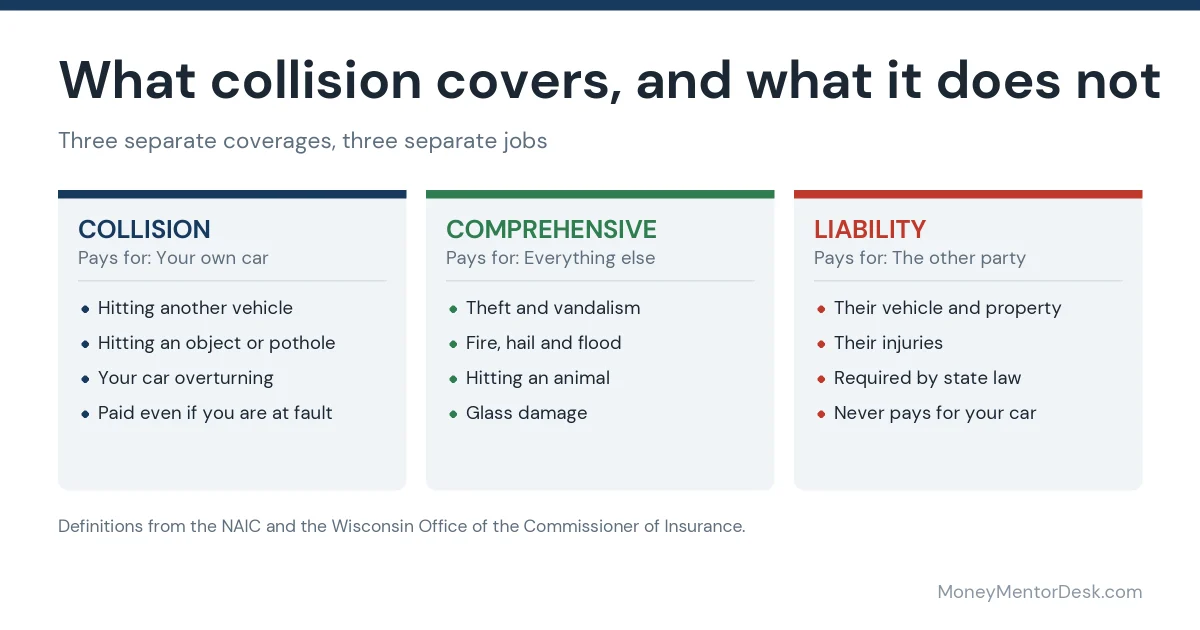
Two traps follow from that split:
- Animals. Hitting a deer feels like a collision, but Wisconsin’s regulator warns that “most policies cover hitting an animal under comprehensive coverage, not collision coverage”.
- Flood. “If you carry collision without comprehensive, you’re not covered for flood damage.”
Collision also does not pay your medical bills, the other driver’s costs, or mechanical breakdown. And it never pays more than the car is worth, which is the point that section 6 turns on.
3. How the deductible works
Your deductible is the first slice of every claim, and you pay it. The NAIC defines it as “the amount you have to pay out-of-pocket on a claim before the policy pays the loss”, and notes the trade-off: “A policy with a $1,000 deductible has a lower premium than the same policy with a $500 deductible.”
Example 1: a repairable car. Your car needs $4,200 of repairs after you hit a barrier. With a $500 deductible, you pay $500 and the insurer pays $3,700.
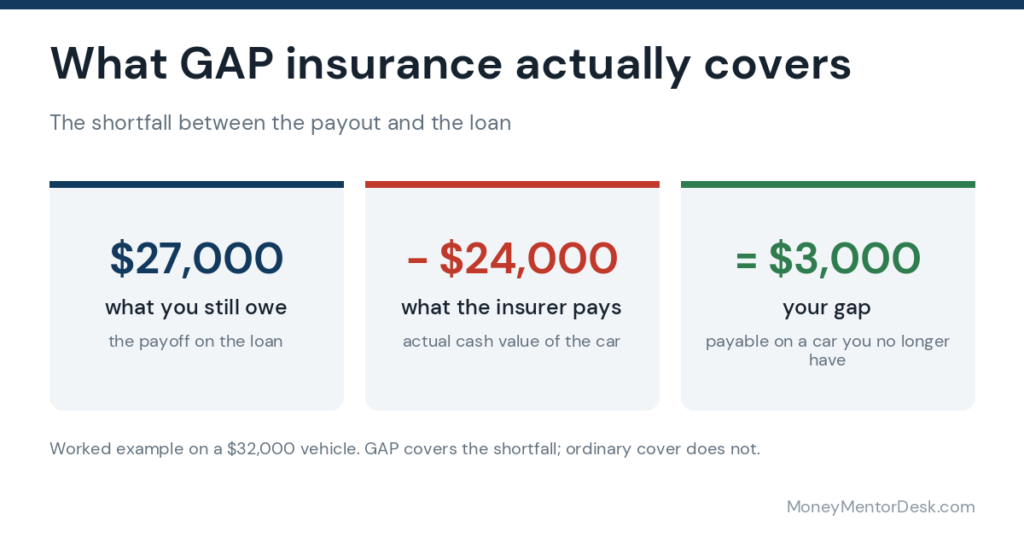
Example 2: a totaled car. The repair bill is higher than the car is worth, so the insurer settles at actual cash value instead. Wisconsin’s regulator explains that actual cash value “is based on the value of your vehicle at the time of the accident, considering its current market value” — so on a car valued at $9,000 with a $500 deductible, you receive $8,500. If $11,000 is still outstanding on the loan, you are $2,500 short, which is the hole GAP insurance is designed to fill.
Figures are illustrative. One more detail catches people out: deductibles apply per occurrence, not per year. Wisconsin gives the example of a comprehensive loss and a collision loss on the same day, where “your policy allows the insurer to apply two different deductibles”.
4. Is collision insurance required?
Not by law, in the ordinary case, but usually by your lender.
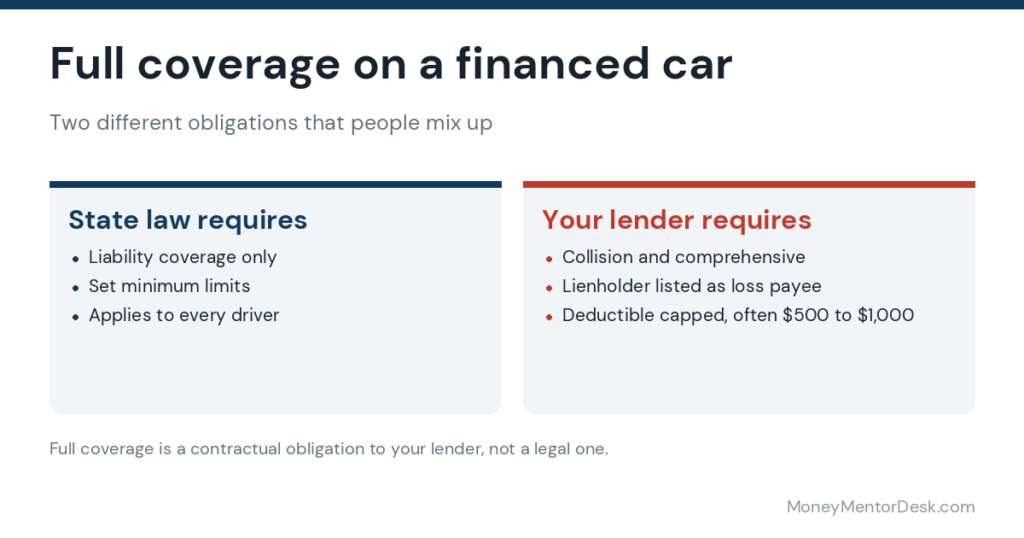
- State law. The South Carolina Department of Insurance states it directly: “While not required by law, comprehensive and collision coverage may be required by your lender.” Mandatory minimums are liability cover, and they vary by state.
- Your lender. The NAIC lists collision and comprehensive under the heading “Required by Your Lender if You Have an Auto Loan”. Wisconsin’s regulator agrees: where the vehicle is collateral, “the terms of your loan will most likely require you to have comprehensive coverage and collision coverage”.
- If you let it lapse. The lender buys cover for itself and bills you. Wisconsin: “the bank will force coverage (obtain a policy) and add the cost of the coverage to your loan payments”, and that “forced coverage protects the bank for its interest in the vehicle and nothing else”.
Our guide to full coverage on a financed car covers what lenders check and how to add a lienholder.
5. How much collision insurance costs
Collision is usually the most expensive single item on a physical damage policy. The NAIC’s latest premium supplement puts the countrywide average collision premium at $463.69 in 2023, against $238.21 for comprehensive.
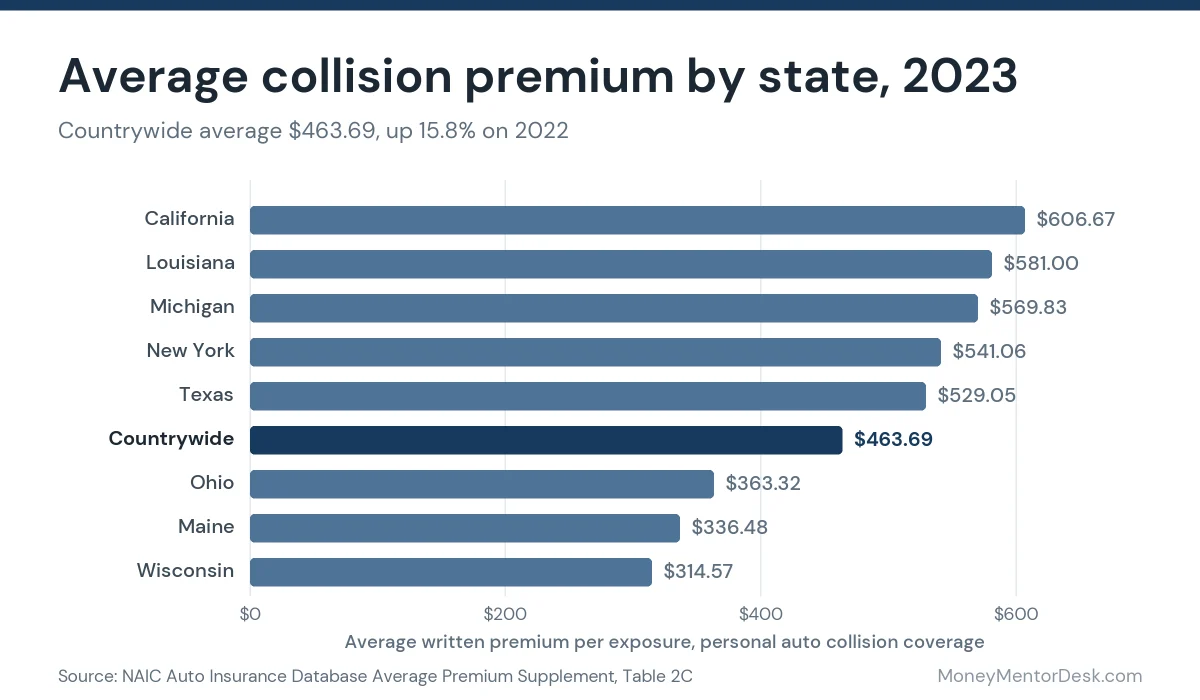
| State | Average collision premium, 2023 | 2022 |
|---|---|---|
| California | $606.67 | $534.36 |
| Louisiana | $581.00 | $471.33 |
| Michigan | $569.83 | $483.39 |
| New York | $541.06 | $486.05 |
| Texas | $529.05 | $456.10 |
| Countrywide | $463.69 | $400.42 |
| Ohio | $363.32 | $316.81 |
| Maine | $336.48 | $297.74 |
| Wisconsin | $314.57 | $272.56 |
Source: NAIC 2023 Auto Insurance Database Average Premium Supplement, Table 2C. An average premium is written premiums divided by written exposures, not a quote for any individual driver.
Two things stand out. The countrywide figure rose 15.8% in a single year, from $400.42 in 2022, and 21.4% since 2019. And the spread between states is wide: California’s average is 1.9 times Wisconsin’s. What you pay depends on your own car and record as well; the NAIC notes you will pay more “particularly for comprehensive and collision coverages, if your vehicle is newer or more expensive”.
6. When collision insurance stops being worth it
Because collision never pays more than the car is worth, the coverage quietly shrinks as the car ages while the premium does not. Wisconsin’s regulator frames the test as affordability rather than a formula: “You may not need this coverage if your vehicle has decreased in value or if you can afford to replace it,” and gives the example of a $5,000 car where you could absorb the $5,000 loss yourself.
The arithmetic is worth doing once. The most a collision claim can ever pay you is the car’s value minus your deductible. Set that against the premium:
| Car’s value | Most a claim could pay (after a $1,000 deductible) | Average premium as a share of that | Years of premiums to equal it |
|---|---|---|---|
| $12,000 | $11,000 | 4.2% | 23.7 |
| $6,000 | $5,000 | 9.3% | 10.8 |
| $4,000 | $3,000 | 15.5% | 6.5 |
| $2,500 | $1,500 | 30.9% | 3.2 |
| $1,500 | $500 | 92.7% | 1.1 |
Illustrative, using the NAIC countrywide average collision premium of $463.69 and a $1,000 deductible. Your own premium and your car’s value are what matter.
At $12,000 the cover buys a lot of protection for the money. At $1,500 you are paying nearly the whole of the maximum payout every year for it. Three practical checks before you drop it:
- Do you still owe money on the car? If so, the decision is not yours to make. Dropping it breaches the loan and triggers force-placed cover.
- Could you replace the car tomorrow out of savings? If not, keep the cover whatever the arithmetic says.
- Would a higher deductible do instead? Raising it lowers the premium while keeping cover for a total loss, though you must be able to pay the larger deductible.
7. What happens when the other driver is at fault
You can claim on your own collision cover even when someone else caused the crash, and it is often faster than waiting for their insurer. You still pay your deductible up front, but you should not be left out of pocket.
Washington State’s insurance regulator explains the recovery process: “When you file a claim, your insurer can try to recover costs from the person responsible for your injury or property damage. This is known as subrogation.” Crucially, “if you paid a deductible, your company must include your deductible in its subrogation demand to the at-fault party”.
Two conditions attach. If you share blame, “you’ll only recover a percentage of your deductible”. And if you settle directly with the other driver, tell your insurer first, because a private settlement can cut across its right to recover.
Collision vs comprehensive: the one-line version
Collision pays when your car hits something or overturns. Comprehensive pays for almost everything else that damages it — theft, fire, hail, flood, vandalism and animal strikes. They are sold separately, carry separate deductibles, and lenders normally require both. Our guide to comprehensive insurance covers that side in full.
FAQs
What is collision insurance in simple terms?
It is optional cover that pays to repair or replace your own car after it collides with another vehicle or an object, or overturns, regardless of who was at fault. You pay a deductible on each claim and the insurer pays the rest, up to the car’s actual cash value.
Does collision insurance cover hitting a deer?
Usually not. Wisconsin’s insurance regulator notes that most policies cover hitting an animal under comprehensive coverage rather than collision. Hitting a deer is a comprehensive claim on a typical policy, so a driver who carries collision alone would not be covered.
Is collision insurance required by law?
No, in the ordinary case. The South Carolina Department of Insurance states that comprehensive and collision are not required by law but may be required by your lender. State minimums cover liability, and requirements differ by state, so check your own state’s department of insurance.
How much does collision insurance cost?
The NAIC puts the countrywide average collision premium at $463.69 for 2023, up 15.8% from $400.42 in 2022. Averages ranged from about $315 in Wisconsin to about $607 in California. Your own premium depends on your car, your record and your deductible.
When should you drop collision insurance?
Only once the car is cheap enough that you could replace it yourself, and only if you no longer owe money on it. Compare the premium with the car’s value minus your deductible: on a $2,500 car with a $1,000 deductible, the average premium is about 31% of the most a claim could ever pay.
Do you get your deductible back if you were not at fault?
Often, but not automatically. Your insurer pursues the at-fault driver through subrogation and, in Washington for example, must include your deductible in that demand. If you were partly at fault, you recover only part of it, and the process takes time.
Sources
- NAIC, A Consumer’s Guide to Auto Insurance (National Association of Insurance Commissioners), checked 20 September 2026
- NAIC, 2023 Auto Insurance Database Average Premium Supplement, June 2025, Tables 2C and 3C, checked 20 September 2026
- NAIC, What Does Auto Insurance Cover?, checked 20 September 2026
- Wisconsin Office of the Commissioner of Insurance, PI-233: Frequently Asked Questions — Automobile Insurance, checked 20 September 2026
- South Carolina Department of Insurance: Automobile Insurance, checked 20 September 2026
- Washington State Office of the Insurance Commissioner: What is subrogation?, checked 20 September 2026
This guide is general information, not insurance or financial advice. Insurance requirements, total-loss rules and claim procedures are set by state law and by your own policy wording, so check your policy and your state’s department of insurance.
Written by Nimra Saleem for MoneyMentorDesk.com. Last reviewed on 20 September 2026 against NAIC consumer publications and premium data, the Wisconsin Office of the Commissioner of Insurance, the South Carolina Department of Insurance and the Washington State Office of the Insurance Commissioner.

Pingback: Does Car Insurance Follow the Car or the Driver? - MoneyMentorDesk.com
Pingback: Is GAP Insurance Worth It? Cost, Need & How to Cancel - MoneyMentorDesk.com
Pingback: Non-Owner Car Insurance: Cost, Coverage and SR-22 (9 Facts)