Non-owner car insurance is a policy for people who drive but don’t own a car. It follows you rather than a vehicle, and pays for the injuries and property damage you cause to other people when you drive a car you’ve borrowed or rented. The Insurance Information Institute describes it as the option for “non car-owners who are frequent renters”, providing “the additional liability needed”.
Non-owner car insurance is narrower than most people expect, and usually cheaper than a standard policy. Here are the nine things that decide whether it fits your situation, including what it costs and how to get it.
1. What non-owner car insurance covers
At its core, a non-owner policy is liability insurance attached to you as a driver:
- Bodily injury liability — other people’s injuries when you cause a crash
- Property damage liability — their car, fence, or other property
Insurers can offer more than that. The standard industry endorsement for these policies, ISO’s Named Non-Owner Coverage form, can schedule “liability, medical payments, other than collision, collision, uninsured, and underinsured motorists insurance”, according to an FC&S analysis of the form. Its 2018 revision added optional collision and other-than-collision coverage for cars you don’t own, which the earlier edition did not offer.
In practice, many insurers sell the liability core and little else, so “liability-only” is the usual offer rather than a rule. Ask for a quote that lists every coverage line.
2. What non-owner car insurance does not cover
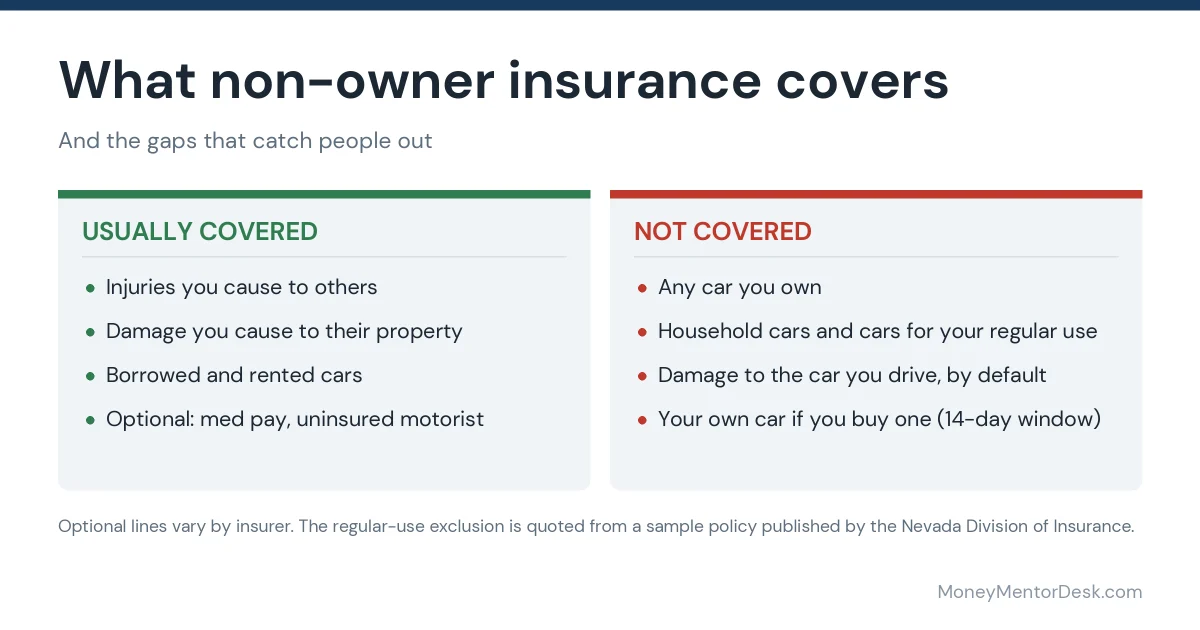
Three gaps matter.
Cars you own. A non-owner policy is built for people without a car. If you buy one, you need a standard policy (see section 6).
Cars in your household, or cars you drive all the time. This is the exclusion that catches people out. Personal auto policies cover a non-owned car only when it isn’t one you have regular access to. A sample auto policy published by the Nevada Division of Insurance, for example, covers a non-owned auto “used with the owner’s permission”, but adds: “This auto must not be available or furnished for the regular use of an insured person.” A partner’s car you drive every day, or a family car in your household, generally needs to be insured on its owner’s policy, with you listed as a driver.
The car itself, by default. Unless you’ve bought one of the optional physical damage coverages, a non-owner policy won’t pay to repair the car you were driving. That falls to the owner’s collision coverage — our guide to whether insurance follows the car or the driver explains how that works.
3. Who needs non-owner car insurance?
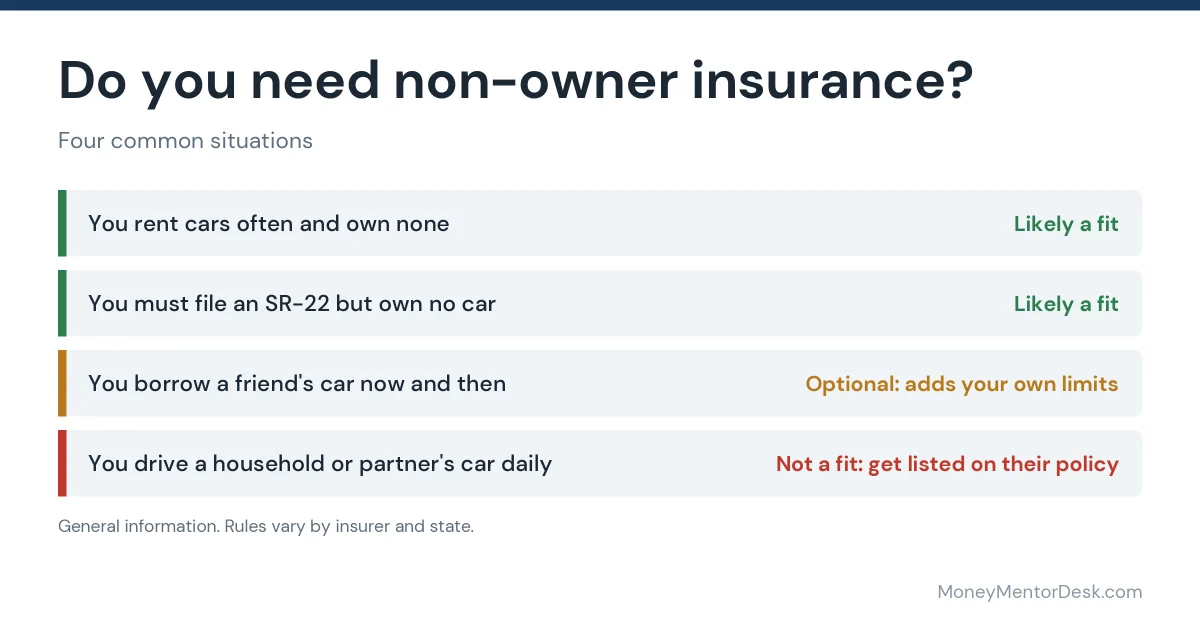
A non-owner policy tends to make sense if you:
- Rent cars often. The Insurance Information Institute points frequent renters without a car to a non-owner liability policy.
- Borrow cars occasionally from people outside your household and want your own liability limits, not just the owner’s.
- Use car-sharing. The Institute notes that renters under 21 in car-sharing programs can check their parents’ policy “or purchase their own non-owner liability policy”.
- Must file an SR-22 but don’t own a car (see section 5).
- Need underlying auto liability for an umbrella policy. The FC&S analysis lists this among common uses of the endorsement.
It usually isn’t the right tool if you regularly drive one particular car, including someone else’s. That is a job for the owner’s policy — see can you insure a car not in your name? for the options.
4. How much does non-owner car insurance cost?
Non-owner car insurance usually costs less than a standard policy, because it normally leaves out cover for damage to the car itself. MoneyGeek’s analysis of 12,128 quotes from 319 companies found that drivers with clean records pay around $578 a year, roughly $48 a month, for a minimum-coverage non-owner policy. The cheapest company in that analysis, Auto-Owners, came in at $285 a year, though it isn’t available everywhere.
What moves your price:
- Your driving record. The $578 figure assumes a clean record; violations or an SR-22 requirement will change your quotes.
- Your state and ZIP code.
- The liability limits you choose. The estimate is for state-minimum cover; higher limits cost more.
- Optional extras such as medical payments or uninsured motorist cover, where your insurer offers them.
Treat these figures as a starting point and get quotes for your own profile.
5. Is non-owner car insurance worth it?
It tends to be worth it if you:
- rent cars often and have no car insurance of your own to carry over
- borrow cars from people outside your household and want your own liability limits
- must file an SR-22 but don’t own a car
- need auto liability cover underneath an umbrella policy
It usually isn’t worth it if you drive one particular car regularly, such as a partner’s or a family car in your household. The regular-use exclusion means that car should be insured by its owner, with you listed as a driver. See can you insure a car not in your name?
6. How non-owner car insurance works with the owner’s policy
When you borrow a car, the owner’s policy is normally the first to respond, because car insurance generally follows the car. A non-owner policy adds liability cover that belongs to you, which matters when the owner carries only low limits or the damage runs past them.
On a rental, your existing auto insurance usually carries over if you have any. The Institute says that “in most cases, whatever auto insurance and deductibles you have on your own car would apply when you rent a car (providing you are using the rental car for recreation and not for business)”. Without a car of your own, you have nothing to carry over, which is the gap a non-owner policy fills for liability.
Damage to the rental itself is a separate question. Wisconsin’s insurance regulator describes the collision damage waiver rental companies sell as a contract that “shifts liability for collision damage from the person renting the car to the car rental company”. A liability-only non-owner policy does not replace it.
7. Non-owner car insurance and SR-22 filings
An SR-22 isn’t a type of insurance. It is a certificate your insurer files with the state to prove you carry the required liability cover, usually after a serious violation, an uninsured crash or a suspension.
Not owning a car doesn’t excuse the filing. Oregon’s DMV states plainly: “You are required to file an SR-22 even if you don’t own a vehicle.” California’s DMV describes three kinds of policy an SR-22 can certify: one covering “only vehicles registered in your name (owner’s policy), only vehicles you do not own (operator’s policy), or all vehicles whether you own them or not (broad coverage)”. An operator’s or non-owner policy is how a driver without a car meets the requirement.
Two rules make lapses expensive:
- Duration is set by the state. California, for example, requires proof for three years after the suspension that follows an uninsured accident.
- Cancellation triggers suspension. California’s DMV warns that if proof “is canceled for any reason during the three-year proof requirement, your driving privilege will be suspended”. Oregon’s DMV “must suspend your driving privileges if you fail to file an SR-22”.
If you switch insurers, get the new filing in place before the old policy ends. Driving with no insurance at all carries its own penalties — see is driving without insurance a crime?.
8. What happens to non-owner car insurance if you buy a car
A non-owner policy is not designed for a car you own, and it gives you only a short window. Under ISO’s form, cover for a newly acquired car lasts “fourteen days”, according to the FC&S analysis, and “if other insurance applies to the newly acquired vehicle, all coverage under the named nonowner policy ceases with respect to that vehicle”.
Tell your insurer the day you buy a car and move to a standard owner’s policy. If you carry an SR-22, make sure the new policy’s filing is accepted before the non-owner policy is cancelled.
9. How to get non-owner car insurance
Getting a policy takes a few steps:
- Check you fit the product. Non-owner car insurance is for people with no car of their own and no household car available for their regular use.
- Choose your liability limits. At least your state’s minimum; more if you often drive other people’s cars.
- Compare quotes from insurers that sell it. Not every insurer does, and some may not sell it online, so you may need to call or use an agent.
- Ask for the SR-22 filing at the same time if your state requires one.
- Keep proof of insurance with you whenever you drive.
Not every insurer sells non-owner cover, and the product varies by company and state. Ask:
- What liability limits are you quoting? At least your state’s minimum; higher if you drive other people’s cars regularly.
- Which optional coverages are available? Medical payments, uninsured motorist, and whether physical damage for non-owned cars is offered at all.
- How do you treat cars in my household? Disclose every vehicle you could use. The regular-use exclusion makes an inaccurate answer expensive at claim time.
- Does it cover rental cars, and for business use?
- Can you file an SR-22 (or my state’s equivalent), and is there a filing fee?
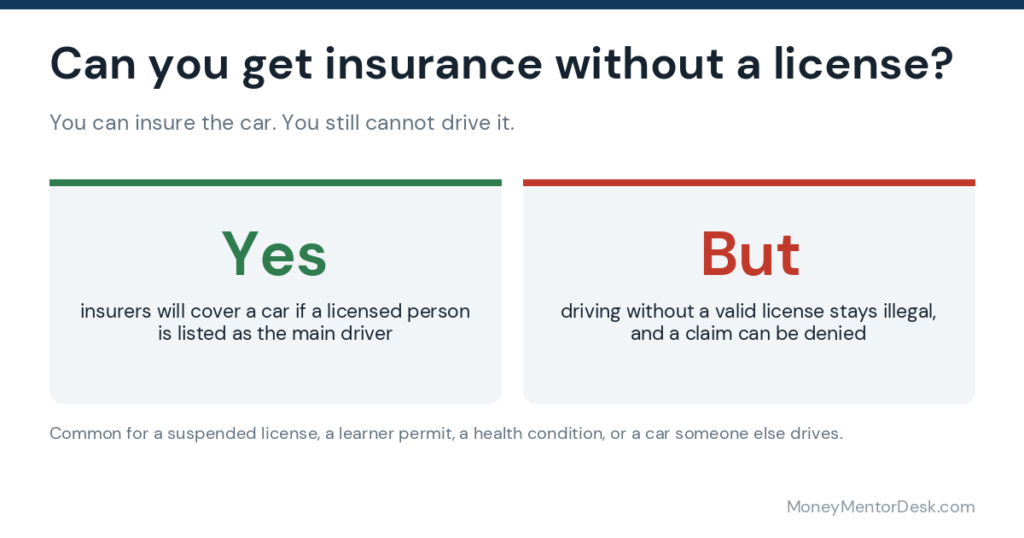
Buying one without a driver’s licence raises separate questions, covered in can you get car insurance without a license?.
FAQs
What is non-owner car insurance?
It is a policy for drivers who don’t own a car. It covers your liability for injuries and property damage you cause while driving a borrowed or rented vehicle. It follows you as a driver rather than a specific car, and by default it does not pay for damage to the car you were driving.
Does non-owner car insurance cover rental cars?
It covers your liability when you drive a rental. It usually does not cover damage to the rental car itself unless you’ve added optional physical damage coverage. Rental companies sell a collision damage waiver, which shifts collision damage liability to the rental company.
Can I get non-owner insurance if someone in my household owns a car?
It won’t cover that car. Policies exclude non-owned cars that are available for your regular use, and household cars usually are. Ask the owner to list you as a driver on their policy instead.
Does non-owner car insurance cover the car I’m driving?
Not by default. It pays for damage you cause to others. Damage to the borrowed car normally falls to the owner’s collision coverage, unless your non-owner policy includes optional physical damage coverage, which not every insurer offers.
Is non-owner insurance the same as an SR-22?
No. An SR-22 is a certificate your insurer files with the state to prove you have liability insurance. A non-owner, or operator’s, policy is one kind of insurance that SR-22 can certify when you don’t own a car.
What happens to my non-owner policy if I buy a car?
Move to a standard policy straight away. Under the standard ISO endorsement, cover for a newly acquired car lasts only fourteen days and ends once other insurance applies to it. If you have an SR-22, make sure the new filing is in place first.
How much does non-owner car insurance cost?
MoneyGeek’s analysis of 12,128 quotes found clean-record drivers pay around $578 a year, roughly $48 a month, for a minimum-coverage non-owner policy, with the cheapest company at $285 where available. Your record, state and liability limits change the price.
How do I get non-owner car insurance?
Check that you have no car of your own and no household car available for your regular use, choose your liability limits, then compare quotes from insurers that sell non-owner policies. Some may require a phone call or an agent. Ask for an SR-22 filing at the same time if you need one.
Is non-owner car insurance worth it?
It is worth it if you rent often, borrow cars outside your household, or need an SR-22 without owning a car. It usually isn’t worth it if you drive one particular car regularly, because that car should be insured by its owner with you listed as a driver.
Sources
- Insurance Information Institute: Rental car insurance, checked 21 September 2026
- California DMV, SR 104: Important facts about the Compulsory Financial Responsibility Law (REV. 1/2017), checked 21 September 2026
- Oregon DMV: SR-22 information, checked 21 September 2026
- Nevada Division of Insurance: sample Allstate Auto Insurance Policy AU127-1, checked 21 September 2026
- FC&S (PropertyCasualty360): Named Non-Owner Coverage PP 03 22 09 18 Analysis, checked 21 September 2026
- Wisconsin Office of the Commissioner of Insurance, PI-057: Consumer’s Guide to Auto Insurance (R 07/2025), checked 21 September 2026
- MoneyGeek: Cheapest non-owner car insurance (analysis of 12,128 quotes from 319 companies, Quadrant Information Services data), checked 22 September 2026
This guide is general information, not insurance or legal advice. Non-owner policies, SR-22 rules and filing periods vary by insurer and by state, so check the policy wording and your state’s DMV or department of insurance.
Written by Nimra Saleem for MoneyMentorDesk.com. Last reviewed on 21 September 2026 against the Insurance Information Institute, the California and Oregon DMVs, a sample policy published by the Nevada Division of Insurance, the FC&S analysis of ISO’s Named Non-Owner Coverage endorsement and the Wisconsin Office of the Commissioner of Insurance.