Part of our guide: PCP vs HP: Which Car Finance Is Better? UK Guide
PCP finance, short for Personal Contract Purchase, is a type of car finance where you pay a deposit and monthly instalments but leave a large final payment until the end of the deal. When the agreement ends, you choose whether to pay that final amount and keep the car, hand the car back, or use any equity towards your next car.
PCP is the most commonly held type of car finance in research carried out for the Financial Conduct Authority (FCA), and the appeal is simple: lower monthly payments. The trade-off is less obvious. You do not own the car, mileage limits apply, and keeping the car at the end can cost more than hire purchase. This guide shows how PCP works, what it really costs once interest is added, and your legal rights to end a deal early.
In short:
- The FCA describes PCP as a form of hire purchase with lower monthly instalments and a final balloon payment.
- The final payment is set at the start and guaranteed by the lender, so it does not change if used car prices fall.
- You do not own the car until everything has been paid, including the final payment.
- Going over your agreed mileage, or returning the car damaged, leads to extra charges.
- In our worked example, keeping a PCP car costs £1,433 more than the same deal on hire purchase.
What is PCP finance?
Personal Contract Purchase is a car finance agreement where the car’s expected value at the end of the deal is worked out on day one and set aside. According to the Finance & Leasing Association’s guide to PCP, PCP is “a variation of a Hire Purchase agreement”, and that deferred value is what keeps the monthly payments down.
Put simply, your monthly payments mainly cover the drop in the car’s value while you have it, plus interest. The rest of the price waits until the end, when you decide whether to pay it.
How does PCP finance work?
A PCP deal has three parts: a deposit at the start, fixed monthly payments during the term, and an optional final payment at the end. The final payment is agreed before you sign, so you always know the figure you would need to keep the car.
- You choose a car and agree the terms. This includes the length of the deal, a mileage allowance and the final payment.
- You pay a deposit. A bigger deposit means smaller monthly payments.
- You make monthly payments. These cover the car’s price minus the deposit and the final payment, plus interest.
- You choose what to do at the end. Pay the final amount and keep the car, hand it back, or use any equity towards another car.
A worked PCP example with interest
This example uses the same £25,000 car on PCP and on hire purchase, both over 48 months at 8% APR. The figures are illustrative, not a quote, and leave out any fees. If APR is new to you, our guide explains what APR means on a car loan.
| £25,000 car, £2,500 deposit, 48 months, 8% APR | PCP | Hire purchase |
|---|---|---|
| Final payment set aside | £10,000 | None |
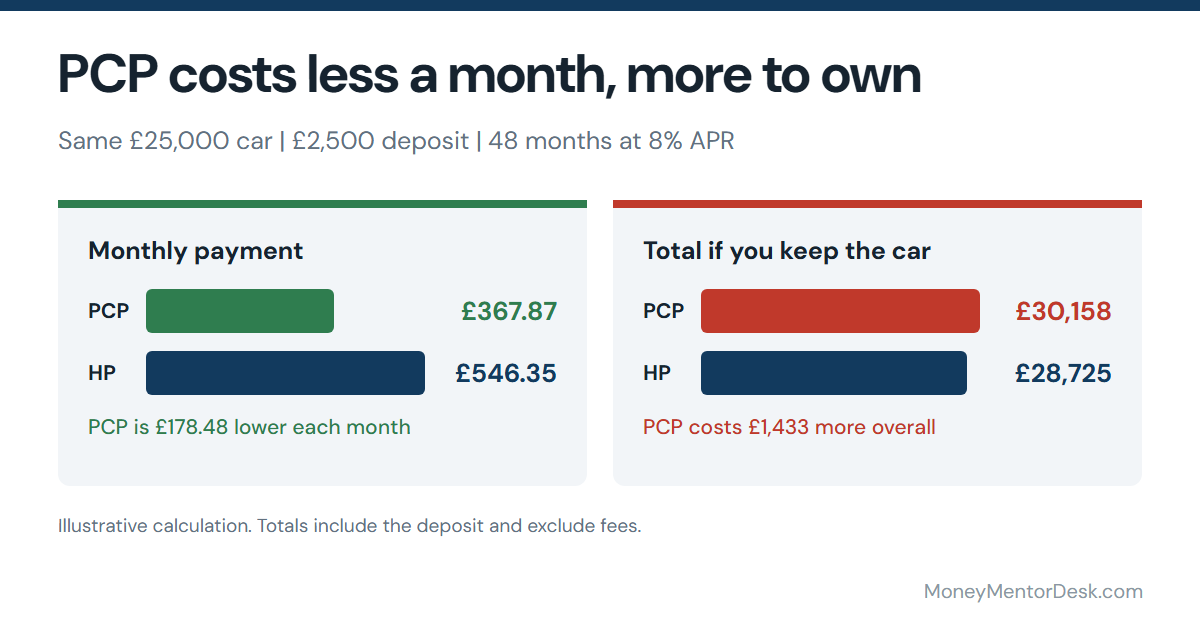
| Monthly payment | £367.87 | £546.35 |
| Total paid if you keep the car | £30,158 | £28,725 |
| Total paid if you hand it back | £20,158 | Not applicable |
PCP costs £178.48 less each month here, but keeping the car costs £1,433 more overall. The reason is that both deals borrow the same £22,500. On PCP you pay less of it off each month, so interest keeps building on the £10,000 you have not repaid. That is why the total cost matters more than the monthly figure.
PCP payment calculator
Change the numbers below to see an estimated PCP monthly payment next to hire purchase for the same car. The calculator starts with the example above. For more on comparing deals, see how to calculate the total cost of a car loan.
| Estimate | PCP | Hire purchase |
|---|---|---|
| Monthly payment | – | – |
| Total if you keep the car | – | – |
| Total if you hand it back | – | Not applicable |
Estimates only. Totals include the deposit and exclude fees, excess mileage and damage charges. APR is applied as an annual rate on the amount borrowed.
What is the balloon payment (GMFV) on PCP?
The balloon payment is the lump sum you pay at the end of a PCP deal if you want to own the car. The FLA says it is usually called the Guaranteed Minimum Future Value (GMFV) and is based on factors such as how old the car will be and how many miles it is expected to have covered by the end.
The word “guaranteed” matters. The FLA’s explanation of the GMFV says the future value “is guaranteed by the lender so will not fluctuate”. If the car turns out to be worth less than the GMFV, you can hand it back instead of paying the difference, although excess mileage or damage charges may still apply.
What happens at the end of a PCP agreement?
At the end of a PCP agreement you have three choices, set out by the FLA: pay the final amount and own the car, hand the car back and walk away, or trade it in. Which one makes sense usually depends on what the car is worth compared with the final payment.
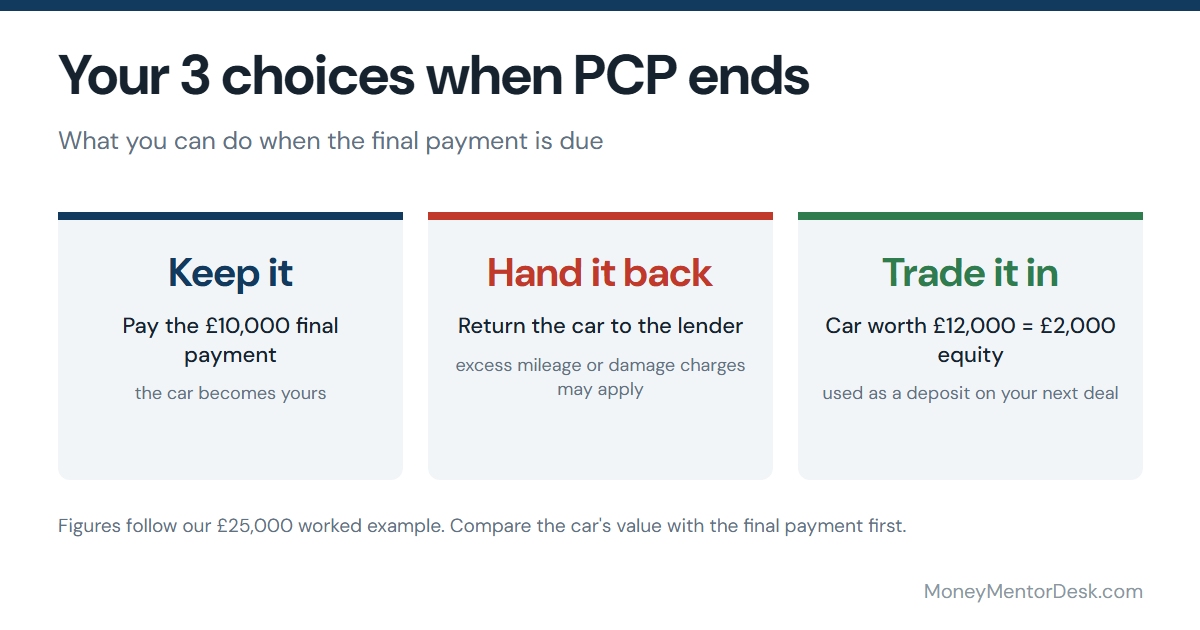
| Option | What you do | When it can suit you |
|---|---|---|
| Keep the car | Pay the final payment in full | You want to own it and can afford the lump sum |
| Hand it back | Return the car to the lender | The car is worth less than the final payment |
| Trade it in | Use any equity as a deposit on a new finance deal | The car is worth more than the final payment |
Equity is the gap between what the car is worth and the final payment. If a car is worth £12,000 at the end and the final payment is £10,000, there is £2,000 of equity you could put towards your next car.
How PCP compares with hire purchase (HP)
PCP and hire purchase are both ways of paying for a car in instalments, and in both cases the lender owns the car until you have paid everything. The main difference is the final payment: hire purchase spreads the whole price across your monthly payments, while PCP holds a large part back until the end.
| PCP | Hire purchase (HP) | |
|---|---|---|
| How the price is paid | Deposit, monthly payments, optional final payment | Deposit and monthly payments covering the full price |
| Monthly payments | Usually lower | Usually higher for the same car and term |
| Owning the car | Only if you pay the final payment | Yours at the end, usually after a small fee |
| Choices at the end | Keep it, hand it back or trade it in | The car becomes yours |
| Total cost if you keep the car | Can be higher (£30,158 in our example) | Can be lower (£28,725 in our example) |
| Ending early | Voluntary termination: up to half the total price | Voluntary termination: up to half the total price |
Which is better depends on whether you want to own the car at the end. Our full PCP vs HP comparison goes deeper, including a side-by-side cost breakdown and which buyers each option suits.
Do you own the car on PCP?
You do not own a car on PCP until every payment has been made. The FCA’s review of motor finance notes that for PCP and other hire purchase, customers do not own the goods until all sums have been paid, including any option-to-purchase fee.
Ownership also affects what happens if you fall behind. The FCA explains that the car can be repossessed without a court order if you default, unless you have already paid a third or more of the total amount payable. If you are struggling with payments, speak to your lender early rather than stopping payments.
What are the mileage and condition rules on PCP?
Every PCP deal has an agreed mileage allowance, and the car must come back in good condition if you hand it back. The FLA says going over the allowance means paying an excess mileage charge, and that any damage “will result in charges”.
Normal ageing is treated differently from damage. The BVRLA’s guidance on returning a vehicle describes fair wear and tear as deterioration caused by normal use. Dents from an impact or careless use are damage, not wear and tear.
- Pick a mileage allowance that matches how much you really drive.
- Check how the excess mileage charge is worked out in your agreement before you sign.
- Look over the car in good light a few weeks before it goes back, so you have time to fix any damage.
- Keep the service history up to date.
Can you end a PCP agreement early?
A PCP agreement can be ended early in two ways: by paying it off, or by handing the car back under a legal right called voluntary termination. Each works differently, so ask your lender for the figures before deciding.
Paying off PCP early (early settlement)
Section 94 of the Consumer Credit Act 1974 gives you the right to pay off a regulated credit agreement early, in full or in part. Once everything owed is paid, including any option-to-purchase fee, the car is yours. Ask your lender for a settlement figure first so you know the exact amount.
Handing the car back (voluntary termination)
Section 99 of the Consumer Credit Act 1974 lets you end a regulated hire purchase agreement at any time before the final payment falls due. Because PCP is a form of hire purchase, this right applies to PCP agreements set up that way.
Under section 100 of the Consumer Credit Act, you can be asked to pay up to half of the total price, minus what you have already paid and what is already due. If you have paid half or more, you normally owe nothing extra. You can still be charged if you have not taken reasonable care of the car.
Check that your agreement is described as a regulated hire purchase agreement. The right does not come from the name “PCP” on a brochure; it depends on the type of agreement you signed.
What are the advantages of PCP finance?
The main advantages of PCP finance are lower monthly payments and flexibility at the end of the deal. The FLA lists a low deposit at the start as another benefit.
- Monthly payments are usually lower than a comparable hire purchase deal over the same term.
- The final payment is fixed and guaranteed by the lender at the start.
- You get three choices at the end, including handing the car back.
- Any equity can go towards a deposit on your next car.
- You keep the legal right to end the agreement early under the Consumer Credit Act 1974.
What are the disadvantages of PCP finance?
The disadvantages of PCP finance mostly show up at the end of the agreement or when your plans change. Knowing them before you sign helps you avoid the costs that catch people out.
You do not own the car unless you pay the final payment
Years of monthly payments do not buy you the car on PCP. Ownership only passes once the final payment and any option-to-purchase fee are paid. If owning the car is the goal, hire purchase is built for that.
Keeping the car can cost more than hire purchase
PCP can be the more expensive route to ownership. The FLA warns that PCP “could work out more expensive overall than a Hire Purchase agreement for an equivalent car”. In our worked example, keeping the car cost £1,433 more on PCP because interest built up on the amount held back until the end.
A large lump sum is due at the end
The final payment can be a large sum: £10,000 in our example. If you want to keep the car but cannot pay it in cash, borrowing again to cover it adds more interest. The FLA says PCP becomes especially expensive when you take out a second finance agreement to pay the deferred value.
Mileage and damage charges
Excess mileage and damage charges apply when you hand a PCP car back. A change of job or a longer commute can push you over the allowance you agreed years earlier, and those charges are added at the end.
Ending early can mean topping up to half the total price
Voluntary termination is not free if you are early in the deal. The Consumer Credit Act’s definition of total price includes any sum payable on the exercise of an option to purchase. On a PCP set up as hire purchase, that normally means the final payment you would pay to keep the car is part of the figure used to work out half. You may need to pay extra to reach that point.
Older used cars may not be offered on PCP
PCP is less available for older, cheaper cars. In its motor finance review, the FCA found independent retailers mostly offered hire purchase because their used stock was typically older and lower priced, and so might be unsuitable or unavailable for PCP.
It is easy to focus on the monthly cost
Low monthly payments can hide the full cost. In the FCA’s September 2025 research, 61% of people with motor finance said they did not know the interest rate they were paying when first asked, and some had not fully considered downsides such as mileage limits or not owning the car without an extra payment.
How common is PCP finance in the UK?
PCP is the most commonly held type of car finance in recent FCA research. In that September 2025 study, 46% of people with motor finance held a PCP, compared with 31% on hire purchase, 16% with a personal loan and 7% on conditional sale.
The same research found new cars were more likely to be bought on PCP, and that the average deposit across all deals was close to 20% of the car’s list price.
Is PCP finance right for you?
PCP finance tends to suit drivers who like to change cars every few years, can predict their mileage, and want lower monthly payments. It suits you less if you want to own the car, drive a lot more than average, or would need to borrow again to cover the final payment.
Before you sign, compare the total amount payable, not just the monthly cost. Try your own numbers in the calculator above, then read our guide to PCP vs HP if you are still deciding.
PCP and car finance compensation claims
Car finance taken out between 6 April 2007 and 1 November 2024, where commission was paid to the broker, may be covered by the FCA’s motor finance redress scheme. The FCA estimates average redress of around £829 per eligible agreement.
The scheme has been partly paused. On 2 July 2026 the FCA confirmed that parts of the scheme were suspended following an Upper Tribunal decision, while firms must still follow the rules that were not suspended. Check the FCA’s page for the latest position before you act. This section reflects the FCA’s update as of 13 September 2026.
PCP finance FAQs
Can I sell a PCP car?
A PCP car is not yours to sell until the finance is paid off, because the lender owns it until then. To sell, ask your lender for a settlement figure and pay the agreement off first. If the car sells for less than you owe, you cover the gap, which is known as negative equity. Our pillar guide covers selling a car that is still on PCP or HP finance.
Do you have to pay the balloon payment on PCP?
The balloon payment on PCP is optional. You only pay it if you want to own the car at the end of the agreement. You can instead hand the car back or trade it in, although excess mileage or damage charges may apply if you return it.
What happens if I cannot afford the balloon payment?
Not being able to afford the balloon payment does not trap you. The FLA says you can hand the car back and walk away, or trade it in using any equity. Borrowing to pay the final amount is possible, but the FLA warns this can make PCP more expensive than hire purchase overall.
Is PCP a type of loan?
PCP is a credit agreement, but it is not a standard personal loan. The FCA describes PCP as a form of hire purchase, which means the lender owns the car until everything is paid, including the final payment if you choose to keep it.
Can you get PCP on a used car?
PCP on a used car is possible, but less common for older, cheaper vehicles. The FCA found retailers selling older, lower-priced used cars mostly offered hire purchase, as those cars might be unsuitable or unavailable for PCP. FCA research also found used cars were more likely to be bought with personal loans.
What happens if you go over the mileage on PCP?
Going over the agreed mileage on PCP usually means an excess mileage charge if you hand the car back. How it is calculated is set out in your agreement. The charge is linked to handing the car back, not to keeping it.
Can you hand back a PCP car early?
A PCP car can usually be handed back early if the agreement is a regulated hire purchase agreement. Voluntary termination under section 99 of the Consumer Credit Act 1974 lets you return the car before the final payment is due. You may need to top up your payments to half of the total price.
Does the final payment count towards the “half” rule?
The final payment is included when working out half the total price. Section 189 of the Consumer Credit Act 1974 defines total price to include any sum payable on the exercise of an option to purchase. On a PCP set up as hire purchase, the halfway point normally takes the final payment into account, not just the monthly payments.
What if my car is worth more than the GMFV?
A car worth more than its GMFV has equity. The FLA says you can use that equity as a deposit on a new finance agreement. You could also pay the final payment, keep the car and sell it yourself once it is yours.
Is PCP more expensive than hire purchase?
PCP can cost more than hire purchase overall if you keep the car. The FLA warns PCP could work out more expensive for the same car, especially if you take out a second finance agreement to pay the final payment. Compare the total amount payable on both quotes.
Written by Nimra Saleem for MoneyMentorDesk.com. Last reviewed on 13 September 2026 against the Financial Conduct Authority, the Finance & Leasing Association, the BVRLA and the Consumer Credit Act 1974 on legislation.gov.uk. The worked example and calculator are illustrations, not quotes. This article is general information for UK readers and is not financial advice. Check the terms of your own agreement or speak to your lender before making a decision.