Part of our guide: Motorcycle Courier Insurance 2026: Honest Costs & Best Cover
Borrowers who rolled an old car loan balance into a new one were more than twice as likely to have the vehicle assigned to repossession within two years. That is not a warning from a personal finance column — it is a finding from the Consumer Financial Protection Bureau’s auto finance data pilot, which examined more than 21 million loans originated between 2018 and 2022.
Negative equity is the gap behind that statistic, and it is worth understanding before you sit down at a dealership, not after.
What negative equity actually is
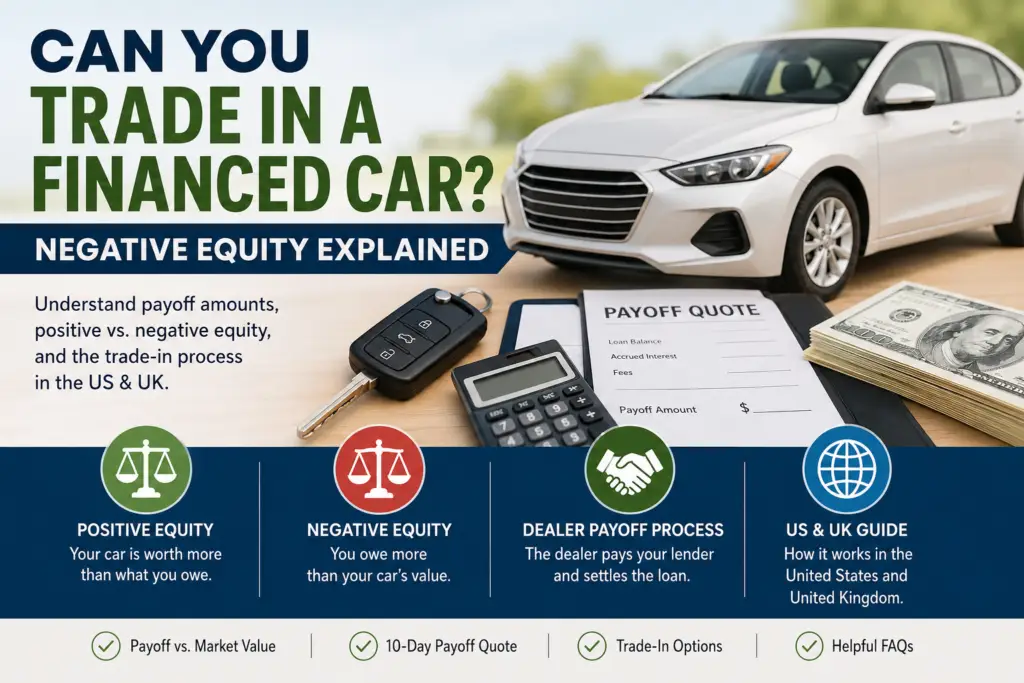
You have negative equity when the amount you still owe on your car loan is larger than what the car is currently worth. Lenders and dealers call it being “upside down” or “underwater” on the loan.
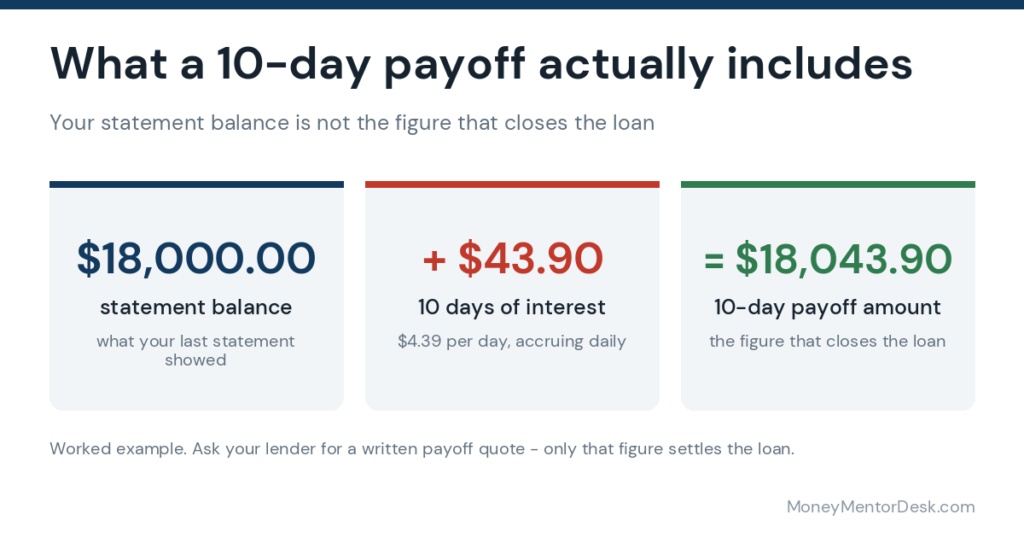
The arithmetic is simple. Ask your lender for your 10-day payoff amount — the exact figure needed to close the loan, including interest accrued to the payoff date. Then get a realistic sale or trade-in figure for the car. Subtract the second from the first. If a dealer offers $15,000 and your payoff quote is $18,000, you have $3,000 in negative equity, and that $3,000 does not disappear because you hand the keys over. It has to be paid by someone, and unless you pay it in cash, it gets added to your next loan.
Two things matter here that people routinely get wrong. Your payoff amount is not the same as the balance printed on your last statement — it includes per-diem interest, so it is usually a little higher — here is how per-diem interest is calculated. And the car’s value is whatever a buyer will actually pay this month, not what a valuation site estimated when you bought it.
The same car, two loan structures
Negative equity is rarely about the car. It is about how the loan was structured on the day it was signed. Here is a $34,000 vehicle financed two different ways.
Structure A — nothing down, 84 months, 9.5% APR. The payment is $555.70 a month, which looks manageable. The loan starts with no equity cushion at all, and because an 84-month term repays principal slowly, the balance falls more slowly than the car loses value. This borrower is underwater from the first month until month 52 — more than four years. The worst point comes around month 19, when the gap reaches roughly $3,410. Total interest over the full term: $12,678.
Structure B — 10% down ($3,400), 60 months, 7.5% APR. The payment is higher at $613.16 a month. But this borrower never goes underwater at any point in the loan, and pays $6,190 in total interest — less than half of Structure A.
Same car. Same day. A difference of about $57 a month in payment, and roughly $6,500 in total interest — plus four years of being unable to sell or trade without writing a cheque.
The chart below tracks Structure A. The red line is what you owe, the green line is what the car is worth, and the shaded band is the period when you owe more than the car could be sold for.
The same figures, year by year:
| Month | Loan balance | Car value | Equity |
|---|---|---|---|
| 0 | $34,000 | $34,000 | $0 |
| 12 | $30,408 | $27,200 | -$3,208 |
| 24 | $26,459 | $23,120 | -$3,339 |
| 36 | $22,119 | $19,652 | -$2,467 |
| 48 | $17,348 | $16,704 | -$643 |
| 60 | $12,103 | $14,199 | $2,096 |
| 72 | $6,338 | $12,069 | $5,731 |
| 84 | $0 | $10,258 | $10,258 |
Why the gap opens, and why it closes
Two curves are running against each other. A car loses value fastest in its first year and then more gradually. A loan repays principal slowest in its first years, because early payments are weighted towards interest. Negative equity is simply the space between those two curves.
That is why four things push borrowers underwater, and why they compound:
- A small or zero down payment. With nothing down you begin at exactly break-even, and the first month of depreciation puts you under.
- A long term. Stretching to 72 or 84 months lowers the monthly payment but slows principal repayment, holding the balance above the car’s value for longer.
- A higher APR. More of each early payment goes to interest, so the APR directly controls how fast the balance falls.
- Rolling in a previous gap. Starting a loan already owing more than the car is worth guarantees a longer underwater period than the car itself would cause.
The good news is that the gap closes on its own. Once the depreciation curve flattens and the principal portion of each payment grows, equity turns positive and keeps improving. Patience is a legitimate strategy.
How common negative equity is
The CFPB’s auto finance data pilot covers loans originated between 1 January 2018 and 31 December 2022. Across that dataset, 11.6% of all vehicle loans included negative equity rolled in from a previous loan. Another 32.1% involved a trade-in with positive equity, and 56.3% had no trade-in at all.
| Year of origination | Share of loans with negative equity rolled in |
|---|---|
| 2018 | 11.8% |
| 2019 | 13.3% |
| 2020 | 17.2% |
| 2021 | 10.9% |
| 2022 | 7.9% |
When negative equity was financed, the amounts were substantial: a mean of $5,073 on new vehicle transactions and $3,284 on used ones. The consequences showed up in the loan terms. For borrowers rolling in negative equity, the loan-to-value ratio at the 25th percentile was 107.7% — meaning even the better quarter of these loans started above the value of the car. For borrowers with no trade-in it was 87.7%, and for those with positive equity, 71.6%.
Payment-to-income ratios were higher too, ranging from 6.6% at the lowest quartile to 12.6% at the highest. And, as noted at the top, these borrowers were more than twice as likely to have the account assigned to repossession within two years than borrowers who traded in with positive equity.
What it costs to roll the gap into the next loan
Rolling negative equity forward is not automatically wrong, but the cost is easy to hide inside a monthly payment. Take a $28,000 replacement car financed over 72 months at 7.5% APR:
- Without a rollover: $484.12 a month, $6,857 total interest.
- With $3,000 of negative equity rolled in: $535.99 a month, $7,592 total interest.
The payment rises by about $52 a month — small enough to feel absorbable. But over the full term you repay the $3,000 and $735 of additional interest on it, for $3,735 in total. You have also started the new loan above the new car’s value, which restarts the cycle. Work out the total cost of the loan before agreeing, not the monthly figure.
Your four realistic options
1. Keep the car and pay it down. The cheapest option in almost every case. Extra payments applied to principal shorten the underwater period considerably. Confirm with your lender that additional payments are applied to principal rather than advancing your due date.
2. Sell privately and pay the difference. Private sale prices usually beat trade-in offers, which can shrink or erase the gap. You will need to settle the loan and arrange the title release with the lienholder, and you will need cash to cover any shortfall on the day.
3. Refinance — carefully. If your credit has improved or rates have fallen, refinancing to a lower APR speeds up principal repayment. The trap is extending the term to cut the payment, which usually deepens and lengthens the negative equity. Refinancing a car you are underwater on is also harder, because the loan-to-value ratio is above 100%.
4. Trade in and roll the gap over. Sometimes unavoidable — a growing family, a failing car, a longer commute. If you do it, know what lenders allow, keep the new term short, and treat the rolled-in amount as debt you are choosing to take on rather than a line item on a contract.
Where GAP insurance fits
Negative equity creates a specific risk that ordinary car insurance does not cover. If the car is written off or stolen, your insurer pays the vehicle’s actual cash value — what it was worth, not what you owe. If you owe $3,400 more than that, the difference is still yours to pay, on a car you no longer have.
Guaranteed asset protection covers that shortfall. It matters most in exactly the window the chart above shades red, and becomes unnecessary once you are comfortably in positive equity — at which point it may be cancellable for a partial refund. Our guide on whether GAP insurance is worth it covers the cost and cancellation rules.
Before you trade or sell: a checklist
- Request a written 10-day payoff quote from your lender, including per-diem interest.
- Get at least three valuations — two dealer offers and one realistic private sale figure.
- Subtract to find the actual gap. Write the number down.
- Compare total cost across all four options above, never monthly payments.
- Check your GAP status and whether a refund is due if you settle early.
- If rolling the gap forward, confirm the exact amount financed appears on the contract before you sign.
Frequently asked questions
How do I know if I have negative equity?
Get a written payoff quote from your lender and a current trade-in or private sale valuation. If the payoff figure is higher, the difference is your negative equity. Use the payoff quote rather than your statement balance — the two differ by accrued interest.
How long does negative equity usually last?
It depends entirely on the down payment, term and APR. In the 84-month example above, it lasts until month 52. On a 60-month loan with 10% down at a lower rate, it never occurs at all. Shorter terms and larger down payments shorten or eliminate the period.
Can I trade in a car with negative equity?
Usually yes. The dealer settles your existing loan and adds the shortfall to your new finance agreement, subject to the new lender approving the higher loan-to-value ratio. Approval is not guaranteed, and a larger down payment on the new car may be required.
Does negative equity affect my credit score?
Not directly — credit reports do not record the value of your car. It affects your credit indirectly, because a larger loan raises your payment and your risk of falling behind. The CFPB data links financed negative equity to a materially higher chance of repossession within two years, and a repossession does damage a credit file.
Is it ever sensible to roll negative equity into a new loan?
It can be, when the current car is unreliable or genuinely unsuitable and the gap is small relative to the new loan. It is a poor idea when the gap is large, the new term is long, or the decision is being driven by a monthly payment target rather than total cost.
Sources
- CFPB — Data Spotlight: Negative Equity Findings from the Auto Finance Data Pilot (share of loans, mean amounts, loan-to-value and repossession findings)
- CFPB — Negative Equity in Auto Lending (full report, June 2024, PDF)
- CFPB — Should I trade in my car if it is not paid off?
- CFPB — What is GAP insurance?
- FTC — Financing or Leasing a Car
Loan and depreciation figures in this article are worked examples calculated for illustration. Depreciation is modelled at 20% in the first year and 15% a year thereafter; actual depreciation varies by model, mileage and condition. Your lender’s payoff quote is the only figure that settles your loan.