
PCP vs HP comes down to a trade-off you can put an actual number on. On a £25,000 car at 9.9% APR over four years, PCP costs about £146 a month less than HP — and about £1,476 more by the time the car is yours. That is the whole decision in two figures. PCP keeps the monthly payment low by pushing a large optional final payment to the end, and you pay interest on that deferred lump the entire time. HP spreads the full price across the term, so the monthly cost is higher and the total is lower. Which one suits you depends on whether you actually intend to keep the car, and on something most comparisons never mention: your right to walk away mid-term is much harder to reach on a PCP.
PCP vs HP at a glance
| PCP (personal contract purchase) | HP (hire purchase) | |
|---|---|---|
| Monthly payment | Lower | Higher |
| Final payment | Large optional payment to own the car | None — the last monthly payment is the last payment |
| Who owns it at the end | You, only if you pay the final sum | You, automatically |
| Mileage limit | Yes, with charges for exceeding it | No |
| Condition charges | Yes, if you hand the car back | No |
| Voluntary termination point | Later — the balloon counts toward the total | Earlier |
| Total cost to own | Higher | Lower |
| Best for | Lower monthly cost, changing car every few years | Keeping the car, high mileage, lowest total cost |
The cost difference on a £25,000 car
Almost every PCP vs HP comparison you will read gives you the monthly figures and stops there. That is the half of the sum that makes PCP look good. Here is the other half.
Take the same car on both products: a £25,000 car, a £2,500 deposit, 48 months, 9.9% APR, and on the PCP an optional final payment of £8,500. Both agreements carry a £10 option-to-purchase fee.
| PCP | HP | |
|---|---|---|
| Deposit | £2,500.00 | £2,500.00 |
| Monthly payment | £418.70 | £565.03 |
| 48 monthly payments | £20,097.60 | £27,121.28 |
| Optional final payment | £8,500.00 | — |
| Option-to-purchase fee | £10.00 | £10.00 |
| Total price to own the car | £31,107.74 | £29,631.28 |
| Cost of credit | £6,107.74 | £4,631.28 |
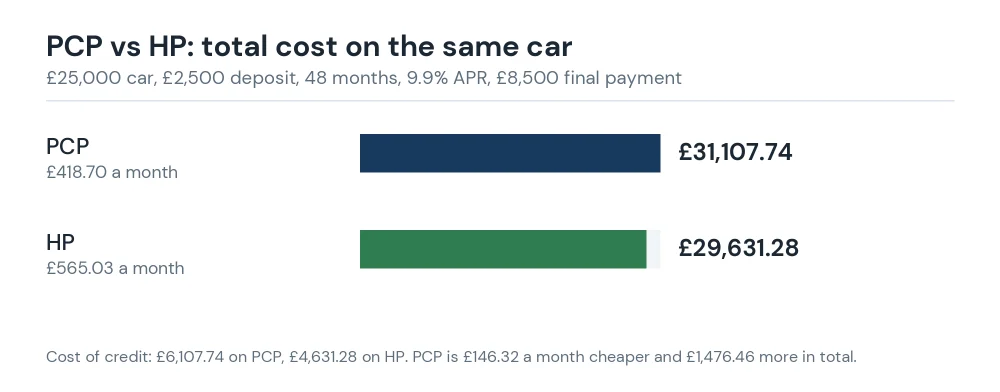
So the PCP saves you £146.32 every month — real money, and for many people the difference between affording the car and not. But if you go on to buy it, the PCP costs £1,476.46 more for exactly the same vehicle.
The reason is simple once you see it. On the HP, the balance you owe falls every month. On the PCP, £8,500 of the car’s value sits untouched until the very end, and you pay interest on it for all 48 months. You are renting that £8,500 for four years.
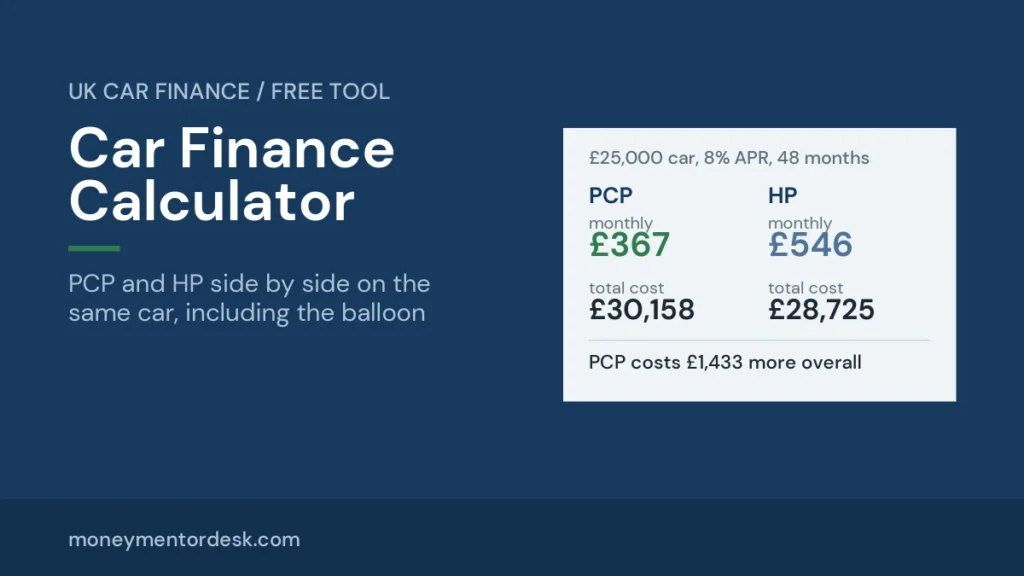
This is why “is PCP cheaper than HP” has two correct answers. Monthly, yes, and by a wide margin. In total, no. If you want to run the same comparison on the figures you have actually been quoted, our car finance calculator does both sides at once.
How PCP works, and what the balloon really costs
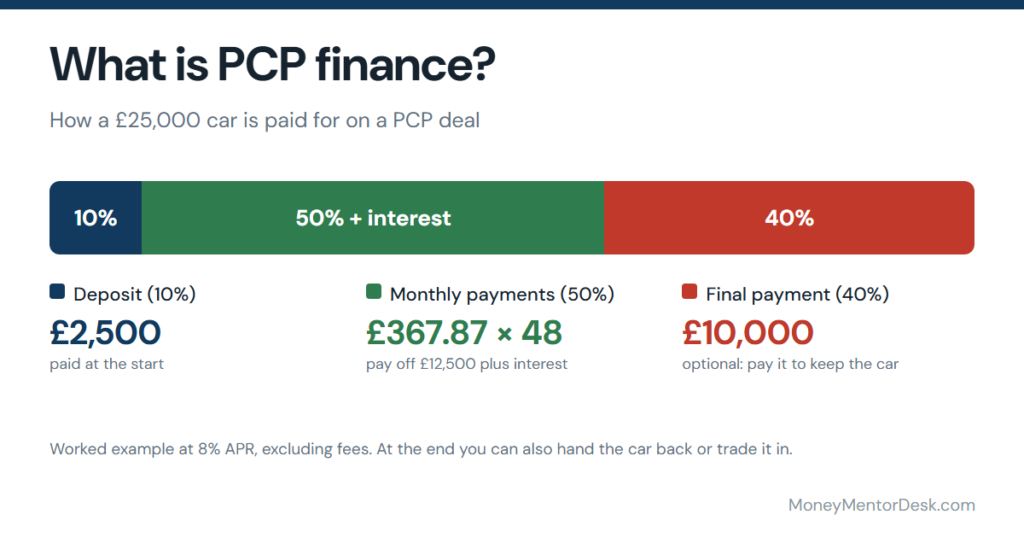
A PCP is a hire purchase agreement with most of the car’s value deferred to the end. The lender estimates what the car will be worth after your term and mileage — the guaranteed future value — and you finance only the gap between the price and that figure, plus interest on the whole amount.
At the end you have three choices. Pay the optional final payment and keep the car. Hand it back and walk away, subject to mileage and condition. Or part-exchange, using any equity above the final payment as a deposit on the next one.
That third option is how most PCPs end, and it is also how people end up in a cycle. Equity only exists if the car is worth more than the final payment. When used values fall, it is not, and you either find cash to cover the gap or start again with nothing down. There is more on how that final sum is set in our guide to the balloon payment on car finance, and the mechanics of the product itself in what PCP finance is.
How HP works, and when it is the cheaper deal
HP is the older and simpler product. You put down a deposit, make equal monthly payments across the term, and the car becomes yours when the final one clears. There is no balloon, no mileage cap and no condition inspection, because nobody is getting the car back.
One detail surprises people: you do not own the car during the agreement. The finance company does, right up to the last payment. That is what makes it hire purchase rather than a loan, and it is why you cannot sell the car mid-term without settling first.
HP is the cheaper choice whenever you intend to keep the car, and it is usually the only sensible choice if you drive a lot. A PCP with a 10,000-mile limit is not cheap at all once you are paying per mile over it.
Your legal rights are not the same on both
This is where PCP vs HP stops being a question about the monthly payment. Both products are regulated agreements under the Consumer Credit Act 1974, so the same sections apply to both. But because a PCP defers so much money to the end, the same rules bite at very different moments. This is the part no comparison seems to cover, and it matters more than the monthly figure.
Voluntary termination: the 50% point arrives much later on a PCP
Under section 99 you can end a regulated hire purchase or conditional sale agreement at any time before the final payment falls due. Hand the car back, walk away.
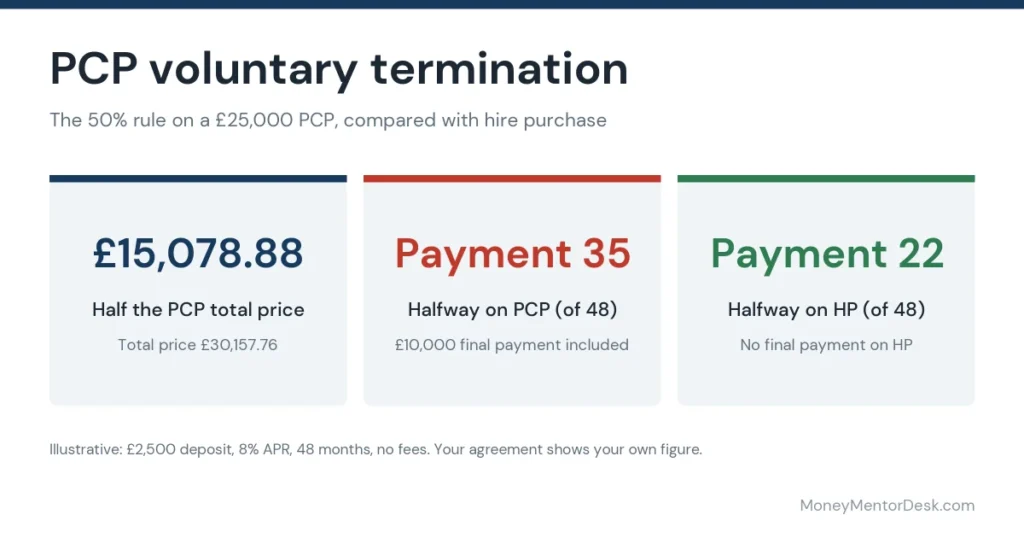
What it costs is set by section 100(1): you are liable for “the amount (if any) by which one-half of the total price exceeds the aggregate of the sums paid and the sums due” at termination. In plain terms, you must have paid half the total price. If you have not, you owe the shortfall.
Here is the part that catches PCP customers out. Section 189 defines “total price” as the total sum payable under the agreement, including any sum payable on the exercise of an option to purchase. On a PCP, that is the balloon. It counts toward the half you must reach, even though you may never intend to pay it.
Run it on the same £25,000 car:
| PCP | HP | |
|---|---|---|
| Total price | £31,107.74 | £29,631.28 |
| Half the total price | £15,553.87 | £14,815.64 |
| You reach it in | month 32 of 48 | month 22 of 48 |

Ten months later on the PCP, on the same car at the same rate. Two thirds of the way through the agreement rather than under halfway. You can still serve notice earlier on either — you simply have to make up the difference in cash, and on a PCP that difference is considerably larger.
Two caveats worth knowing. Section 100(3) lets a court substitute a smaller sum equal to the lender’s actual loss, and section 100(4) allows the figure to rise if you have not taken reasonable care of the car. Our step-by-step guide to PCP voluntary termination covers the notice and handover.
Protected goods: when they need a court order
Under section 90, once you have paid one-third or more of the total price, the car becomes “protected goods”. If you then fall into arrears, the lender cannot repossess it without a court order.
The same deferral shifts this too. On our figures, the HP reaches one-third in month 14. The PCP does not reach it until month 19. For five months in the middle of the agreement, the HP customer has a protection the PCP customer does not.
Settling early
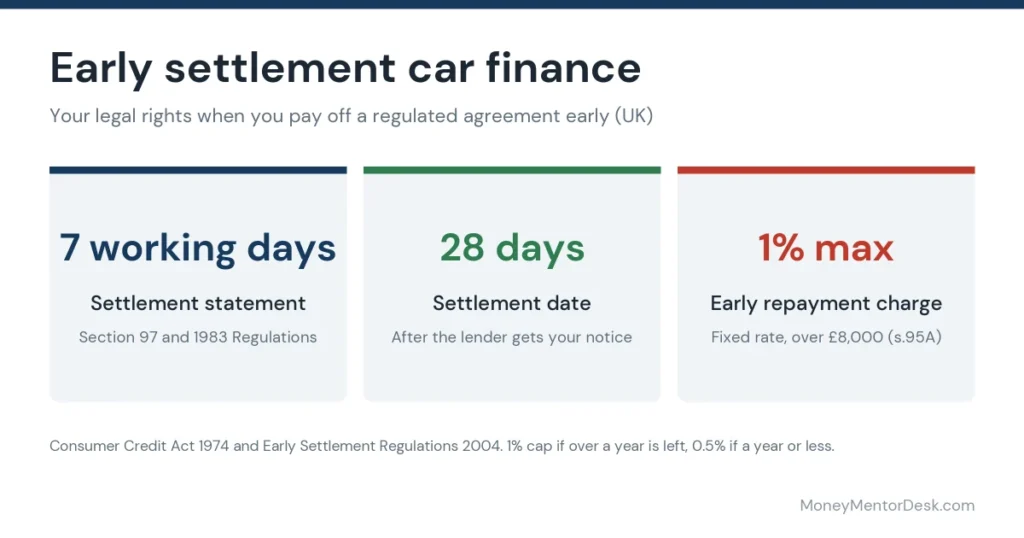
On both products section 94 gives you the right to settle early at any time, and section 95 entitles you to a rebate on the interest you have not yet run up. Ask for a settlement figure in writing. On a PCP it will include the balloon, so it is usually a much larger number than people expect. See early settlement on car finance for how the figure is built.
You also have 14 days to withdraw from either agreement under section 66A, repaying the credit plus interest for the days you had it.
Mileage, condition and the charges people miss
These apply to PCP only, and only if you hand the car back. Pay the final payment and none of them matter.
- Excess mileage. Your agreement sets an annual limit and a pence-per-mile charge over it. Going 5,000 miles over at 10p a mile is £500. At 20p it is £1,000. Check the rate before you sign, not after.
- Fair wear and tear. You are allowed normal use. You are not allowed damage. The industry standard is the BVRLA fair wear and tear guide, and an inspector will measure kerbed alloys and scratches against it.
- Servicing. A missed service history can reduce what the car is worth and show up as a charge.
- Negative equity. If the car is worth less than the final payment, part-exchanging means carrying that gap into the next agreement. Our guide to selling a financed car covers how that unwinds.
PCP vs HP vs leasing: the three-way comparison
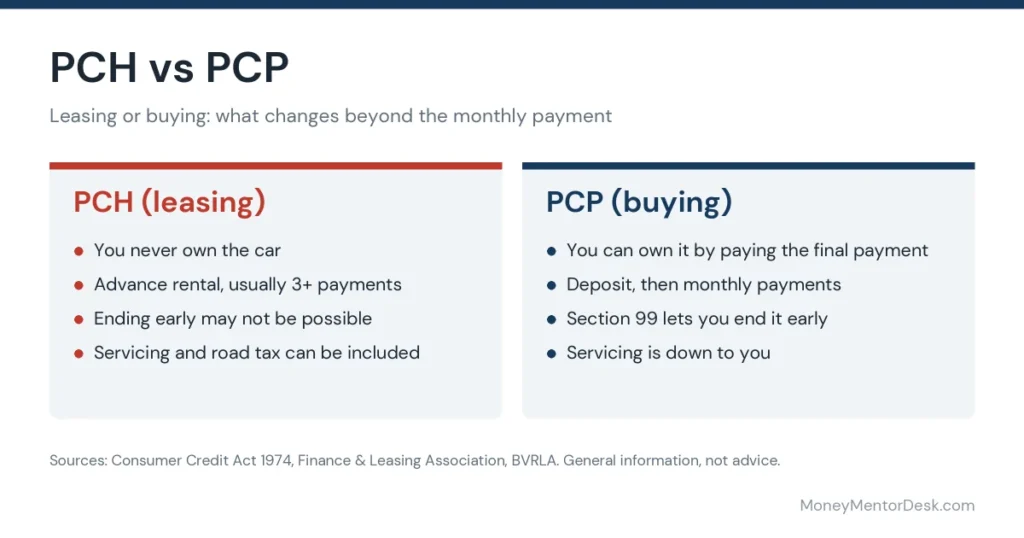
Personal contract hire — leasing — is the third option people weigh alongside PCP vs HP, and it is a genuinely different product rather than a variation. You are renting the car for a fixed term. There is no option to buy it at any point.
| PCP | HP | PCH (leasing) | |
|---|---|---|---|
| Can you own it? | Yes, by paying the final sum | Yes, automatically | No, ever |
| Monthly cost | Lower | Highest | Usually lowest |
| Mileage limit | Yes | No | Yes |
| Condition charges | If handed back | No | Always |
| Early exit right | s.99 voluntary termination | s.99 voluntary termination | Usually none — it is not a credit sale |
| Up-front payment | Deposit | Deposit | Initial rental, often 3–9 months |
That early exit row is the one to look at. Because a lease is not a hire purchase or conditional sale agreement, the section 99 right to terminate does not apply to it in the way it does to the other two. Leaving a lease early usually means paying a chunk of the remaining rentals. There is a fuller breakdown in PCH vs PCP, and all five UK products side by side in types of car finance in the UK.
What about conditional sale?
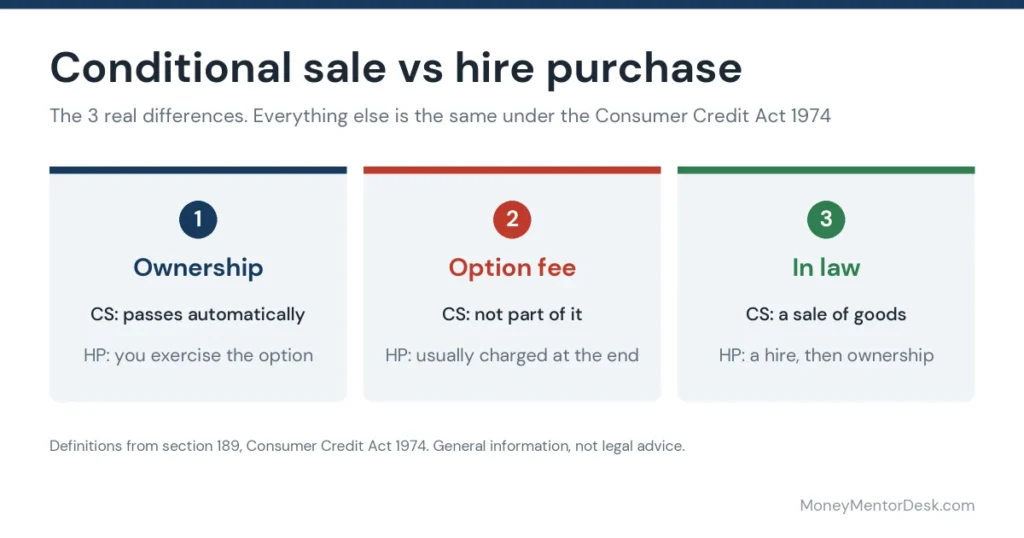
Conditional sale (CS) sits very close to HP — equal payments, ownership at the end, no balloon — with one difference: on CS you are contracted to buy from the outset rather than holding an option. It changes very little in practice but it is not identical.
Rather than repeat it here, we cover it properly in two places: conditional sale vs hire purchase for the CS and HP comparison, and PCP vs CS if you are weighing it against a PCP.
Which should you choose?
Comparisons that end on “it depends” are not much use, so here is a straight answer to the PCP vs HP question.
- Choose HP if you intend to keep the car. It is cheaper in total, there is no mileage cap, no condition inspection, and your legal protections arrive earlier. On our figures it saves £1,476 and gets you to voluntary termination rights ten months sooner.
- Choose HP if you drive a lot. Any PCP saving disappears the moment you pay excess mileage.
- Choose PCP if you change car every three or four years anyway and were never going to pay the final sum. You are only paying for the depreciation you use, and the lower monthly cost is real.
- Choose PCP if the HP monthly payment is genuinely out of reach — but go in knowing the higher total, and knowing you are further from being able to hand the car back.
- Consider leasing if you are certain you never want to own it and your mileage is predictable.
Whichever way the PCP vs HP decision falls for you, compare the total amount payable on the two quotes rather than the monthly figure. That single habit is worth more than any rule of thumb.
This article is general information about how these agreements work, not financial advice or a recommendation of any product. Figures are worked illustrations, not quotes. Check your own agreement and speak to a qualified adviser before deciding.
PCP vs HP: frequently asked questions
Is PCP cheaper than HP?
Monthly, yes. In total, no. On a u00a325,000 car at 9.9% APR over 48 months, PCP costs about u00a3418.70 a month against u00a3565.03 on HP u2014 a saving of u00a3146.32. But the total price to own the car is u00a331,107.74 on PCP against u00a329,631.28 on HP, so the PCP costs u00a31,476.46 more. You pay interest on the deferred final payment for the whole term.
Is PCP better than HP?
Neither is better outright. HP is cheaper in total, has no mileage limit and gets you to your voluntary termination rights sooner, so it suits anyone keeping the car or driving a lot. PCP has a lower monthly cost and suits people who change car every few years and were never going to pay the final sum.
Do you own the car on HP finance?
Not during the agreement. The finance company owns it until the final payment clears, which is why you cannot sell it mid-term without settling first. Ownership passes to you automatically once the last payment is made u2014 there is no separate decision to take, unlike a PCP.
Can you modify a car on PCP?
Generally no, not in any way that cannot be reversed. You do not own the car and it has to be returned in a condition that matches the fair wear and tear standard. Permanent modifications can reduce the value and show up as a charge at handback. On HP you can modify it freely once the agreement ends and the car is yours.
Is PCP or HP better with bad credit?
Neither is automatically easier to get. Both are regulated credit agreements and both involve a full affordability check. A larger deposit helps on either. HP is sometimes more achievable on an older or cheaper car, because PCP deals concentrate on newer vehicles where a future value can be predicted.
What happens if I go over my PCP mileage?
You pay an excess mileage charge set out in your agreement, usually a few pence per mile. At 10p a mile, going 5,000 miles over costs u00a3500; at 20p it is u00a31,000. It only applies if you hand the car back. If you pay the optional final payment and keep it, the mileage limit stops mattering.
Can I switch from PCP to HP partway through?
Not directly. You would settle the PCP and take out a new agreement, which means asking for a settlement figure under section 94 of the Consumer Credit Act. On a PCP that figure includes the balloon, so it is usually larger than people expect, and whether it is worth doing depends on the rate you are offered on the new deal.
Sources
- Consumer Credit Act 1974, s.66A — right of withdrawal
- s.90 — protected goods, one-third of the total price
- s.94 and s.95 — early settlement and rebate
- s.99 and s.100 — voluntary termination and the half-of-total-price liability
- s.189 — definition of “total price”, including any option-to-purchase sum
- Consumer Rights Act 2015, s.3 — contracts covered
Pingback: Car Finance Calculator UK: PCP vs HP Side by Side
Pingback: PCP vs CS: Conditional Sale or PCP? 4 Key Differences
Pingback: Negative Equity Car Finance: 6 Ways Out (UK Guide)
Pingback: Types of Car Finance UK: 5 Options Compared
Pingback: Balloon Payment Car Finance: 5 Options at the End
Pingback: What Is PCP Finance? How PCP Car Finance Works (UK)