Part of our guide: Motorcycle Courier Insurance 2026: Honest Costs & Best Cover
Can You Sell a Financed Car? Yes, you can sell a financed car. What you cannot do is hand over ownership while the lender’s lien is still attached to the title. The loan does not transfer to the buyer and it does not disappear at the sale — it has to be paid off, and the lien has to be released, before the title can legally change hands.
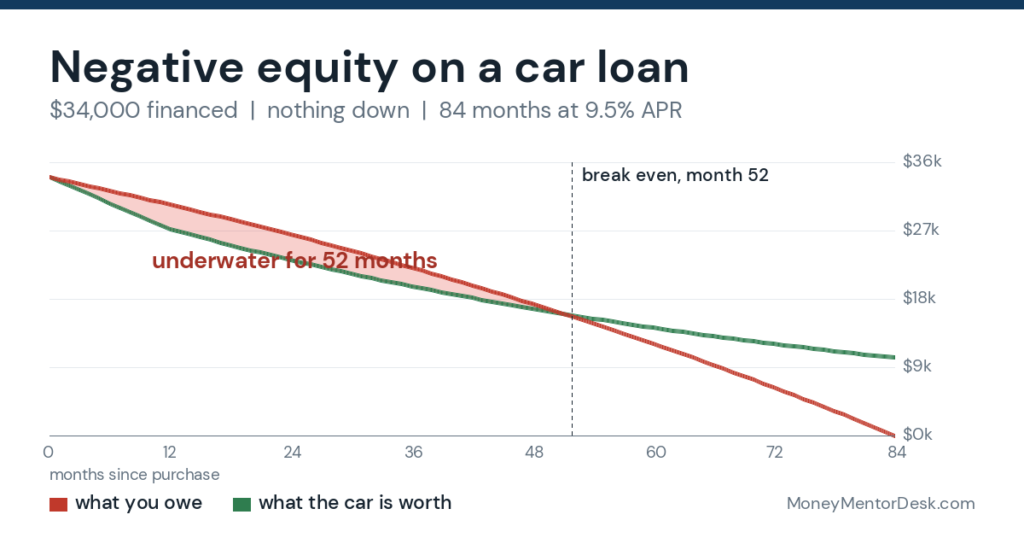
Three numbers decide how your sale goes: your payoff amount (what the lender needs to close the loan), your car’s market value, and the gap between them. If the car is worth more than the payoff, you keep the difference. If it is worth less, you have negative equity and you will need to cover the shortfall before the sale can complete.
This guide walks through both situations, step by step.
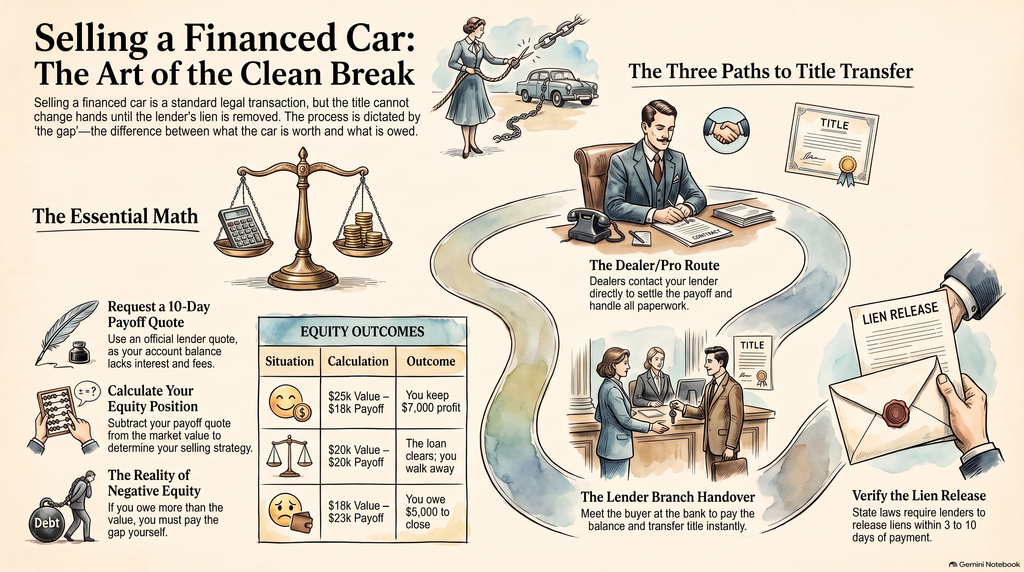
Key takeaways
- You can sell a financed car, but the lien must be released before the title transfers.
- Your payoff amount is not the same as the balance shown in your account — the CFPB confirms it includes interest through your payoff date plus any unpaid fees.
- Car value minus payoff equals your equity position. That single subtraction determines your options.
- With negative equity you must cover the gap in cash or roll it into another loan. The FTC warns about how dealers handle this.
- Lien-release deadlines are set by state law — Texas gives lienholders 10 days; New York gives 3 business days.
Can You Sell a Car That Is Still Being Financed?
Yes. Selling a financed car is a normal, legal transaction that lenders handle every day. What changes is the order of operations: the lender gets paid first, the lien comes off, and only then does the buyer get a clean title.
Two things’ people get wrong:
The loan does not go with the car. It is your debt, not the vehicle’s. Selling does not transfer it to the buyer.
You usually cannot hand over the title on the day of sale. Your lender holds the lien, and in many states holds the physical title too. New York’s Department of Financial Services states plainly that a lien release “is required in order to transfer ownership of a vehicle.”
The sequence looks like this:
1. Get your payoff amount from the lender
↓
2. Find out what the car is actually worth
↓
3. Subtract: value − payoff = your equity
↓
4. Choose your selling route
↓
5. Lender gets paid → lien released → title transfers
How to Sell a Financed Car, Step by Step
1. Get your 10-day payoff quote from your lender
A payoff quote is a document from your lender stating exactly what it takes to close the loan completely as of a specific future date. You need it before you can price anything, because the number in your online account is not it.
GM Financial explains the difference directly: “Interest charges, fees or other charges applied to your account could create a difference in the two balances. Your payoff balance is ultimately what you owe on your account.”
Three fields on that letter matter:
- The payoff amount — the full figure, including interest and any unpaid fees. The CFPB confirms a payoff amount includes interest due through your intended payoff date plus “other fees you have been charged and have not yet paid.”
- The good-through date — the date the quoted figure expires. Toyota Financial Services, for example, states its payoff quote is “good for 10 days from the date it is provided,” while warning the amount can still change if returned payments or fees post afterward.
- The per diem — the interest that accrues each day after that date. If your sale slips a week, this tells you what it costs.
Most large lenders issue the quote instantly online. → How to request a 10-day payoff letter walks through the request at each major lender, and What is a 10-day payoff? explains the document in full.
One check before you go further: confirm your loan has no prepayment penalty. Most mainstream lenders do not charge one — Chase states there is “no pre-payment penalty” on its auto loans — but the CFPB is direct about the general rule: “Your contract and state law will determine whether you can pay off your auto loan early.”
2. Find out what your car is worth
You need a market value, not a guess. Use more than one source, because they disagree.
- Valuation guides — Kelley Blue Book and Edmunds give private-party and trade-in ranges. Private-party values are normally higher for the same car.
- Real cash offers — CarMax and similar buyers give you an actual offer, usually valid for a set number of days. Even if you do not sell to them, it is a real number rather than an estimate.
- Local listings — search comparable year, mileage, trim and condition in your area.
Treat the lowest as your floor and the highest as optimistic. Condition, mileage and accident history all move the number.
3. Compare your car’s value with your payoff
One subtraction decides everything:
Car value − Loan payoff = Your equity position
The three outcomes:
| Situation | Example | What it means |
| Positive equity | Car worth $25,000, payoff $18,000 | The sale clears the loan and you keep $7,000 |
| Break-even | Car worth $20,000, payoff $20,000 | The sale clears the loan. You walk away even |
| Negative equity | Car worth $18,000, payoff $23,000 | You must find $5,000 to close the loan |
Figures are worked examples for illustration, not market data.
Positive equity makes this an ordinary sale. Negative equity changes your options, and the rest of this guide deals with it. → What is negative equity on a car loan?
Can You Sell a Financed Car If You Owe More Than It Is Worth?
Yes, but the gap has to be paid by someone, and that someone is you. Capital One puts it plainly: “Negative equity means your vehicle’s value isn’t high enough to pay off your outstanding loan balance,” and in that case you “either need to pay off the remaining loan balance out of pocket or roll that amount into a new loan.”
There is no third door. Here are your realistic routes.
Pay the difference yourself
The cleanest option. You bring cash to close the gap.
Loan payoff: $25,000
Sale price: $20,000
─────────────────────────
You pay: $5,000
Worked example.
The loan closes, the lien releases, the title transfers, and nothing follows you into your next purchase. If you have the money, this is the least expensive path in total cost.
Sell to a dealer or an online buyer
These buyers handle the lender contact themselves, which removes the hardest part of the transaction.
CarMax, for example, states that if you still owe on the car it needs “your lien holder’s name and contact information” plus your lien account number, and that “we’ll contact your lender or lien holder to facilitate a payoff.” You supply account details; they deal with the lender.
| Route | Advantage | Trade-off |
| Franchise dealer | Handles payoff and paperwork; can roll negative equity into a purchase | Offer usually below private-party value |
| Online buyer (CarMax and similar) | Fast, fixed offer; contacts your lender directly | Offer usually below private-party value |
| Private sale | Typically the highest price | You coordinate the lien release yourself |
| Licensed-dealer intermediary | Pays the lender and handles the title for a private sale | Charges a fee; adds a third party to the deal |
On that last row: a small category of licensed intermediaries exists to solve the private-sale lien problem. KeySavvy, for example, describes itself as “a licensed dealership, so we can pay your lender directly and sign the title over to your buyer,” charging $99 per party plus $99 extra for a seller with a loan. That is one company’s description of its own service, not a recommendation — compare fees and check licensing first.
Roll the negative equity into another loan
A dealer can fold your shortfall into the financing on your next car. It solves today’s problem and creates tomorrow’s.
The FTC describes the mechanism: “some dealers just roll over the negative equity into your new car loan, so you still end up paying it.” You start the new loan already upside down, on a car that will itself depreciate.
The FTC also flags a specific abuse: if a dealer promises to pay off your negative equity but actually rolls it into your new loan instead, that is illegal conduct and should be reported. Read the contract disclosures — the FTC’s advice is to “look for details about the downpayment and the amount financed on the installment contract.”
Selling Privately vs Trading It In
| Private sale | Trade-in | |
| Price | Usually higher | Usually lower |
| Effort | Listing, showings, paperwork | One appointment |
| Who handles the payoff | You and the buyer coordinate with the lender | The dealer handles it |
| Negative equity | You must cover the gap to close | Can be rolled into the new loan |
| Speed | Weeks | Days |
| Title risk | You manage the lien release | Dealer manages it |
The honest trade-off: a private sale usually puts more money in your pocket, and a trade-in is far less work. With negative equity the calculation shifts, because a dealer can absorb the gap into new financing while a private buyer cannot. That convenience is not free — you pay for it in the rolled-over debt.
→ Can you trade in a financed car? covers the trade-in route in detail.
How Does the Loan Actually Get Paid Off When You Sell?
The buyer’s money goes to the lender first. Only what is left goes to you.
Buyer pays: $22,000
Lender payoff: − $18,500
─────────────────────────────────
To the seller: $3,500
Worked example.
How the money reaches the lender depends on the route:
Through a dealer or online buyer. They send the payoff directly to your lender and pay you any surplus. This is the simplest path.
Through your lender’s branch. Capital One describes this for bank and credit union loans: “the lender might have you bring the buyer into your local branch to pay off the loan balance (either in cash or with financing of their own).” The lender takes payment, releases the lien, and the title paperwork happens on the spot. For a private sale, this is the safest arrangement for both sides.
Directly by you. You pay the loan off first, wait for the lien release and title, then sell. Cleanest for the buyer, but it requires you to have the money up front.
After the payoff clears
- The lien is released. Deadlines are set by state law, not lender preference. Texas DMV states that “after the lien on a vehicle is paid off, the lienholder has 10 days after receipt of payment to release the lien.” New York’s DFS gives lenders 3 business days to provide the release and notify the DMV. Look up your own state’s rule — it is your leverage if a lender stalls.
- The title is issued or updated. In paper-title states the lienholder mails it. In electronic-title states the DMV handles it. Chase notes it mails the title or lien release to the address on your billing statements — and flags that in Florida the state does not automatically issue a lien-free title when an electronic lien releases, so you must contact the Florida DMV yourself. GM Financial confirms the general rule that release processes “vary by state.”
- Confirm the loan reads zero. Capital One advises reviewing your credit reports to confirm the loan shows a zero balance within 30 to 60 days.
What If You Cannot Pay Off the Loan Before Selling?
If the gap is more than you can cover right now, these are the choices. Which one fits depends on your numbers and your situation.
- Wait and build equity. Every payment cuts principal while depreciation slows with age. On many loans the gap closes on its own within a year or two. Doing nothing is a legitimate option.
- Make extra principal payments. Shrinking the payoff shrinks the gap. Confirm your lender applies extra payments to principal rather than holding them as a future payment.
- Refinance. A lower rate can reduce what you owe over time, though it does not erase negative equity by itself. → When to refinance a car loan and when to wait
- Trade in and roll the gap. Solves today’s problem, carries the debt forward. See the FTC warning above.
Which route fits depends on the size of the gap, how long you plan to keep driving, and whether you can absorb the cost now or later.
Can You Sell a Financed Car Without Paying It Off?
No — the loan has to be satisfied before the lien comes off and the title transfers. What varies is when in the transaction that happens and who does it.
The practical exceptions people mean when they ask this:
- The buyer’s money pays it off. You never pay out of pocket; the sale proceeds clear the loan at closing. This is the normal case with positive equity.
- A dealer or online buyer pays it off. They settle with your lender as part of the purchase.
- A licensed intermediary pays it off. The dealer-intermediary route described above.
- The buyer finances through your lender’s branch. Capital One’s branch method — the buyer’s own financing pays your loan at the counter.
What you cannot do is transfer the car and leave the loan in your name with the lien attached. That is not a legal sale, and no legitimate buyer will accept it.
Documents You Need to Sell a Financed Car
- Payoff quote from your lender, with a good-through date covering your expected closing date
- Loan account number and the lienholder’s name and contact details — CarMax specifically requires both
- Title or lien information — whoever holds the title
- Current registration
- Valid photo identification
- Bill of sale — required in some states, sensible everywhere
- Odometer disclosure — required on most transfers
- Lien release letter once the loan is paid
Requirements vary by state. Check your own DMV before the sale rather than after.
Common Mistakes When Selling a Financed Car
Pricing the car before getting the payoff figure. People use their account balance, find the real payoff is higher, then have to renegotiate or find cash late.
Letting the payoff quote expire. The good-through date is a hard deadline. Miss it and a small balance remains, the loan stays open, and the lien stays on. If the sale will take three weeks, do not request a ten-day quote.
Treating rolled-over negative equity as solved. It is deferred, not erased — and you start the next car upside down from day one.
Not confirming the lien release. Get written confirmation the loan is paid in full, then verify with your state DMV that the lien is actually cleared.
Cancelling autopay too early. If the payoff falls a few dollars short and autopay is off, the account goes delinquent on a loan you believed was closed.
Forgetting refunds you are owed. Prorated GAP and warranty refunds are usually not automatic — you have to ask. → Is GAP insurance worth it?
Frequently Asked Questions
Can I sell a financed car if I still owe money?
Yes. Selling a car with an outstanding loan is routine. The lender must be paid and the lien released before the title can transfer to the buyer. If the sale price covers your payoff, the loan clears at closing and you keep the difference.
Can I sell my car if I owe more than it is worth?
Yes, but you must cover the shortfall. Capital One states that with negative equity you “either need to pay off the remaining loan balance out of pocket or roll that amount into a new loan.” Paying cash costs less overall; rolling it forward carries the debt into your next car.
How do I sell a financed car privately?
Get a payoff quote, agree a price, then arrange payment through your lender so the loan clears and the lien releases as part of the sale. Capital One notes some lenders have you bring the buyer into a branch to complete the payoff directly.
Does selling a financed car hurt my credit?
Selling itself does not. Paying the loan off closes an installment account, which can cause a small temporary score dip by reducing your credit mix. That is normal. Missing payments during the process, or leaving a residual balance unpaid, is what causes real damage.
Can a dealership pay off my car loan?
Yes. Dealers and online buyers routinely contact your lender and settle the payoff as part of the purchase. CarMax states it needs your lienholder’s name and contact information plus your lien account number, and that it will “contact your lender or lien holder to facilitate a payoff.”
How long does a lender take to release a lien?
It depends on your state. Texas DMV states the lienholder has 10 days after receiving payment to release the lien. New York’s Department of Financial Services gives lenders 3 business days to provide the release and notify the DMV. Check your own state’s deadline.
What happens if my payoff quote expires before the sale closes?
Interest keeps accruing at the per diem rate, so your payment falls short by a small amount and the loan stays open. Call your lender for the current figure, pay the difference the same day, and get written confirmation the account is paid in full.
Sources
- CFPB — What is a payoff amount and is it the same as my current balance?
- CFPB — Can I prepay my loan at any time without penalty?
- FTC — Auto Trade-Ins and Negative Equity
- Texas DMV — Add or Remove a Lien on a Vehicle
- New York State DFS — How to obtain a lien release on a vehicle
- Capital One — How to Sell a Financed Car You Still Owe Money On
- Capital One — Paying your previous auto lender
- CarMax — How to Sell Your Car to CarMax
- Chase Auto — Loan payoff FAQs
- Toyota Financial Services — Payoff information
- GM Financial — I paid off my car, now what?
Written by Nimra Saleem for MoneyMentorDesk.com. Reviewed against CFPB, FTC, Texas DMV, New York DFS, and official documentation from Capital One, Chase, CarMax, Toyota Financial Services and GM Financial. Lender processes and state rules were verified in September 2026 and can change — confirm with your own lender and state DMV. This article is educational only and is not financial advice.