
Part of our guide: PCP vs HP: 5 Differences and a Worked Cost Example (UK)
Two years into a four-year PCP deal, your job changes and the monthly payment stops fitting your budget. You may not have to keep the car until the end of the deal. PCP voluntary termination is a right under section 99 of the Consumer Credit Act 1974. It lets you end a regulated hire purchase or conditional sale agreement early, including a PCP set up that way, and hand the car back before the final payment is due. If you’ve paid less than half the total price, you may need to top up to half, plus any arrears and charges for not taking reasonable care of the car.
This guide covers:
- how the half rule works when your deal has a large final (balloon) payment
- the steps to take
- what a lender can still charge
- what to do if a lender says no
If you’re new to PCP, start with what PCP finance is and how it works.
What is PCP voluntary termination?
Voluntary termination is your legal right to end a regulated hire purchase or conditional sale agreement by giving notice to the lender, then returning the car. Section 100 of the Consumer Credit Act limits what you owe. You can use it at any time before the final payment under the agreement falls due.
Agreements it covers
- Regulated hire purchase and regulated conditional sale agreements (section 99(1)).
- A PCP deal, if it’s set up as one of these. Go by what your agreement says, not by the product name.
- For agreements covered by the Consumer Credit (Agreements) Regulations 2010, look for a section headed “Termination: Your rights”. It must tell you that you can end the agreement and state the amount involved: normally half the total amount payable, or less if your agreement allows a smaller payment. If you can’t find it, ask your lender.
Where it doesn’t apply
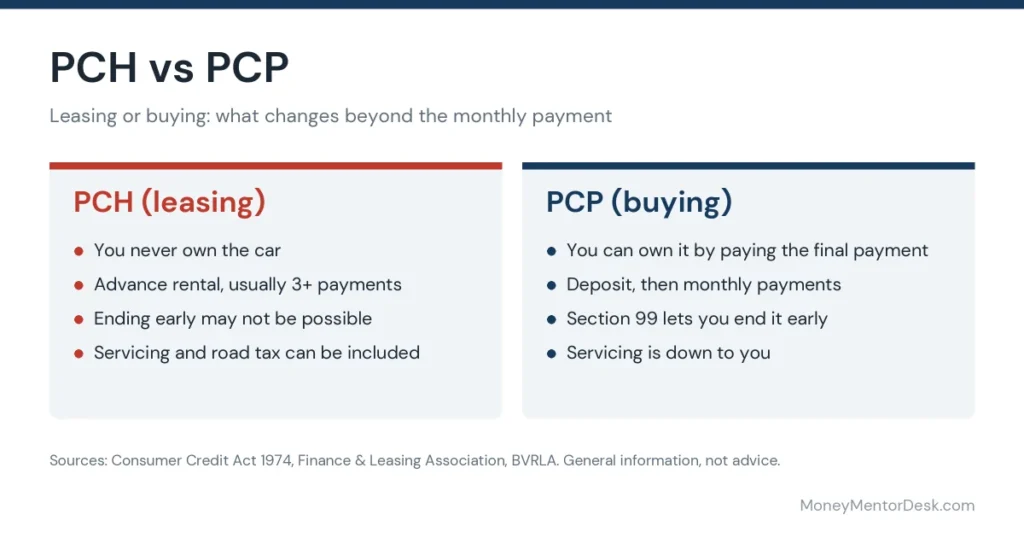
- Personal contract hire (leasing). That’s a hire agreement, not hire purchase. Regulated consumer hire has its own termination right in section 101, but your notice can’t end the agreement earlier than 18 months after it was made. That right also doesn’t apply if your payments add up to more than £1,500 in any year.
- Agreements that aren’t regulated by the Consumer Credit Act. For example, credit over £25,000 taken out wholly or predominantly for business purposes can be exempt (Regulated Activities Order, article 60C). Check your agreement or ask the lender.
- After the final payment has fallen due.
Your agreement can’t take the right away. Under section 173(1), a term in a regulated agreement is void if it’s inconsistent with a protection the Act gives you.
How does the half rule work on PCP?
When you end the agreement under section 99, section 100(1) says you pay the amount, if any, by which half the total price is more than what you’ve paid plus what’s already due. If you’ve already paid half or more, the half rule adds nothing more to pay.
What goes into the total price
- Section 189 defines the total price as the total sum you pay under the agreement. That includes any sum payable to use an option to purchase, but not penalties, compensation or damages.
- The prescribed “Termination: Your rights” wording in the Agreements Regulations 2010 refers to half the “total amount payable”. The regulations define that as the credit, plus the total charge for credit, plus any advance payment. An advance payment includes your deposit and any part-exchange allowance.
- On a PCP set up as hire purchase, the final payment is normally part of the figure. Lender documents such as Northridge Finance’s voluntary termination leaflet say the total includes the Guaranteed Future Value (balloon) payment. The amount in your agreement’s “Termination: Your rights” section shows the figure your lender uses.
What counts towards what you’ve paid
- Every monthly payment you’ve made.
- Your deposit and any part-exchange allowance are part of the total amount payable, and the prescribed “Termination: Your rights” wording compares half of that total with what you’ve “already paid”. Your agreement shows the amount your lender uses, so check it, or ask the lender how your deposit has been counted.
- Instalments that were already due but unpaid also count in the calculation. You still owe them, though (see the arrears example below).
Three things people often get wrong
- “You have to pay off half before you can end it.” You don’t. Section 99 lets you end the agreement at any time before the final payment falls due. Below halfway, you pay a top-up.
- “It’s half the term.” No. The rule is about money, not time.
- “It’s half of what you borrowed.” No. The total price includes interest, the deposit, any option-to-purchase fee and, on PCP, the final payment.
Two details that can work in your favour
- Your agreement can set a smaller payment than the Act does (section 100(1)).
- If a court is satisfied that the lender’s actual loss is less, it can order you to pay that lower sum instead (section 100(3)).
Worked example: what you’d pay to hand back a PCP car
This example uses the same car as our PCP guide:
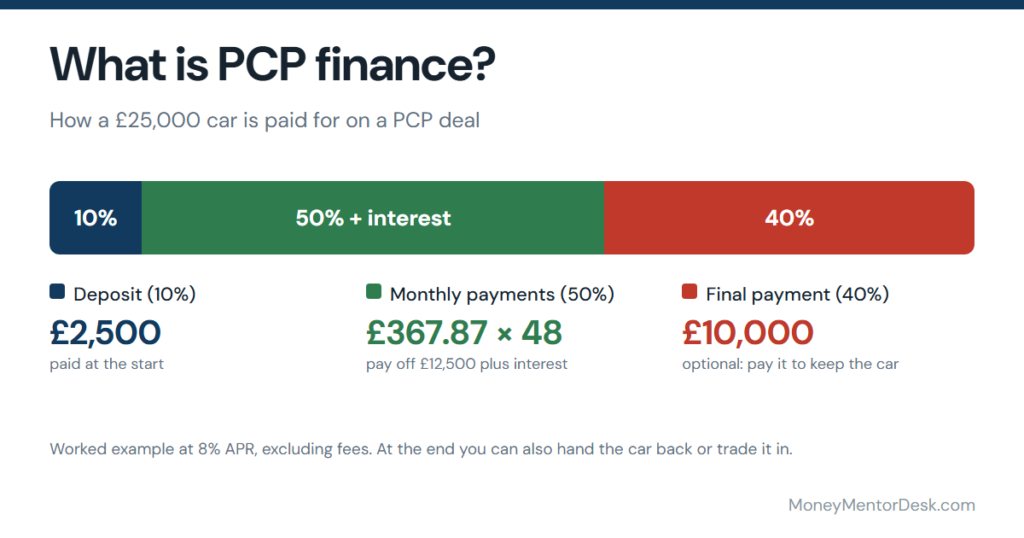
- £25,000 car and a £2,500 deposit, so £22,500 is borrowed
- 8% APR over 48 months
- 48 monthly payments of £367.87
- a £10,000 final payment due alongside the 48th monthly payment
- no fees, and every payment made on time
- the deposit counted as paid towards the total price (check how your own agreement counts it)
The figures are illustrative, not a quote.
- Total price: £2,500 + (48 × £367.87) + £10,000 = £30,157.76
- Half the total price: £15,078.88
| After this many monthly payments | Paid so far, including the £2,500 deposit | Top-up to reach half |
|---|---|---|
| 6 | £4,707.22 | £10,371.66 |
| 12 | £6,914.44 | £8,164.44 |
| 24 | £11,328.88 | £3,750.00 |
| 30 | £13,536.10 | £1,542.78 |
| 34 | £15,007.58 | £71.30 |
| 35 | £15,375.45 | £0.00 |
Illustrative calculation. Your agreement’s “Termination: Your rights” section and your lender’s figures are what count.
- After payment 35 of 48, the half rule leaves nothing extra to pay in this example. Condition charges and any arrears would still apply.
- Option-to-purchase fee: if your agreement has one, it’s part of the total price. That raises the halfway figure by half the fee.
- Arrears: suppose 24 payments had fallen due but you’d missed 2 of them.
- The missed payments still count as “sums due” in the section 100 calculation, so the top-up stays at £3,750.00.
- Section 99(2) keeps the 2 missed payments (£735.74) owing.
- The total to pay would be £4,485.74.
Why the halfway point comes later on PCP than on HP
Take the same car on hire purchase with no final payment: 48 payments of £546.35.
- Total price: £28,724.80. Half: £14,362.40.
- Halfway is reached after payment 22. After 12 payments, the top-up would be £5,306.20.
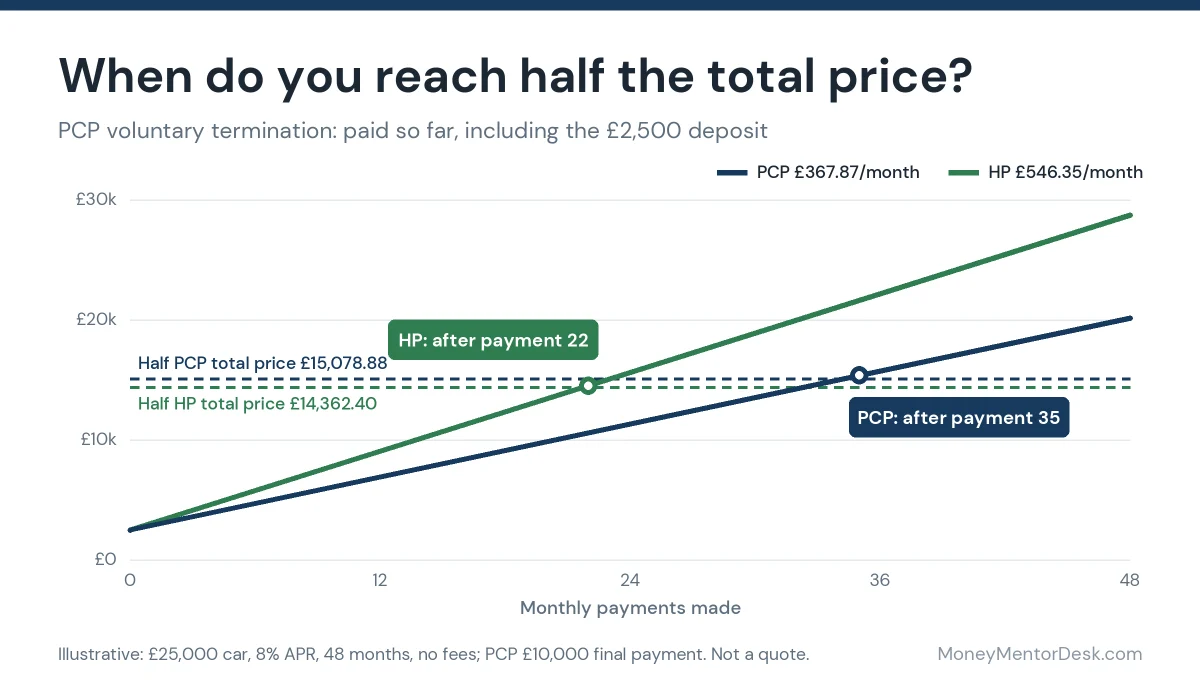
On the PCP, halfway takes until payment 35. In this example the £10,000 final payment counts in the total price from the start, but you don’t pay it until the end. See PCP vs HP for the full cost comparison.
How to voluntarily terminate a PCP agreement, step by step
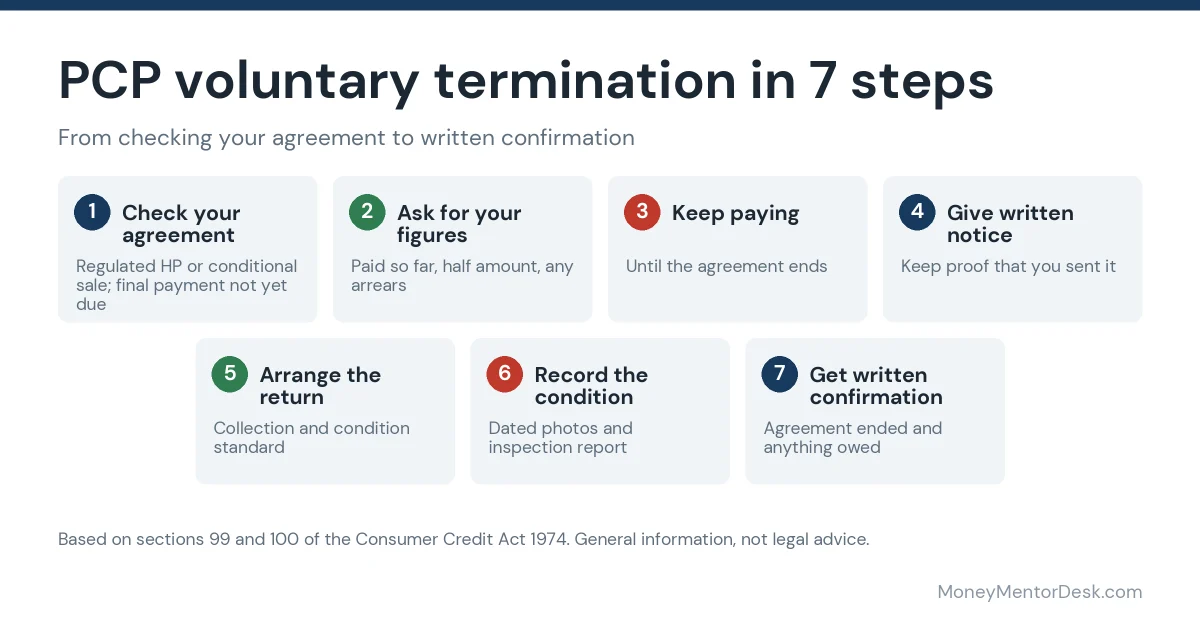
- Check your agreement. Confirm it’s a regulated hire purchase or conditional sale agreement and that the final payment isn’t due yet. Find the “Termination: Your rights” section and note the amount shown.
- Ask the lender for your figures. Ask what you’ve paid so far, how much you’d need to reach half, and any arrears. Also ask for an early settlement figure so you can compare options (see the table below).
- Keep paying until the agreement ends. Payments that fall due before termination stay owing (section 99(2)).
- Give notice in writing.
- Section 99(1) says notice goes to anyone entitled or authorised to receive your payments, and section 189 defines notice as notice in writing.
- The prescribed “Termination: Your rights” wording also tells you to write to the person you make your payments to.
- Citizens Advice has a template letter to end a hire purchase or conditional sale agreement that you can post or email. A letter like this typically includes:
- your name, address and agreement number
- a clear statement that you’re ending the agreement under section 99(1) of the Consumer Credit Act 1974
- that any amount owed should be worked out under section 100
- a request for the arrangements to return the car, and confirmation of anything left to pay
- If a lender’s website suggests phoning, a call can help, but still send written notice and keep proof you sent it.
- Arrange the return. Ask how and when the car will be collected or returned, and what return condition standard your agreement uses.
- At handover, record the car’s condition. Take dated photos, including the mileage, and ask for a copy of any inspection report.
- Get written confirmation. Ask the lender to confirm that the agreement has ended and what, if anything, you still owe. Later, check that your credit report shows the agreement correctly.
What can the finance company still charge when you hand the car back?
The top-up to half the total price. If you’re below halfway: the amount calculated under section 100(1).
Arrears. Payments that fell due before you ended the agreement (section 99(2)).
Damage from not taking reasonable care. If you haven’t taken reasonable care of the car, section 100(4) increases the amount by what it takes to compensate the lender. What counts as reasonable wear depends on your agreement and the car’s actual condition, which is why photos and the inspection report matter.
Excess mileage: it depends on your agreement.
- Section 100 doesn’t list excess mileage as a separate charge. Whether a mileage charge applies when you end a PCP early depends on the terms of your agreement, including how the mileage allowance works if the agreement ends before the end of the term.
- Lenders don’t all handle this the same way. Northridge Finance’s leaflet, for example, says it factors in the early return when working out whether you owe anything for mileage.
- If you’re charged, ask for the clause and the calculation. If you disagree, you can complain (see below). Don’t assume a charge is automatically valid or automatically invalid: it depends on your agreement and the facts.
Other fees. Only if your agreement provides for them. Ask the lender to point to the clause.
How to challenge a charge
- Ask for the calculation, the agreement clause, photos and the inspection report.
- Complain to the lender in writing. Under the FCA’s complaint rules (DISP 1.6.2R), the firm must send a final response within eight weeks, or explain why it needs longer.
- If you’re unhappy with the final response, or eight weeks have passed, you can take the complaint to the Financial Ombudsman Service. You normally need to do this within six months of the final response (DISP 2.8.2R).
Can a finance company refuse voluntary termination?
If your agreement qualifies, the right is yours to use. Section 99 gives it to you, and a term in the agreement that’s inconsistent with it is void (section 173).
The right may not apply if:
- the agreement isn’t a regulated hire purchase or conditional sale agreement (for example, personal contract hire, or an agreement that isn’t regulated)
- the final payment has already fallen due
- it’s a conditional sale agreement where ownership had already passed to you and you then transferred the car to someone else (section 99(4))
If a lender refuses or delays:
- Ask for the reason in writing.
- Make a written complaint.
- Use the Financial Ombudsman Service if the complaint isn’t resolved (see the steps above).
Does voluntary termination affect your credit file?
It can show on your credit file.
- Experian’s guidance for lenders that report data to it describes a “V” flag for hire purchase accounts ended by voluntary termination.
- Once the section 100 balance is met, the guidance says the account should be closed with a zero balance. The guidance also covers accounts where a section 100 balance is still owed, so agree with the lender how you’ll pay any top-up.
- Separately, each month’s payment status is reported, so missed payments before termination can also appear.
How a future lender weighs a voluntary termination marker is up to that lender. After the agreement ends, check your report with the credit reference agencies to make sure it’s recorded accurately.
Voluntary termination vs early settlement vs voluntary surrender
| Voluntary termination | Early settlement | Sell or part-exchange | Voluntary surrender | |
|---|---|---|---|---|
| What happens to the car | You return it to the lender | You keep it and own it once everything is paid | You sell or trade it after the finance is cleared | The lender takes the car back on terms it sets out, so ask for them in writing |
| What you pay | A top-up to half the total price if you’re below halfway, plus arrears and any reasonable-care charge (sections 99–100) | Everything payable, less any rebate the law allows, plus any early repayment compensation the lender is entitled to claim (section 94) | The settlement figure, often paid from the sale proceeds | Section 100’s limit applies to agreements ended under section 99. Ask the lender to confirm in writing whether it’s treating your request as voluntary termination under section 99, and what you’d owe |
| Notice | In writing (section 99, section 189) | Notice, which doesn’t have to be in writing (section 94(6)) | Ask the lender for a settlement figure first | Ask the lender how to request it, in writing |
| May suit you when | You want to return the car and you’re near or past halfway | You want to keep the car and can pay the settlement figure | The car is worth more than the settlement figure | Only after comparing it with voluntary termination in writing |
If payments are a struggle:
- Contact your lender early.
- Free debt advice is available from Citizens Advice and MoneyHelper.
- Before you pay a lump sum, compare the voluntary termination amount with the settlement figure.
- For the choices at the end of a deal, see what happens at the end of a PCP agreement.
Does voluntary termination work on hire purchase too?
Yes. Sections 99 and 100 apply to regulated hire purchase and conditional sale agreements. An HP deal has no large final payment, so you’d usually reach halfway sooner than on a similar PCP. In the example above, that’s payment 22 on HP compared with payment 35 on PCP. Our guide to how PCP and HP compare sets out the wider differences.
Can you cancel a PCP within 14 days?
Voluntary termination is not the only way out. For the first 14 days you have a separate right to withdraw from the credit agreement under section 66A of the Consumer Credit Act 1974. You give oral or written notice before the end of the 14 days, which start the day after the agreement is made or you receive your copy, whichever is later. The right does not apply where the credit is over £60,260.
Withdrawing cancels the finance, not the car purchase. You must repay the credit, plus interest for the days you had it, within 30 days, and on a PCP set up as hire purchase the car then becomes yours. If you want to hand the car back instead, that depends on the dealer’s own returns policy or your rights if the car is faulty. After the 14 days, voluntary termination is the route to hand the car back.
FAQs
Can I voluntarily terminate a PCP in the first year?
Yes, if it’s a regulated hire purchase or conditional sale agreement. Section 99 lets you end it at any time before the final payment falls due. Early in the deal you’ll usually owe a top-up to reach half the total price. In our example, that was £8,164.44 after 12 payments.
Does the balloon payment count towards the half?
Normally, yes. The total price includes everything you pay under the agreement, including any sum payable to use an option to purchase (section 189), and lender documents such as Northridge Finance’s say the total includes the balloon payment. Check the amount in your agreement’s “Termination: Your rights” section.
Does my deposit count towards the halfway point?
Your deposit, and any part-exchange allowance, is part of the total amount payable under the Agreements Regulations 2010. The prescribed “Termination: Your rights” wording compares half that total with what you’ve already paid. Check the amount in your own agreement, or ask your lender how your deposit has been counted.
Do I have to pay excess mileage if I voluntarily terminate?
It depends on your agreement and the facts. Section 100 doesn’t list excess mileage as a separate charge, so what matters is what your agreement says about mileage when a deal ends early. Ask the lender for the clause and the calculation, and complain if you disagree.
Can I use voluntary termination if I’m behind on payments?
Yes. Section 99 has no condition about being up to date. But missed payments that were already due stay owing (section 99(2)), and they’re added to any top-up you owe.
Can I use voluntary termination on a lease (PCH) or a business agreement?
- PCH: section 99 doesn’t apply, because personal contract hire isn’t hire purchase. Regulated consumer hire has a separate right under section 101, but it isn’t available if payments exceed £1,500 in any year.
- Business agreements: some aren’t regulated. For example, credit over £25,000 taken out wholly or predominantly for business purposes can be exempt (article 60C). Check your agreement or ask the lender.
Can I cancel a PCP within 14 days?
You can withdraw from the credit agreement within 14 days under section 66A of the Consumer Credit Act 1974, by oral or written notice. You then repay the credit plus interest within 30 days and keep the car. Handing the car back is a separate question, answered by voluntary termination after the 14 days.
Sources
- Consumer Credit Act 1974, sections 94, 99, 100, 101, 173 and 189 (legislation.gov.uk, checked 14 September 2026)
- Consumer Credit (Agreements) Regulations 2010: regulation 1 and Schedule 2 (legislation.gov.uk, checked 14 September 2026)
- FCA Handbook: DISP 1.6 and DISP 2.8, complaint handling and time limits (checked 14 September 2026)
- Citizens Advice: hire purchase and conditional sale and template letter (checked 14 September 2026)
- Financial Services and Markets Act 2000 (Regulated Activities) Order 2001, article 60C (legislation.gov.uk, checked 14 September 2026)
- Experian: CAIS FAQs for data-reporting lenders (checked 14 September 2026)
- Northridge Finance: voluntary termination information leaflet (dated March 2021, checked 14 September 2026)
This guide explains your rights in general terms and isn’t financial or legal advice. Check your own agreement and your lender’s figures before you decide. For free, impartial help, contact Citizens Advice or MoneyHelper.
Written by Nimra Saleem for MoneyMentorDesk.com. Sources checked on 14 September 2026 against the Consumer Credit Act 1974, the Consumer Credit (Agreements) Regulations 2010 and the Regulated Activities Order 2001 (legislation.gov.uk), the FCA Handbook complaint rules, Citizens Advice, Experian and Northridge Finance.
Pingback: Conditional Sale vs Hire Purchase: The 3 Key Differences
Pingback: Early Settlement Car Finance: 6 Steps to Pay Off Early (UK)
Pingback: PCH vs PCP: 5 Key Differences Before You Lease or Buy