
Part of our guide: PCP vs HP: 5 Differences and a Worked Cost Example (UK)
A dealer offers you “CS” on one quote and “HP” on another, and the monthly payments look almost identical. Conditional sale vs hire purchase comes down to three real differences: how ownership passes to you, whether there’s an option-to-purchase fee at the end, and what the agreement is in law. Everything else, including your right to end the agreement early and the protection against repossession, works the same way under the Consumer Credit Act 1974.
If your quote says PCP instead, read what PCP finance is and how it works first.
Conditional sale vs hire purchase: the short answer
| Conditional sale | Hire purchase | |
|---|---|---|
| What it is in law | A sale of goods where the price is paid in instalments and the seller keeps ownership until the agreed conditions are met | An agreement where goods are bailed (hired) to you for periodical payments, with ownership passing when the terms are met and a specified act or event happens |
| How you become the owner | Automatically once the conditions, normally all the payments, are met | When the terms are met and you exercise the option to purchase (or another specified act or event happens) |
| Option-to-purchase fee | Not part of the structure | Usually charged at the end to transfer ownership |
| Voluntary termination (s.99–100) | Yes | Yes |
| One-third protection (s.90) | Yes | Yes |
| Settle early (s.94) | Yes | Yes |
| Can you sell the car mid-agreement? | No, not until ownership passes | No, not without the lender’s permission |
What is a conditional sale agreement?
A conditional sale agreement is a way of buying something in instalments where the seller stays the owner until you’ve met the conditions in the contract.
Section 189 of the Consumer Credit Act 1974 defines it as an agreement “for the sale of goods or land under which the purchase price or part of it is payable by instalments, and the property in the goods or land is to remain in the seller (notwithstanding that the buyer is to be in possession of the goods or land) until such conditions as to the payment of instalments or otherwise as may be specified in the agreement are fulfilled”.
In car finance terms:
- You choose the car and agree a deposit, a term and fixed monthly payments.
- The finance company owns the car during the agreement. The Finance & Leasing Association says motor finance providers “will own the vehicle whilst the customer is repaying the finance”, and that customers “will usually be listed as the registered keeper and hold the V5C registration certificate”.
- Ownership passes to you when the conditions are met. The Finance & Leasing Association’s Financing Your Car site puts it plainly: “Under a Conditional Sale agreement, ownership passes to you automatically once the finance is repaid in full.”
What is a hire purchase agreement?
Hire purchase is legally a hire arrangement that turns into ownership.
Section 189 defines it as an agreement, other than a conditional sale agreement, under which “goods are bailed or (in Scotland) hired in return for periodical payments”, and ownership “will pass to that person if the terms of the agreement are complied with and one or more of the following occurs: the exercise of an option to purchase by that person, the doing of any other specified act by any party to the agreement, or the happening of any other specified event”.
That option to purchase is where the familiar end-of-agreement fee comes from. Financing Your Car describes it as “an ‘Option to Purchase’ fee which covers the administrative cost to the finance company of transferring ownership of the car to you”.
The 3 real differences
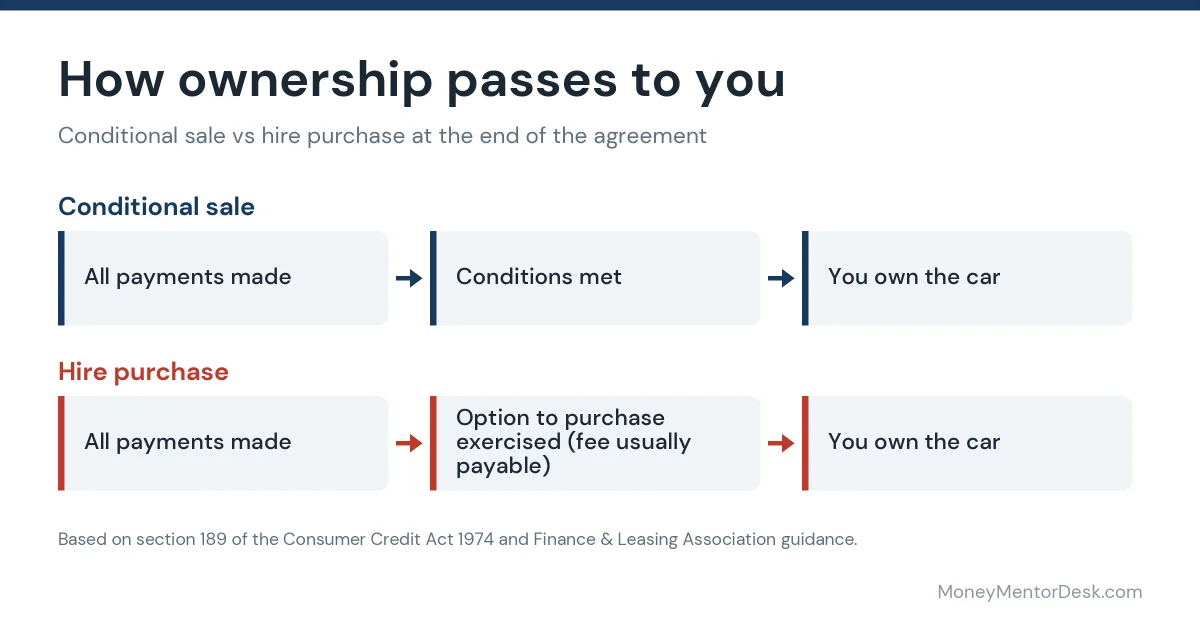
1. How ownership passes. On conditional sale, meeting the conditions is enough: ownership passes automatically. On hire purchase, ownership passes when the terms are met and a specified act or event happens, which is normally you exercising the option to purchase.
2. The option-to-purchase fee. Because hire purchase needs that final step, agreements usually carry a fee for it. Stellantis Financial Services contrasts the two products directly: “with Conditional Sale you automatically become the legal owner of the vehicle once all payments have been made. With a hire purchase agreement an option to purchase fee will need to be paid to be registered as the legal owner.” The fee is normally small next to the loan, but it’s part of the total price you’re comparing.
3. What the agreement is in law. Conditional sale is a sale with deferred ownership. Hire purchase is a bailment (a hire) with a route to ownership. That’s why the paperwork uses different language, and it’s the reason the option to purchase exists on one and not the other.
Anything else a salesperson describes as a difference, such as deposit levels, terms or interest rates, is a feature of the deal in front of you, not of the product type. Compare the quotes.
5 rights that work the same way on both
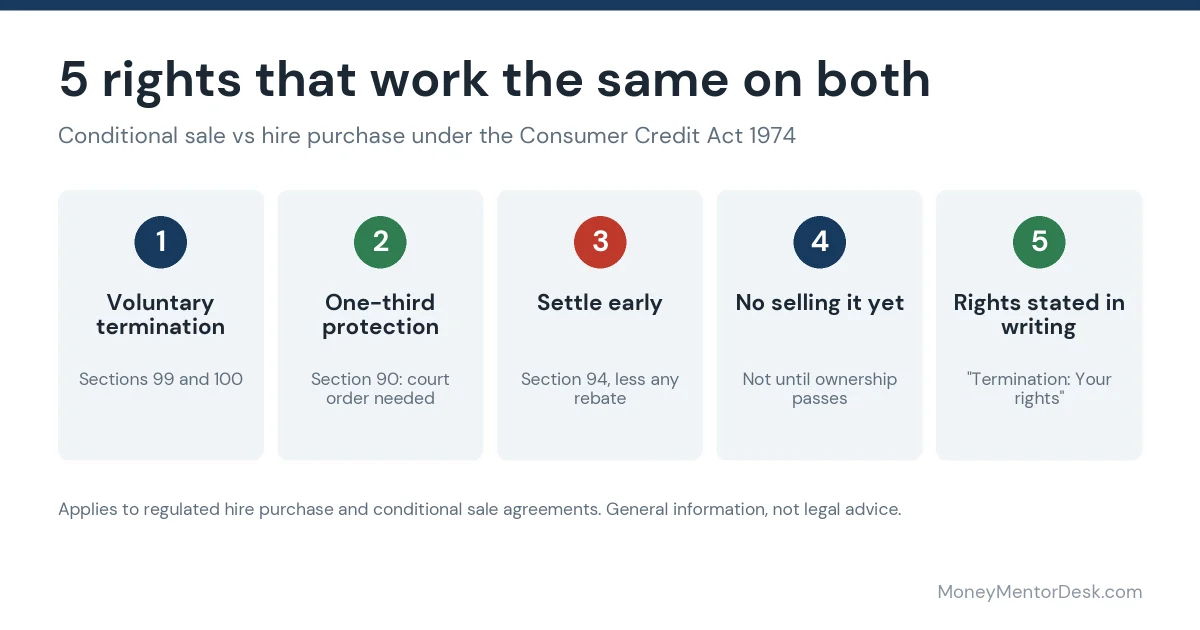
Both are regulated agreements under the Consumer Credit Act 1974, so these apply either way:
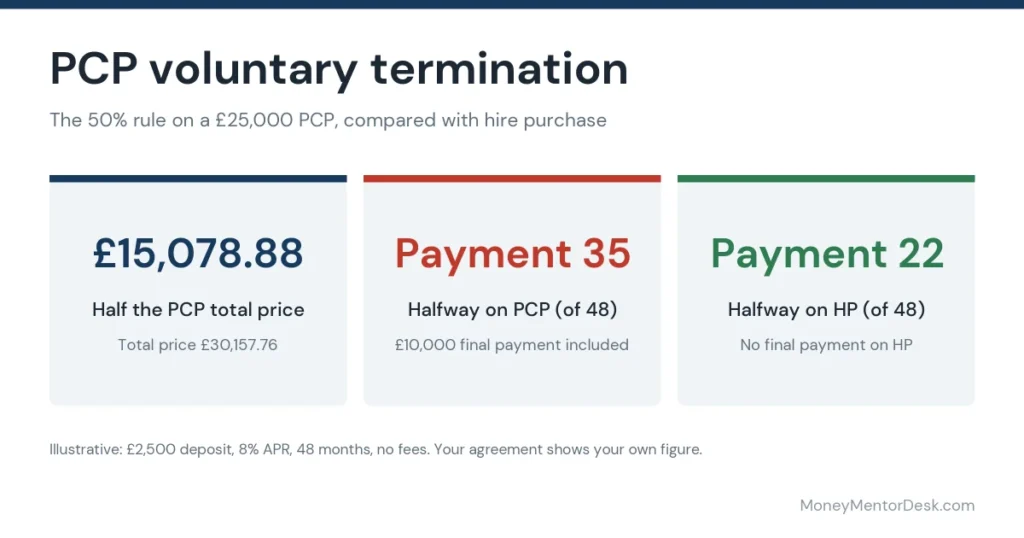
- Voluntary termination. Section 99 lets you end a regulated hire purchase or conditional sale agreement at any time before the final payment falls due. Section 100 caps what you owe at half the total price, less what you’ve paid and what’s already due. See our guide to voluntary termination and the half rule.
- Protection from repossession once you’ve paid a third. Under section 90, if you’ve paid at least one-third of the total price and are in breach, the creditor “is not entitled to recover possession of the goods from the debtor except on an order of the court”. The Act calls these “protected goods”. It covers conditional sale and hire purchase alike.
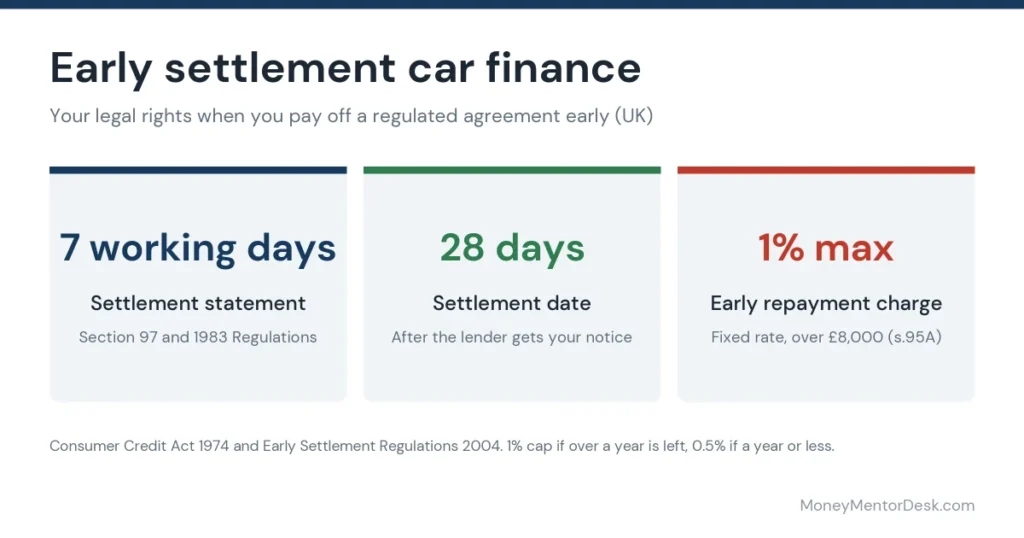
- Settling early. Section 94 gives you the right to pay off a regulated agreement early, in full or in part, with any rebate the law allows.
- You can’t sell the car until ownership passes. Citizens Advice says that with hire purchase “you aren’t allowed to sell or dispose of the goods without the lender’s permission. If you do, you’ll be committing a criminal offence.” On conditional sale the car isn’t yours to sell until the conditions are met either.
- Your agreement must set out your termination rights. Regulated hire purchase and conditional sale agreements covered by the Consumer Credit (Agreements) Regulations 2010 include a “Termination: Your rights” section showing the half-the-total-amount-payable figure.
Where PCP fits in
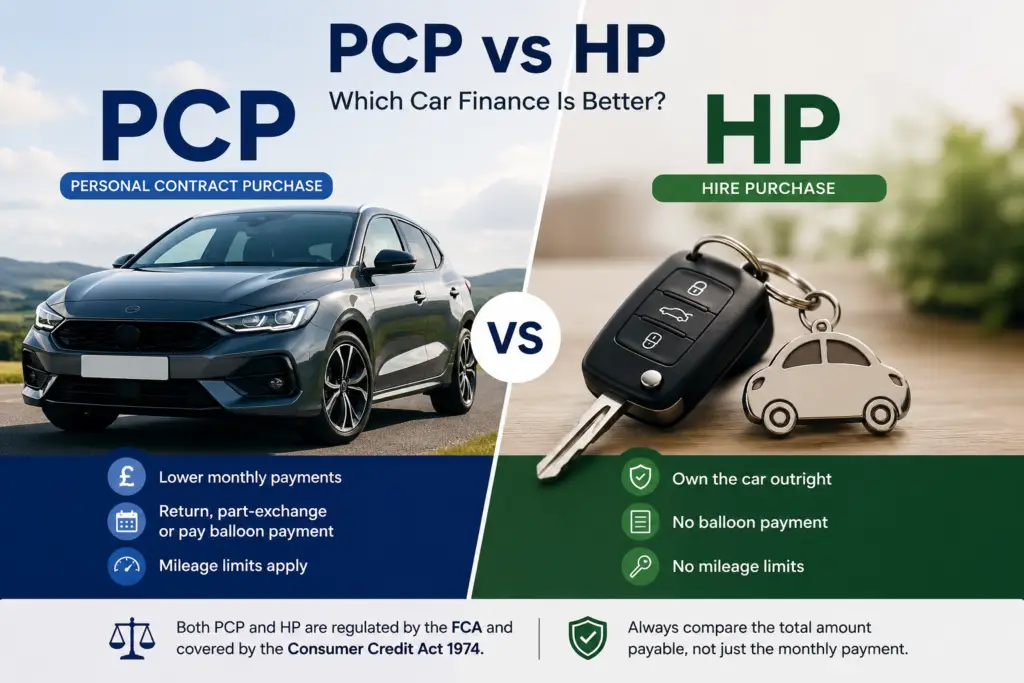
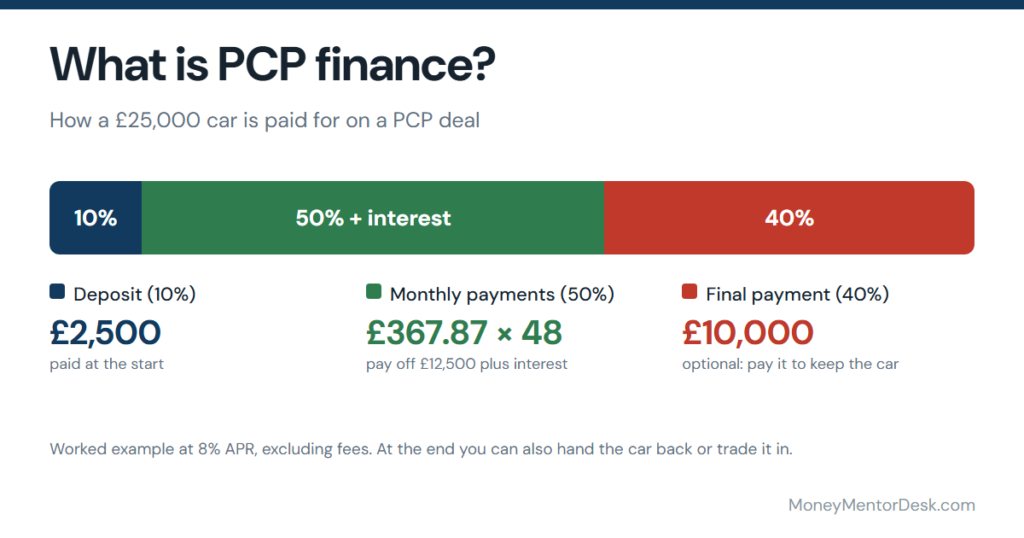
A PCP is normally a hire purchase agreement with a large optional final payment, so the hire purchase rules above apply to it, including the option to purchase. The practical difference is the choice at the end: pay the final payment, hand the car back, or part-exchange. Our PCP vs HP comparison sets out the costs side by side.
Conditional sale has no balloon payment structure of that kind. You pay the agreement off and the car is yours.
Which is better for you?
The product type rarely decides it. Compare the two quotes on:
- Total amount payable, not the monthly payment.
- The option-to-purchase fee, if the agreement is hire purchase, and whether it’s included in the total.
- APR and term. A longer term lowers the monthly payment and raises the total cost.
- Deposit and any part-exchange allowance.
- What you plan to do with the car. If you want to own it at the end, both work. If you want the option to hand it back at the end instead, that’s PCP.
Ask each lender for the total amount payable and the option fee in writing, then compare like for like.
FAQs
Is conditional sale the same as hire purchase?
Not quite. Both are regulated agreements where the finance company owns the car until you’ve paid. The difference is that conditional sale passes ownership automatically once the conditions are met, while hire purchase needs a specified act, usually exercising the option to purchase, which normally carries a fee.
Do you pay an option-to-purchase fee on conditional sale?
No. Stellantis Financial Services says that with conditional sale you automatically become the legal owner once all payments have been made, unlike hire purchase, where an option-to-purchase fee is payable to be registered as the legal owner. Check your own agreement’s total amount payable.
Can you use voluntary termination on a conditional sale agreement?
Yes. Section 99 of the Consumer Credit Act 1974 covers regulated conditional sale agreements as well as hire purchase. Section 100 sets the half-the-total-price cap. One point is specific to conditional sale: under section 99(4), if ownership has already passed to you and the car has been transferred to someone else, the right no longer applies.
Does the one-third rule apply to conditional sale?
Yes. Section 90 applies to regulated hire purchase and conditional sale agreements. Once you’ve paid at least a third of the total price, the lender needs a court order to take the car back if you’re in breach.
Who owns the car on a conditional sale agreement?
The finance company owns it until the conditions in the agreement are met. The Finance & Leasing Association says the customer is usually the registered keeper and holds the V5C, which isn’t the same as being the legal owner.
Can I switch from hire purchase to conditional sale?
Not on an existing agreement. You’d be taking out a new agreement, which means a new credit check and new terms. Compare the total amount payable of the new deal against what settling the old one costs.
Sources
- Consumer Credit Act 1974, section 189 (definitions of conditional sale, hire purchase and total price), section 90 (protected goods), section 99 and section 100 (voluntary termination), section 94 (early settlement), legislation.gov.uk, checked 17 September 2026
- Consumer Credit (Agreements) Regulations 2010, checked 17 September 2026
- Financing Your Car (Finance & Leasing Association): hire purchase or conditional sale, checked 17 September 2026
- Finance & Leasing Association: DVLA services briefing (29 January 2021, checked 17 September 2026)
- Stellantis Financial Services: conditional sale, checked 17 September 2026
- Citizens Advice: hire purchase and conditional sale, checked 17 September 2026
This guide is general information, not legal or financial advice. Check your own agreement and ask your lender for the figures before you decide.
Written by Nimra Saleem for MoneyMentorDesk.com. Last reviewed on 17 September 2026 against the Consumer Credit Act 1974 and the Consumer Credit (Agreements) Regulations 2010 on legislation.gov.uk, the Finance & Leasing Association’s Financing Your Car, Stellantis Financial Services and Citizens Advice.
Pingback: PCP Voluntary Termination Explained: The 50% Rule in 7 Steps