
Part of our guide: What Is a 10-Day Payoff Quote? Auto Loan Payoff Explained
Your last car payment has posted and the loan shows a $0 balance, but there’s no title in your mailbox. That’s normal for the first few weeks. A lien release after car payoff is the lender’s formal confirmation that it no longer has a claim on your car. Depending on your state, that release reaches you as a paper title, a lien release letter, or an electronic update at the DMV. Published lender timeframes run from a few weeks to about two months.
This guide covers:
- how long lenders say the process takes
- how paper and electronic titles differ
- the steps to get a clear title
- what to do if nothing arrives
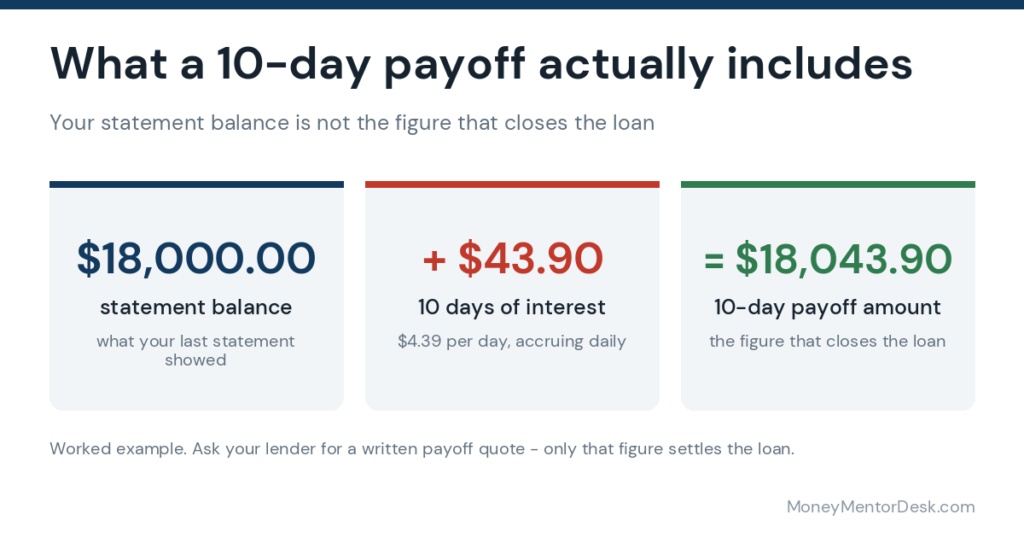
If you haven’t paid off yet, start with what a 10-day payoff is.
What is a lien release on a car?
A lien release confirms that the lender (the lienholder) has been paid in full and gives up its legal claim on the car. Chase describes a lien as “a creditor’s legal claim on an asset, used as collateral until a debt is satisfied”. While the lien is in place, it stops you selling the car or transferring ownership until the lienholder is satisfied.
According to Chase, the release process usually involves:
- The lienholder signing a release document confirming you’ve met the terms of the loan.
- The document going to your state’s department of motor vehicles (DMV) for processing.
- The DMV removing the lien from your title if everything is correct.
The process varies from state to state. The rest of this guide explains the main differences.
How long does it take to get your title after paying off a car?
There’s no single national deadline. The time depends on your lender, your state and whether your title is paper or electronic. These are the timeframes lenders and a federal agency publish, as of September 2026:
| Source | Paper title or lien release | Electronic title | Notes |
|---|---|---|---|
| Chase Auto | Allow up to 45 days after the final payment posts | Released electronically; the state titling agency then mails a lien-free title on its own timeframe | Includes mail time and DMV processing. Your account must show a $0 balance |
| Lexus Financial Services | 25–40 business days from payoff posting, including mail time | Paper title from the state within 7.5–9.5 weeks of payoff posting | Lexus says it sends paper titles or notifies the state within 10 business days |
| Texas law (Finance Code §348.408) | Lien released no later than the 10th day after payment in full is tendered | — | Applies when the buyer pays in full using balance information from the contract holder (see below) |
| FDIC (lender was a failed bank) | Allow 30 business days after the FDIC receives all required documents | — | Only when your lender has failed and the FDIC handles its loans |
Lender timeframes are published estimates, not guarantees. Your state DMV sets its own processing time.
Paper title vs electronic title: what happens after payoff
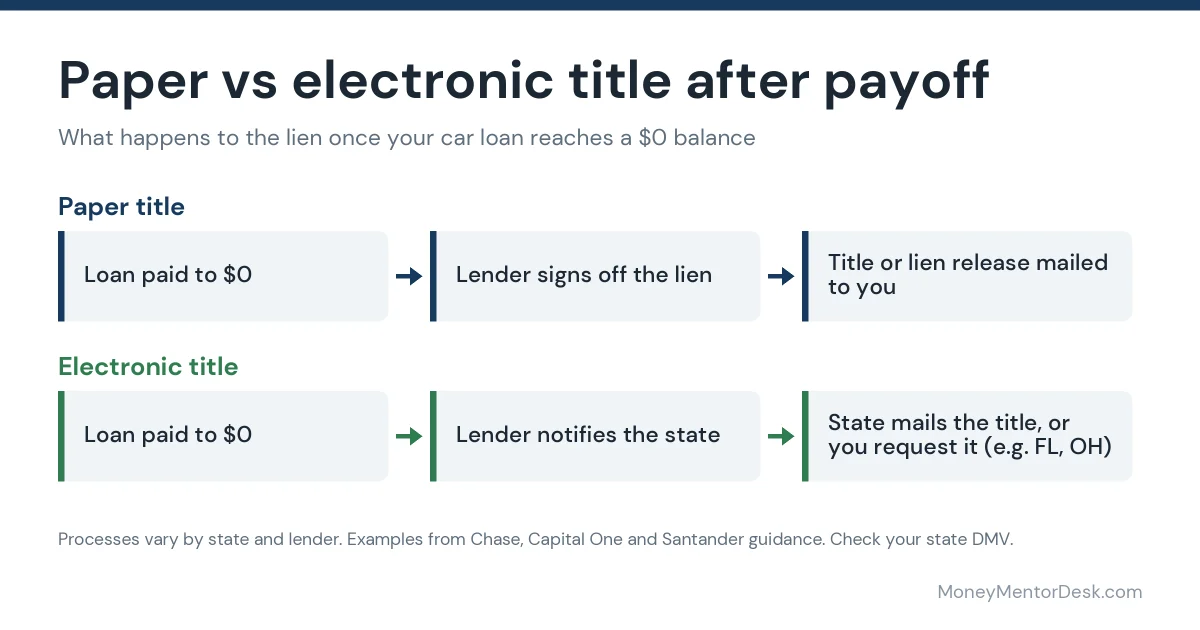
- Paper title. Your lender holds the paper title (or a record of the lien). After payoff, it signs off the lien and mails you the title or a lien release. Chase mails these “to the mailing address that appears on your auto billing statements”.
- Electronic title. Some states keep the title as an electronic record while a lien is in place. Santander explains that, in these states, “when a loan is paid in full, the lender notifies the state agency that they no longer have an interest in the vehicle”. The state then either mails a paper title or keeps it electronic until you ask for one.
States where you may need to request the title yourself. Several lenders single out the same states:
- Florida: Chase says Florida “requires the title to remain electronic unless the owner requests a paper title”. Lexus Financial says titles in Florida and Arizona typically stay electronic unless you request a paper title.
- Ohio and Florida: Santander says these states “do not automatically mail the title. You have to request the title online at the DMV and pay for it to be shipped lien free.” Capital One also tells Florida and Ohio borrowers to contact the DMV directly for a copy of the title.
States where you may get a lien release letter instead of a title. Capital One says it mails a lien release letter for vehicles titled in Kentucky, Minnesota, Missouri, Montana and New York, and that the owner may already hold the title.
Lender lists don’t always line up. Capital One places some states in more than one group, so confirm your state’s process with your DMV.
5 steps to get your title after paying off your car
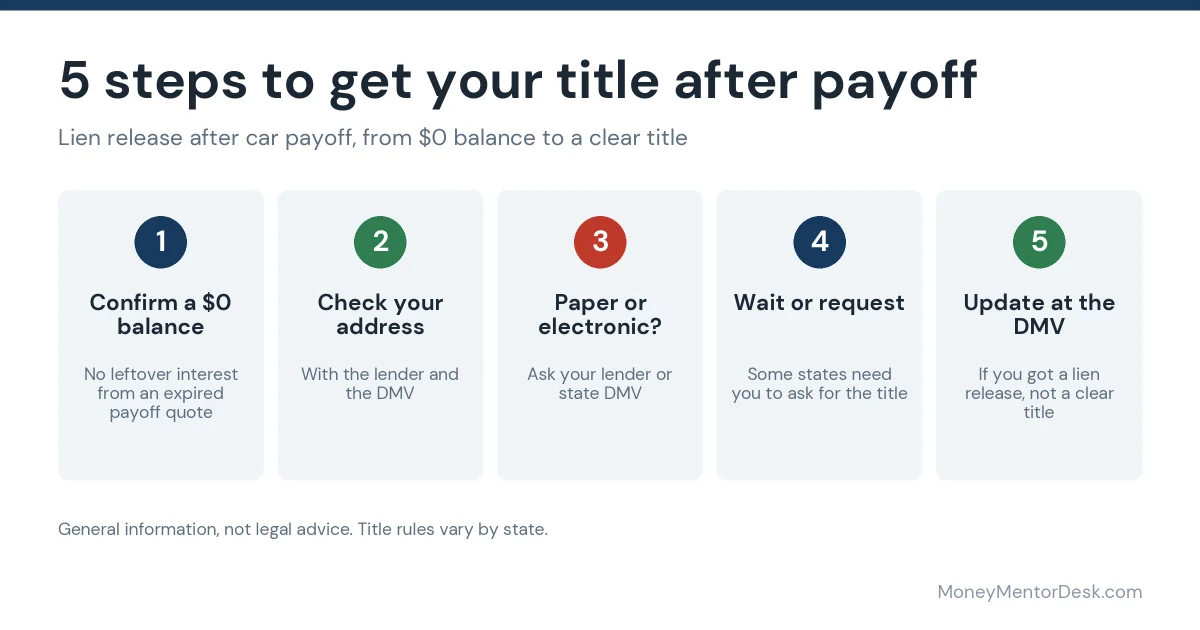
- Make sure the loan is fully paid. Chase says the account “must be fully paid with a $0 balance” before it releases the lien. If you paid from a payoff quote after it expired, interest may have kept building and left a small balance. Check before you assume the loan is closed. Our guides explain how to request a payoff letter and how to calculate your payoff amount.
- Check your address with the lender and the DMV. The lender mails the title or release to the address on your account. An electronic title comes from the state, so its address matters too. Chase recommends reviewing your address with both before you pay off.
- Find out whether your title is paper or electronic. Your lender or state DMV can tell you. Lexus Financial, for example, shows this under “Title Information” in the online account.
- Wait for the release, or request the title if your state needs you to. Allow for the lender’s stated timeframe (see the table). If your state keeps titles electronic, such as Florida, request a paper title from the DMV. The DMV may charge a fee.
- Update the title with your DMV if you get a lien release instead of a clear title. Some states have you take the release document and title to the DMV for a new title. Texas Transportation Code §501.115(b), for example, says the owner “may submit the discharge and title to the department for a new title”. Check your state DMV’s requirements and fees.
What if your title or lien release doesn’t arrive?
- Contact your lender first. Have your loan details ready and keep proof of your final payment. For a lien release request, Chase asks for your full name, loan account number, vehicle year, make and model, VIN, and the address where you want the release sent.
- If the lien was released electronically, contact your state titling agency. Santander advises this if you haven’t received your title from an electronic lien state.
- Know your state’s deadline, if it has one. In Texas, when you pay in full using the balance information the contract holder gave you, Finance Code §348.408(b)(2) requires the holder to “release the holder’s lien against the motor vehicle within a reasonable time not later than the 10th day after the date on which the amount is tendered”. Other states have their own rules. Check your state’s DMV or statutes.
- If your lender was a bank that failed, the FDIC handles lien release requests. It asks for the title or an inquiry report plus proof the loan was paid in full, and says to allow 30 business days after it receives all required documents.
- If the lender won’t resolve it, you can submit a complaint to the Consumer Financial Protection Bureau (CFPB). “Vehicle loans or leases” is one of its complaint categories, and it says most companies respond within 15 days.
Lost the title or lien release? Ask the lender for a replacement lien release (Chase lists the details it needs, as above). Your state DMV handles duplicate titles.
What to do after the lien is released
- Review your car insurance. Lenders can make coverage such as comprehensive a condition of the loan until they no longer have a financial interest in the car, according to Chase. Once the lien is released, that lender condition ends. Speak to your insurer before changing coverage. See whether you need full coverage on a financed car for how lender requirements work.
- Keep your documents together: the final payment confirmation, the lien release or title, and any DMV receipt.
- Selling later? A clear title makes a sale or trade-in simpler. If you sell before the release is complete, see how to sell a financed car.
FAQs
How long does it take to get your title after paying off a car?
It depends on your lender and state. Chase says to allow up to 45 days after the final payment posts. Lexus Financial quotes 25–40 business days for paper titles and 7.5–9.5 weeks for electronic titles. In Texas, the lien must be released by the 10th day in the situation set out in Finance Code §348.408.
Do you get a new title after paying off your car?
Often, but not always automatically. In paper title states, the lender usually mails the title or a lien release. In electronic title states, the state may mail a lien-free title or keep it electronic until you ask. Lenders say Florida and Ohio borrowers need to request the title from the DMV.
What is a lien release letter?
It’s a document from your lender confirming the loan is paid and its claim on the car is released. Capital One says it mails a lien release letter, rather than a title, for vehicles titled in Kentucky, Minnesota, Missouri, Montana and New York. Keep it with your title in case your DMV needs it.
What should I do if my lender went out of business?
If the lender was a bank that failed, contact the FDIC. It handles lien release requests for failed banks. It asks for the title or an inquiry report plus proof of payment in full, and says to allow 30 business days after it has all the documents.
Do I need to go to the DMV after paying off my car?
Sometimes. If you receive a clear title, you may not need to do anything. If you receive a lien release, or your state keeps titles electronic, you may need to request or update the title with your DMV. Texas, for example, lets the owner submit the discharge and title for a new title.
Can I complain if my lien isn’t released?
Yes. Contact the lender first. If it doesn’t resolve the problem, you can submit a complaint to the CFPB under “Vehicle loans or leases”. The CFPB says most companies respond within 15 days.
Sources
- Texas Transportation Code §501.115, Discharge of Lien and Texas Finance Code §348.408 (statute text via Texas.Public.Law, checked 15 September 2026)
- FDIC: Obtaining a Lien Release (last updated 24 June 2024, checked 15 September 2026)
- CFPB: Submit a complaint (checked 15 September 2026)
- Chase: Title & Lien Release FAQs and What is a lien on a car? (checked 15 September 2026)
- Capital One: Paying off your auto loan (checked 15 September 2026)
- Lexus Financial Services: title and lien release timing FAQ (checked 15 September 2026)
- Santander Consumer USA: When do you get your title after paying off your car loan? (20 February 2025, checked 15 September 2026)
This guide is general information, not legal advice. Title and lien rules vary by state, and lender processes change. Check with your lender and state DMV for your situation.
Written by Nimra Saleem for MoneyMentorDesk.com. Last reviewed on 15 September 2026 against Texas statutes, the FDIC, the CFPB, and lender guidance from Chase, Capital One, Lexus Financial Services and Santander Consumer USA.
Pingback: Can You Sell a Financed Car? How It Works with and Without Negative Equity - MoneyMentorDesk.com
Pingback: 10-Day Payoff Letter Example: How to Read Every Section - MoneyMentorDesk.com
Pingback: How to Request a 10-Day Payoff Letter (4 Ways to Get One Fast)