Part of our guide: PCP vs HP: 5 Differences and a Worked Cost Example (UK)
Two quotes for the same car, and the leasing one is cheaper each month. PCH vs PCP looks like a price comparison, but the important difference is legal: PCP is regulated credit that can end with you owning the car, while PCH is a hire agreement that always ends with you handing it back. That changes your exit rights, not just your monthly payment.
New to PCP? Start with what PCP finance is and how it works.
PCH vs PCP: the short answer
| PCH (personal contract hire) | PCP (personal contract purchase) | |
|---|---|---|
| Can you own the car? | No. You hand it back at the end | Yes, if you pay the final payment |
| What it is in law | A hire (bailment) of the car | Normally a regulated hire purchase agreement |
| Upfront payment | An advance rental, usually 3 or more monthly payments | A deposit |
| Monthly payments | Usually lower for a comparable car | Higher than the same car on PCH, lower than hire purchase |
| Ending it early | May not be possible; costs can be high | Voluntary termination or early settlement |
| Mileage limit | Yes, with an excess mileage charge | Yes, and it matters if you hand the car back |
| Servicing and road tax | Can be built into the monthly payment | Not included |
What is PCH (personal contract hire)?
PCH is car leasing. The BVRLA, the industry body for vehicle rental and leasing, describes it as an arrangement where “you pay a fixed monthly amount for the use of a vehicle, and at the end of the hire agreement you hand the vehicle back”.
The Finance & Leasing Association’s Financing Your Car site sets out how the money works:
- Advance rental: “You agree the advance rental payment you are able to make up front (similar to a deposit), usually this will be the equivalent of 3 or more monthly payments.”
- Lower monthly cost: contract hire has “lower monthly payments than Hire Purchase or Conditional Sale for a comparable car and term. You are only making payments based on how the car is expected to depreciate, not the initial value.”
- Bundled costs: payments can include “road tax, servicing and maintenance plans”.
- At the end: “You will hand back the vehicle to the lessor.”
In law, a lease like this is a hire agreement. Section 15 of the Consumer Credit Act 1974 defines a consumer hire agreement as an agreement for the bailment of goods to an individual that isn’t a hire purchase agreement and is capable of lasting more than three months.
What is PCP?
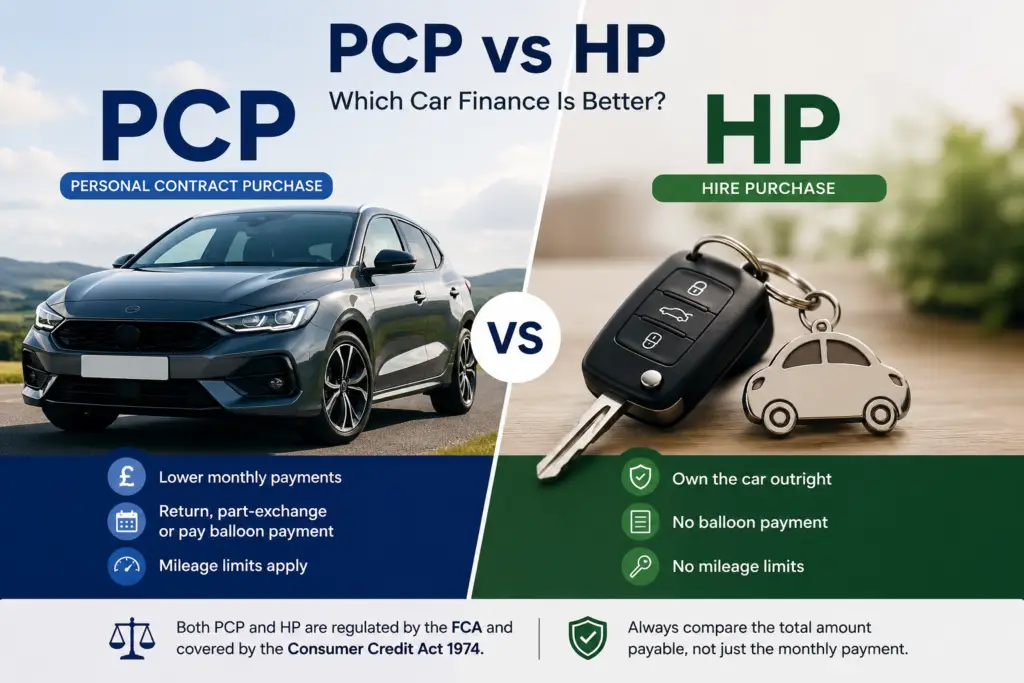
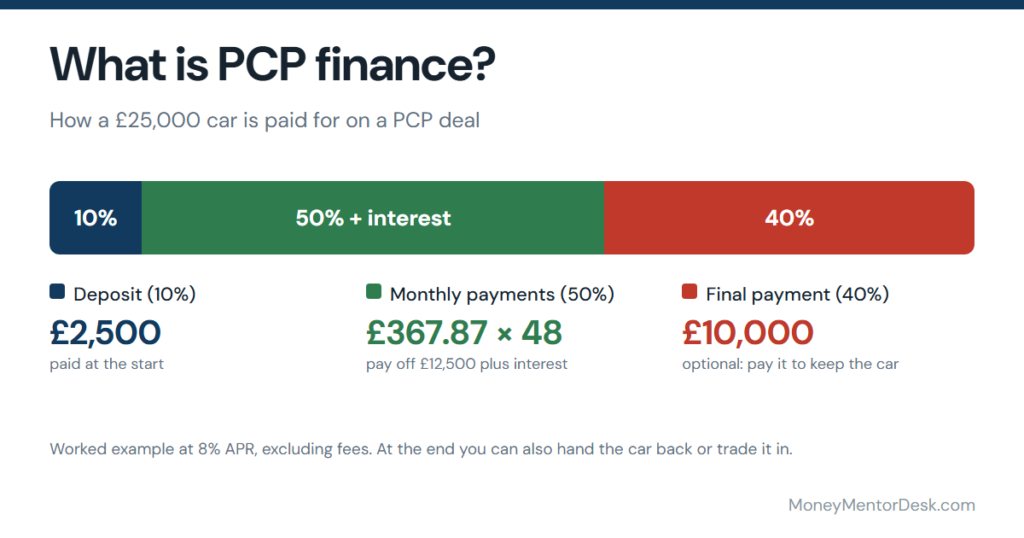
A PCP is normally a regulated hire purchase agreement with a large optional final payment. You pay a deposit and monthly payments, then choose at the end whether to pay the final payment and keep the car, hand it back, or part-exchange it.
Because it’s hire purchase, the Consumer Credit Act rights that apply to buying on credit apply to it.
The 5 key differences
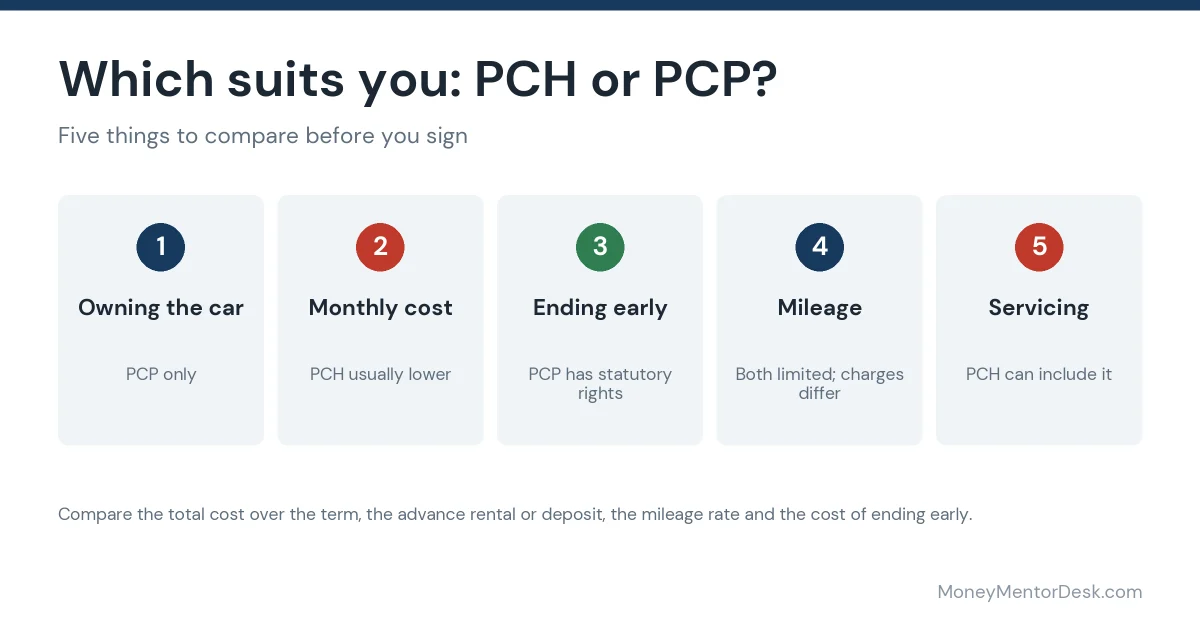
1. Ownership. On PCP you can own the car by paying the final payment, and any value above that final payment is yours to use as a deposit next time. On PCH there’s no purchase option at all. The BVRLA puts the distinction simply: with PCH you hand the vehicle back, while PCP lets you pay a final payment to own the car or trade it in.
2. Your right to get out early. This is the difference that catches people out.
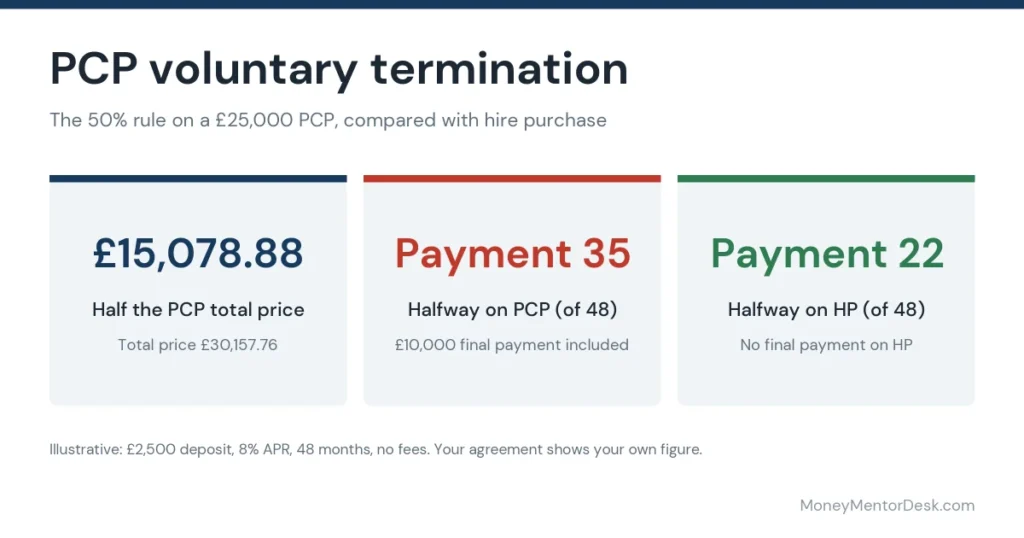
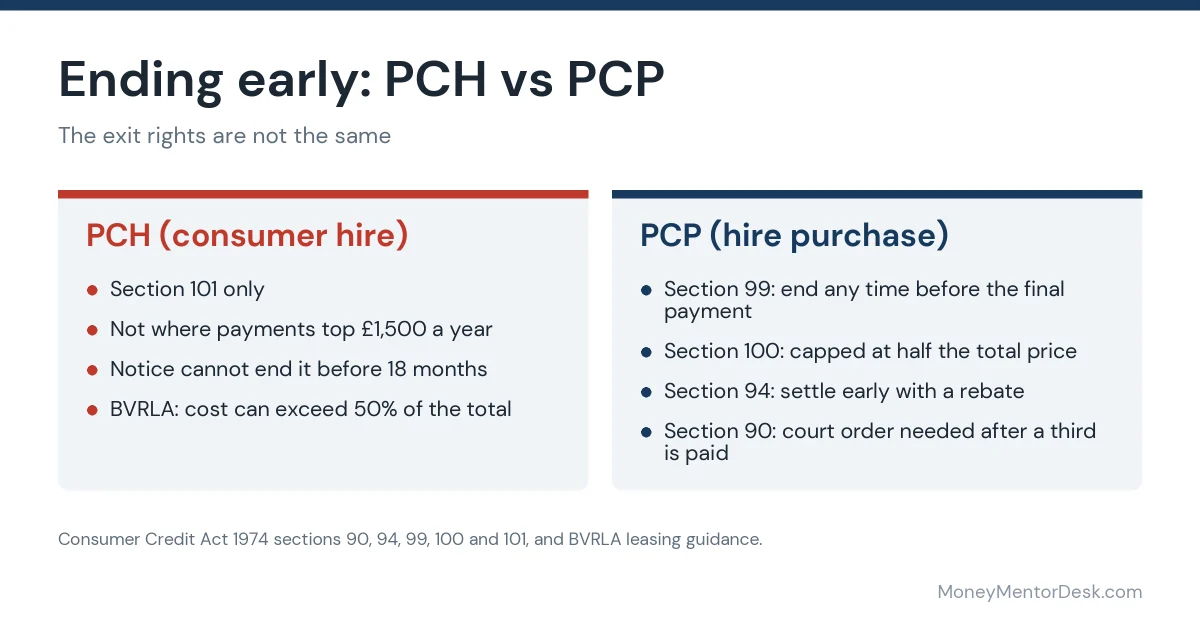
- PCP: section 99 of the Consumer Credit Act lets you end the agreement at any time before the final payment falls due, with your liability capped by section 100 at half the total price. See voluntary termination and the half rule.
- PCH: section 99 doesn’t apply, because it isn’t hire purchase. Regulated consumer hire has its own right in section 101, but a notice under it can’t end the agreement earlier than 18 months after it was made, and the right doesn’t apply at all where the payments exceed £1,500 in any year, which covers most car leases.
- The BVRLA warns that for contract hire, “early termination may not be an option” and if allowed “the costs may be much higher than 50% of the total amount payable”.
3. What you pay, and when. PCH asks for an advance rental, typically three or more monthly payments, then fixed rentals. PCP asks for a deposit, then monthly payments that leave the final payment outstanding. For the same car and term, the PCH monthly figure is usually the lower of the two, because you’re paying for depreciation rather than the whole price.
4. Mileage and condition. Both set a mileage allowance. On PCH, Financing Your Car says that if you exceed it, “you will be required to pay an additional pence per mile charge as set out in the hire agreement”, and that damage “beyond ‘reasonable wear and tear'” also carries charges. The BVRLA describes fair wear and tear as what “occurs when normal usage causes acceptable deterioration to a vehicle”, as distinct from damage from a specific event. On PCP the same charges bite only if you hand the car back rather than buying it.
5. What’s included. Contract hire can bundle road tax, servicing and maintenance into one payment. On PCP those stay your responsibility.
Getting out early: the rights are not the same
| PCH | PCP | |
|---|---|---|
| Statutory right to end early | Section 101 only, and not where payments exceed £1,500 a year; a notice can’t end it before 18 months | Section 99, at any time before the final payment falls due |
| What you’d pay | Whatever the contract sets; the BVRLA says it may not be allowed at all, and can cost more than half the total payable | Section 100 caps it at half the total price, less what you’ve paid and what’s due |
| Settling early to own the car | Not applicable, there’s no purchase option | Section 94 right to settle early, with an interest rebate |
| Protection from repossession after a third is paid | Section 90 applies to hire purchase and conditional sale, not hire | Yes |
If flexibility matters to you, that table is the comparison to weigh, not the monthly payment.
Which suits you?
PCH may suit you if:
- you want the lowest monthly cost for a given car and never want to own it
- your mileage is predictable and within the allowance
- you want servicing and road tax in one payment
- you’re confident you can keep the agreement to the end
PCP may suit you if:
- you might want to keep the car
- you want the option to end the agreement early under section 99
- you’d rather have the choice at the end than the lowest payment now
Compare the quotes on: the total you’ll pay over the term, the advance rental or deposit, the mileage allowance and excess mileage rate, what’s included, and the cost of ending early. Our PCP vs HP comparison covers the buying options side by side.
FAQs
Is PCH cheaper than PCP?
The monthly payment usually is. Financing Your Car says contract hire has lower monthly payments than hire purchase or conditional sale for a comparable car and term, because you’re paying for expected depreciation. Whether it’s cheaper overall depends on what the car is worth at the end, which only matters on PCP.
Can you buy the car at the end of a PCH agreement?
No. PCH has no purchase option. The BVRLA describes handing the vehicle back at the end of the hire agreement. If owning the car matters, PCP or hire purchase is the route.
Does voluntary termination apply to PCH?
No. Section 99 of the Consumer Credit Act 1974 applies to regulated hire purchase and conditional sale agreements. Regulated consumer hire has a separate right under section 101, which can’t take effect before 18 months and doesn’t apply where payments exceed £1,500 in any year.
What happens if you go over the mileage on a lease?
You pay an excess mileage charge. Financing Your Car says you’ll pay “an additional pence per mile charge as set out in the hire agreement”. Check the rate in your agreement before you sign, and be realistic about your annual mileage.
What counts as fair wear and tear?
The BVRLA says fair wear and tear “occurs when normal usage causes acceptable deterioration to a vehicle” and is not the same as damage from a specific event, such as an impact. Your leasing company should tell you which standard it uses before the car is collected.
Is PCH the same as PCP with no balloon payment?
No. The difference isn’t only the final payment: PCH is a hire agreement, so the Consumer Credit Act rights that come with hire purchase, including voluntary termination and the one-third repossession protection, don’t apply in the same way.
Sources
- Consumer Credit Act 1974: section 15 (consumer hire agreements), section 101 (hirer’s right to terminate), section 99 and section 100 (voluntary termination), section 90 (protected goods), section 94 (early settlement), legislation.gov.uk, checked 18 September 2026
- Financing Your Car (Finance & Leasing Association): contract hire, checked 18 September 2026
- BVRLA: leasing frequently asked questions, checked 18 September 2026
This guide is general information, not financial or legal advice. Check the agreement in front of you, including the mileage allowance, excess mileage rate and the cost of ending early.
Written by Nimra Saleem for MoneyMentorDesk.com. Last reviewed on 18 September 2026 against the Consumer Credit Act 1974 on legislation.gov.uk, the Finance & Leasing Association’s Financing Your Car and the BVRLA.