Part of our guide: Motorcycle Courier Insurance 2026: Honest Costs & Best Cover
Below is a 10-day payoff letter example with every field explained — the payoff amount, the good-through date, the per diem, the remittance address, and the lien release language. A payoff letter is not a monthly statement. It states one number, valid until one date, and if you read the wrong line on it you can send the wrong amount and leave your loan open.
This page also answers the question that brings most people here by mistake: you cannot write your own payoff letter. Only your lender can issue one. What you can write is a payoff request letter, and there is a free template for that further down.
Key Takeaways
- A payoff letter states the exact amount to close your loan by a specific date — not your current balance.
- The five fields that matter: payoff amount, good-through date, per diem, remittance address, account details.
- The remittance address on a payoff letter is often different from your normal payment address.
- Only the lender can issue a valid payoff letter. Filling in a blank template does not create one.
- You can write a payoff request letter to ask for one. Template below.
What a 10-Day Payoff Letter Actually Is
A payoff letter (also called a payoff quote, payoff statement, or 10-day payoff) is a document your lender issues stating what it will take to close your loan completely as of a stated future date. It exists because loan balances move daily — interest accrues every day, so “what I owe” has no single answer without a date attached.
People request one when they are refinancing, selling or trading a financed vehicle, paying the loan off early, or clearing a lien from a title.
For the full explanation of the document and why the number behaves the way it does, see What Is a 10-Day Payoff?
10-Day Payoff Letter Example
This is an illustrative sample. Lender formats differ, but the fields below appear on nearly every auto payoff letter.
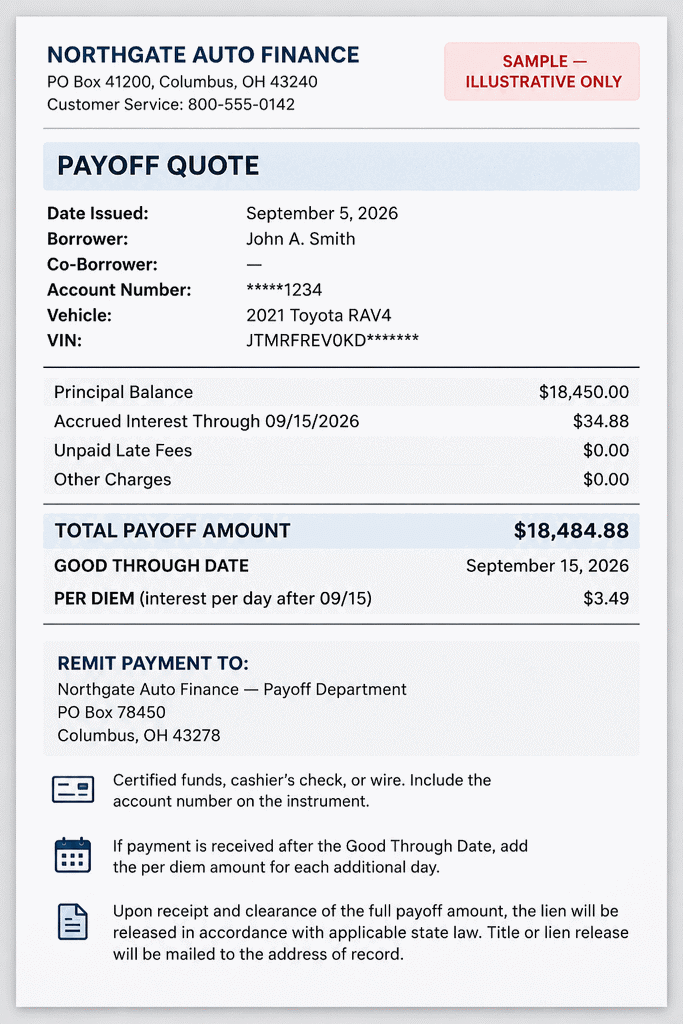
This is a sample for reading practice, not a document you can use. A payoff letter is only valid when your own lender issues it on your account.
How to Read a 10-Day Payoff Letter, Field by Field
1. Total Payoff Amount
The single number to pay. It bundles remaining principal, interest accrued through the good-through date, and any unpaid fees.
It is not your current balance. The Consumer Financial Protection Bureau explains a payoff amount includes interest due through the date you intend to pay plus “other fees you have been charged and have not yet paid.”
GM Financial puts the practical version bluntly: “Interest charges, fees or other charges applied to your account could create a difference in the two balances. Your payoff balance is ultimately what you owe on your account.”
Check: is the number labelled payoff, or current balance? Paying a current balance leaves the loan open.
2. Good-Through Date
The date the quoted amount stops being correct. This — not the phrase “10 days” — is the real deadline.
In the sample it is September 15. Pay $18,484.88 on or before that date and the loan closes. Pay it on the 18th and you are three days short.
These are calendar days. A quote issued the Friday before a holiday weekend loses three of its days to nobody being at a desk.
Toyota Financial Services states its payoff quote is “good for 10 days from the date it is provided” — while warning the amount can still change if returned payments or fees post afterward.
3. Per Diem Interest
Per diem is the interest that accrues each day. On the sample it is $3.49.
The arithmetic behind it, on a simple-interest loan:
Per diem = principal balance × APR ÷ 365
$18,450 × 0.069 ÷ 365 = $3.49
Per diem is how you fix a late payoff. Three days past the good-through date is $3.49 × 3 = $10.47 extra.
Not every letter prints a per diem. If yours does not, call and ask for it — you cannot correct a late payment without it. More on the underlying rate in What Is APR on a Car Loan?
4. Remittance Address and Payment Instructions
The most commonly misread section on the whole letter.
Payoffs frequently go to a different PO Box than your monthly payments. In the sample, customer service is at PO Box 41200 but the payoff goes to PO Box 78450. Sending a payoff to the regular lockbox is one of the most common causes of a final payment being applied as an ordinary monthly payment.
Also read: accepted payment types (many lenders require certified funds or a wire for a payoff), whether the account number must appear on the instrument, and whether an online payoff option exists.
Never use an address from an old statement. Use the one on the current letter.
5. Account and Vehicle Details
Account number, VIN, borrower name, vehicle year and model.
If a refinance lender, dealer, or online buyer is receiving this letter, these fields must match their records exactly. A misspelled name or a wrong VIN gets the letter rejected and costs you days off the good-through date.
6. Lien Release Language
Usually a short paragraph near the bottom stating the lien is released once the payoff clears, and where the title or release will be sent.
Timing is set by state law, not the lender’s preference. New York’s Department of Financial Services states the lender has three business days after the loan is satisfied to provide the release and notify the DMV. GM Financial notes release processes “vary by state” and require the final payment to clear first.
Check the mailing address in this section before you pay. Chase warns that it mails the title or lien release to the address on your billing statements — and flags that in Florida the state does not automatically issue a lien-free title when an electronic lien releases, so you must contact the Florida DMV yourself.
Payoff Letter vs Monthly Statement
| Payoff Letter | Monthly Statement | |
| Purpose | Close the loan completely | Collect the next scheduled payment |
| Amount shown | Full payoff as of a set date | Amount due this cycle |
| Includes future interest | Yes, through the good-through date | No |
| Has an expiry date | Yes | No |
| Payment address | Often a separate payoff address | Standard payment address |
| Shows per diem | Usually | Rarely |
| Issued | On request | Automatically each month |
Can You Write Your Own 10-Day Payoff Letter?
No — and this is worth being clear about, because most of the results for “payoff letter template” are fillable-form websites that imply otherwise.
A payoff letter is a statement of account issued by the creditor. Its value is that the lender is standing behind the figure. A borrower-completed template has no such backing. A refinance lender, dealer, title company, or online buyer will not accept one, because it certifies nothing.
If someone has asked you for a 10-day payoff letter, they are asking you to obtain one from your lender, not to produce one.
Payoff Request Letter Template (the letter you can write)
There is a second document people conflate with the first: the letter you send to your lender asking for a payoff quote. That one you can absolutely write, and some smaller banks and credit unions still prefer a written request.
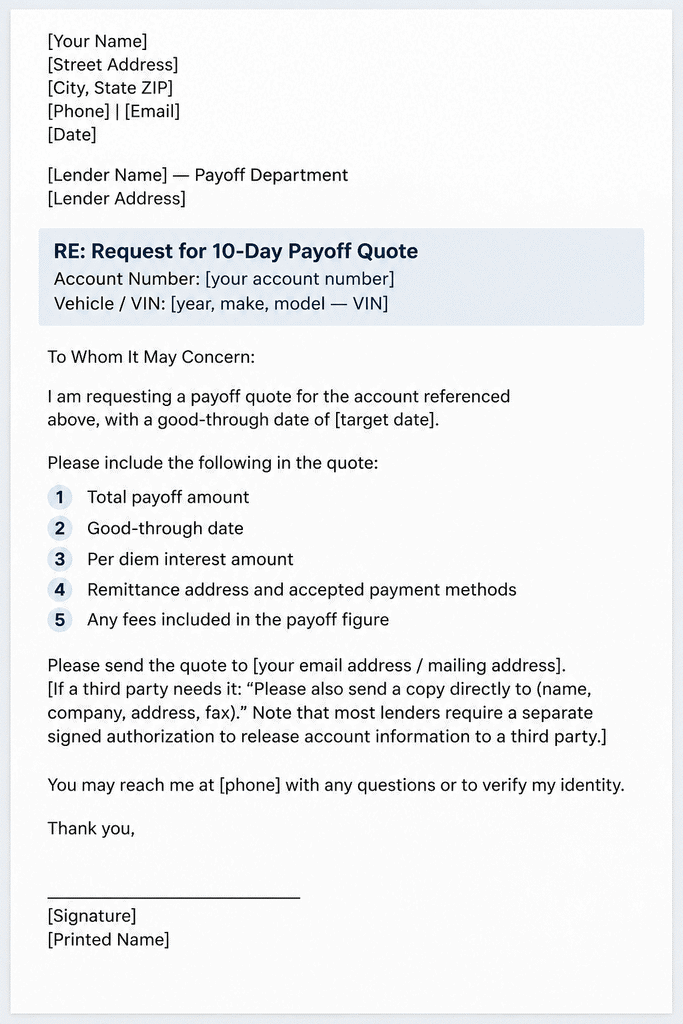
Most large lenders now issue payoff quotes instantly online or in their app, so a written request is usually the slowest route. Use it when there is no self-service option, or when you want a paper trail.
Why Your Payoff Is Higher Than Your Balance
Three reasons, in order of how often they explain the gap:
- Interest accrued between your last payment and the good-through date. This is the bulk of it, and it is the $34.88 line in the sample.
- Fees that have not posted yet — a late fee, a returned-payment fee, a repair or title fee.
- Payment timing. A payment you sent has not been applied yet, so the balance the letter used was higher than the one you are looking at.
A prepayment penalty is a fourth possibility, though uncommon on mainstream auto loans. The CFPB is direct: “Your contract and state law will determine whether you can pay off your auto loan early.” Chase states there is “no pre-payment penalty” on its auto loans, but subprime contracts differ.
What to Do After Reading Your Letter
- Confirm the good-through date is far enough out for your payment method to clear.
- Pay the exact amount on the letter. Do not round down, and do not substitute your own estimate.
- Send it to the payoff remittance address, not the regular payment address.
- Keep autopay running until the balance confirms at zero.
- Get written confirmation the account is paid in full — a $0 dashboard is not the same thing.
- Track the lien release and title, and claim any prorated GAP or warranty refund you are owed. Those are usually not automatic.
Frequently Asked Questions
What does a 10-day payoff letter include?
Borrower and account details, the total payoff amount, the good-through date, the per diem interest, the remittance address and accepted payment methods, and lien release language. Most also itemize principal, accrued interest and fees separately.
What does a 10-day payoff letter look like?
A one-page statement on lender letterhead with an itemized payoff breakdown, a bolded total, a good-through date, a per diem figure, and payment remittance instructions. See the annotated example above.
How long is a payoff letter valid?
Through the good-through date printed on it — commonly ten calendar days from issue, though it varies. After that date the quoted amount is short by the per diem for each extra day.
Can I get a payoff letter online?
Most large auto lenders generate one instantly in your online account or app. Credit unions and smaller banks often require a phone call or a written request.
Is a payoff letter the same as a settlement letter?
No. A payoff letter states the full amount to satisfy the loan as agreed. A settlement letter documents a lender agreeing to accept less than the full balance, which is a different transaction and is typically reported differently on your credit file.
Can I make my own payoff letter?
No. Only the creditor can issue a valid payoff statement. You can write a payoff request letter asking your lender for one — template above.
What if my payment arrives after the good-through date?
The shortfall equals the per diem times the number of extra days. The loan stays open until it is paid. Call for the current figure, pay it electronically the same day, and get written confirmation of payment in full.
Related MoneyMentorDesk Resources
- What Is a 10-Day Payoff?
- What Is APR on a Car Loan?
- Can You Trade In a Financed Car?
- What Is Negative Equity?
- When to Refinance a Car Loan and When to Wait
- Is GAP Insurance Worth It?
Sources
- CFPB — What is a payoff amount and is it the same as my current balance?
- CFPB — Can I prepay my loan at any time without penalty?
- Chase Auto — Loan payoff FAQs
- Toyota Financial Services — Payoff information
- GM Financial — I paid off my car, now what?
- New York State Department of Financial Services — Obtaining a lien release on a vehicle
The sample letter on this page is illustrative and uses a fictional lender. Figures are examples, not quotes. Your lender’s own payoff letter is the only authoritative document. Sources verified August 2026.