
Part of our guide: PCP vs HP: Which Is Cheaper? 5 Key Differences (UK)
There are five types of car finance in the UK, and the difference between them is simply who owns the car and when. PCP, hire purchase and conditional sale all end with you owning the car if you want it. Personal contract hire never does. A personal loan means you own it from day one.
Dealers rarely explain it that way, and the monthly payments are quoted in a manner that makes very different products look alike. This page sets out the five side by side, what each costs on the same car, and the statutory rights that come with them, including the one that leasing does not get.
Types of car finance UK buyers are offered, at a glance
| PCP | HP | Conditional sale | PCH (leasing) | Personal loan | |
|---|---|---|---|---|---|
| Do you end up owning it? | Only if you pay the final payment | Yes, after the last payment | Yes, automatically | No | Yes, from the start |
| Monthly payment | Lowest of the three purchase routes | Higher | Higher | Often lowest overall | Depends on the loan |
| Large final payment | Yes, optional | No | No | No | No |
| Mileage limit | Yes | No | No | Yes | No |
| Who owns the car during the agreement | The lender | The lender | The lender | The leasing company | You |
| Hand it back early under s.99? | Yes | Yes | Yes | No | No, but you can sell it |
Which type of car finance do you actually have?
Four checks on the paperwork settle it, and they beat whatever was said in the showroom.
- Read the document title. It names the agreement type, and that is what governs.
- Look for a large optional final payment. That plus a mileage limit means PCP.
- Look for an option-to-purchase fee. Hire purchase and PCP have one, conditional sale does not.
- Check whether ownership transfers at all. If nothing in the agreement lets you keep the car, it is a hire agreement rather than a purchase.
PCP: the lowest monthly payment, with a decision at the end
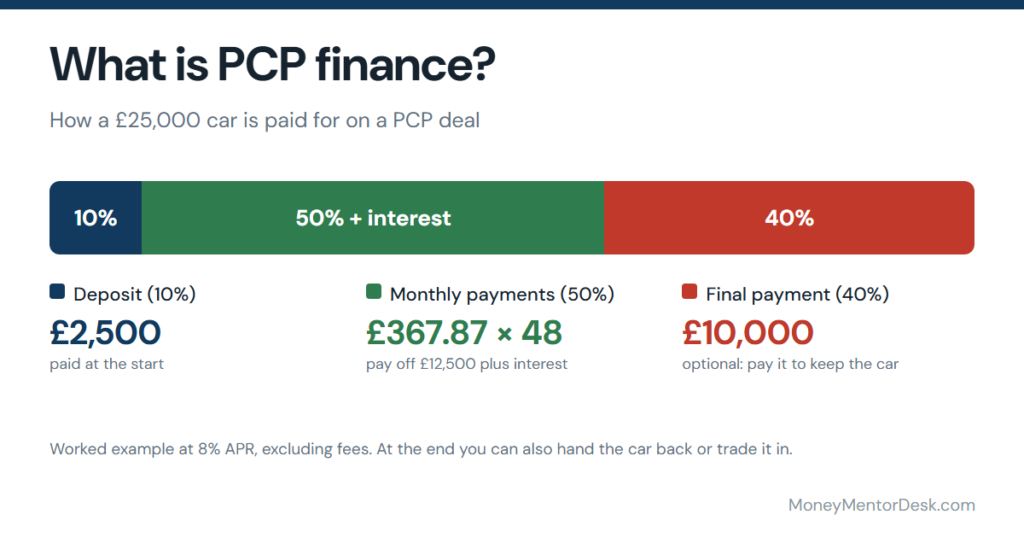
A personal contract purchase defers a large part of the car’s price to the end as an optional final payment, known as the guaranteed minimum future value. Your monthly payments cover the gap between the amount financed and that figure, plus interest on the whole balance.
At the end you pay the final payment and keep the car, hand it back and owe nothing more, or part-exchange it and use any surplus as a deposit. The lender carries the depreciation risk, which is the real benefit: if the car is worth less than the final payment, that shortfall is theirs.
The cost of that flexibility is interest on money you have not used yet. See what PCP finance is for the mechanics and balloon payment car finance for what the final payment really costs.
Hire purchase: simple, and you own it at the end
Hire purchase spreads the entire price across the monthly payments. There is no large final payment, no mileage limit and no condition inspection, because nobody is taking the car back. Once the last payment and any option-to-purchase fee are made, the car is yours.
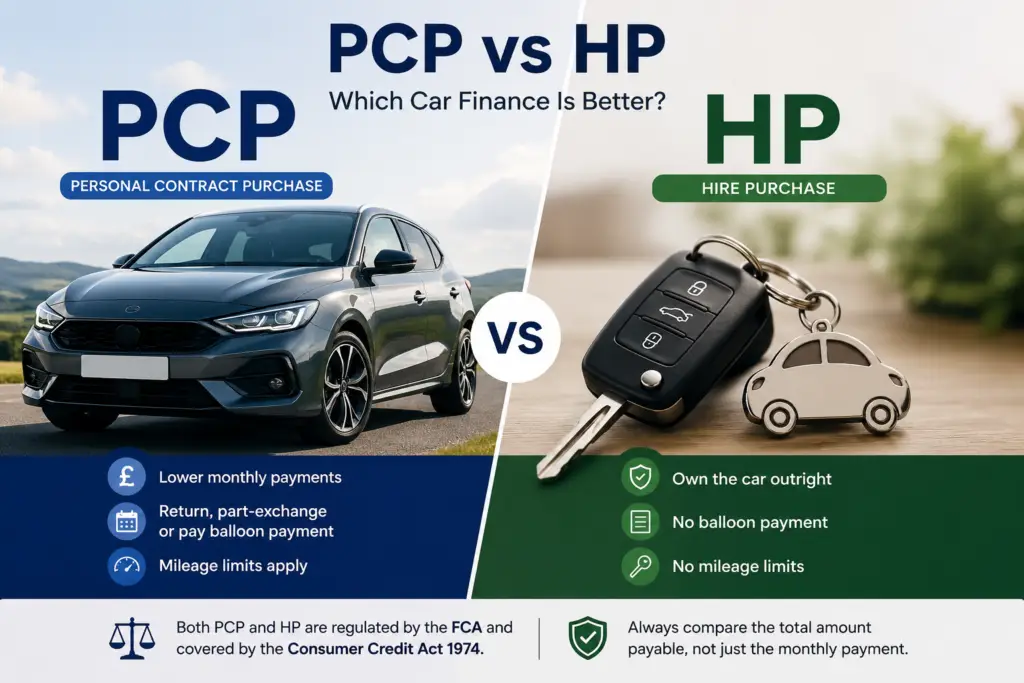
Payments are higher than PCP on the same car, and the total is lower. It suits drivers who keep cars, cover high mileage, or simply want the arrangement to be over at the end. Our full comparison is in PCP vs HP.
Conditional sale: hire purchase without the option fee
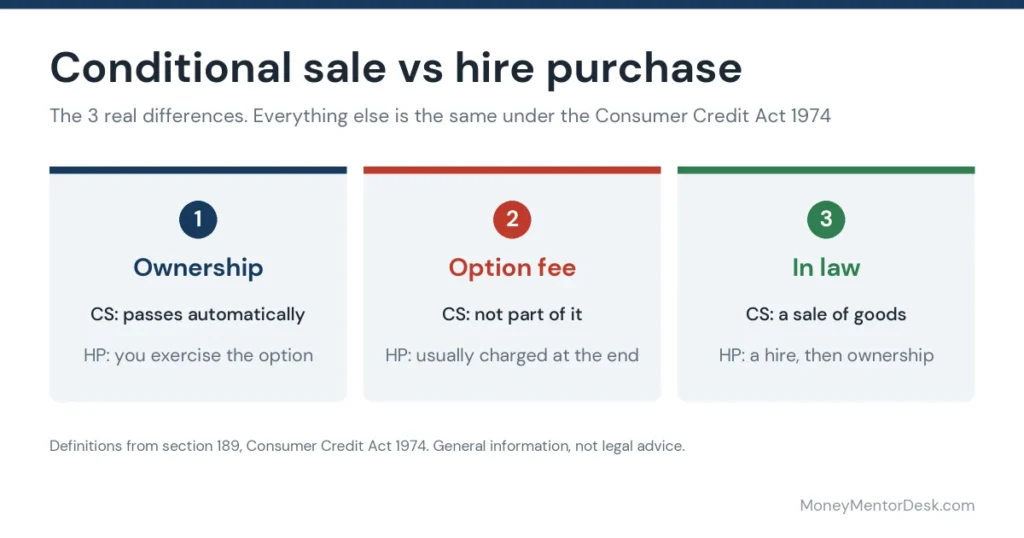
A conditional sale works almost identically to hire purchase, with one legal difference. Ownership passes automatically once the conditions are met, normally meaning all payments have been made. There is no option to exercise and no option-to-purchase fee.
Dealers write it as CS on quotes, which is why searches for cs vs hp are so common. The differences are covered in conditional sale vs hire purchase and, against PCP, in PCP vs CS.
Personal contract hire: long-term rental
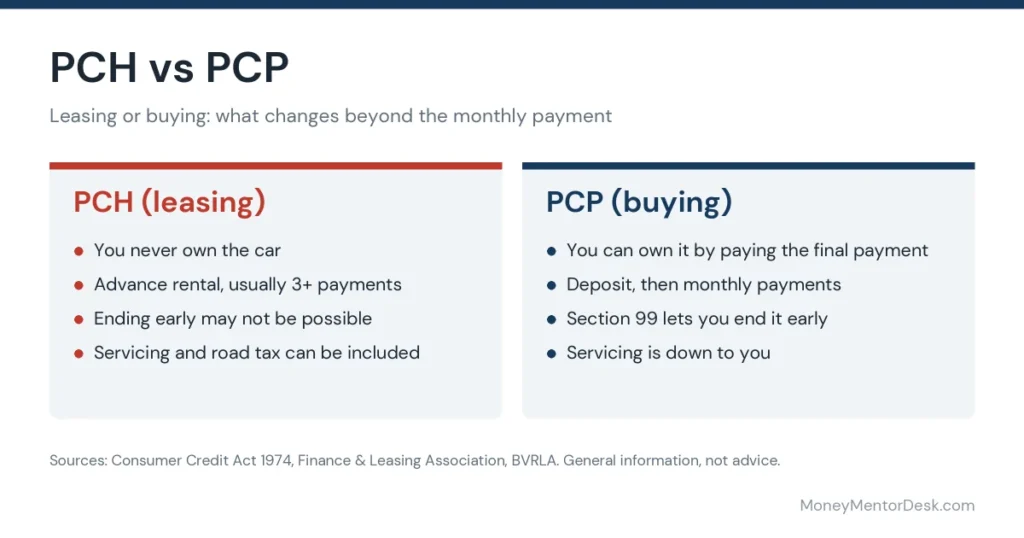
PCH is leasing. You pay an initial rental and then monthly rentals for an agreed term and mileage, and at the end you hand the car back. There is no option to buy it, because you were never buying it.
It can be the cheapest way to drive a new car, and maintenance packages are often available. It is also the least flexible, for a reason most comparisons miss, set out in the next section. See PCH vs PCP.
Personal loan: you own the car outright
An unsecured personal loan is not car finance at all in the legal sense. You borrow the money, buy the car as a cash buyer, and the loan sits separately from the vehicle.
- The upside: the car is yours immediately, so you can sell it, modify it or do whatever you like without asking anyone. No mileage limits, no condition standards.
- The downside: the loan is unsecured, so rates are often higher than secured car finance for the same borrower. You also carry all the depreciation risk, and you have no voluntary termination right, because there is no hire or purchase agreement to end.
- Buying privately? This is usually the only practical route, because dealer finance is arranged through the dealer.
The right three of them share, and leasing does not
Early exit is the difference that costs people the most, and it is almost never mentioned when a lease is being sold.
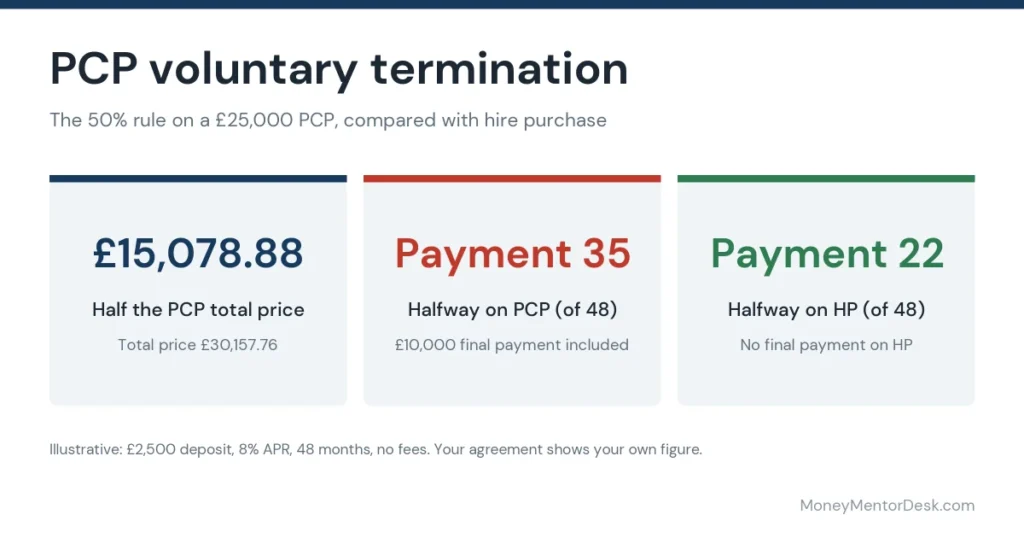
Section 99 of the Consumer Credit Act 1974 lets you end a regulated hire-purchase or conditional sale agreement at any time before the final payment falls due, and section 100 caps what you owe at half the total price. Because a PCP is normally a hire purchase agreement, all three purchase routes carry this right.
Leasing is a consumer hire agreement, so a different section applies. Section 101 does allow a hirer to terminate, but only after the agreement has run for 18 months, and subsection (7) removes the right entirely where the payments exceed £1,500 in any year.
That threshold matters more than it looks. £1,500 a year is £125 a month. Almost every car lease costs more than that, which means in practice most car leases carry no statutory right to end the agreement early at all. If you need out, you are relying on whatever the leasing company’s own early termination terms say, and those usually involve paying a large share of the remaining rentals.
So if there is any chance your circumstances will change, that is a strong argument for a purchase agreement over a lease, whatever the monthly comparison says. Our guide to PCP voluntary termination explains how the half rule works when you do have the right.
What the types of car finance cost on the same car
A £25,000 car with a £2,500 deposit over 48 months at 8% APR, with a £10,000 final payment on the PCP:
| Monthly | Final payment | Total paid | You end up with | |
|---|---|---|---|---|
| PCP, keeping the car | £367.87 | £10,000 | £30,157.76 | The car |
| PCP, handing it back | £367.87 | None | £20,157.76 | Nothing |
| Hire purchase | £546.35 | None | £28,724.80 | The car |
| Conditional sale | £546.35 | None | £28,724.80 | The car |

Keeping the car costs £1,432.96 more on the PCP, which is the interest charged on the deferred £10,000 across the whole term. Handing it back means four years of motoring for £20,157.76 and nothing to show at the end. Neither is wrong. They are different purchases.
Where to get each of the types of car finance UK lenders offer
The car finance options UK buyers are shown depend partly on where they ask. The same agreement can be arranged in four different places, and the route changes the rate, the paperwork and who you complain to if it goes wrong.
- At the dealership. Most PCP, HP and conditional sale agreements are arranged this way, usually through the manufacturer’s own finance arm. Convenient, and the place where manufacturer deposit contributions and low promotional rates live. It is also where the monthly payment gets quoted before the total does.
- Through a broker. Brokers search several lenders, which helps if your credit file is less than perfect. Ask how they are paid and whether the quote is a representative rate or a decision.
- From a bank or building society. Usually a personal loan rather than car finance, so you buy as a cash buyer. Worth comparing even when the showroom rate looks competitive.
- Direct from an online lender. Often a personal loan or a pre-approval you take to the dealer, which turns you into a cash buyer and separates the car negotiation from the finance negotiation.
Whichever route, the comparable figure is the APR and the total amount payable, not the monthly payment. A deposit contribution that looks generous can be funded by a higher rate across the term.
Car finance explained: the words that trip people up
| Term | What it actually means |
|---|---|
| APR | The yearly cost of the credit including compulsory fees. The only figure that compares two quotes properly |
| Flat rate | Interest quoted on the original amount rather than the falling balance, so it looks lower than the APR for the same cost |
| Representative APR | An advertising figure offered to a proportion of successful applicants. Yours may be higher |
| Total amount payable | Everything you will pay across the agreement, including the deposit and any final payment |
| GFV or balloon | The optional final payment on a PCP, set at the start as the car’s guaranteed minimum future value |
| Equity | The car’s value above what you still owe. On a PCP this can become the deposit on the next car |
| Negative equity | Owing more than the car is worth, which usually gets carried into the next agreement and makes it more expensive |
| Settlement figure | What it costs to clear the agreement today, including a rebate of future interest under section 94 |
If a salesperson answers a question about the total with a figure about the monthly payment, ask again. The pre-contract credit information sets out the APR, the duration, the total amount payable and every fee in one place, and you are entitled to see it before you sign.
Choosing between the types of car finance
- You want to own the car and keep it for years: hire purchase or conditional sale. Lowest total cost, no mileage limit.
- You change cars every three or four years: PCP. The lender carries the depreciation risk and part-exchanging is straightforward.
- You want the lowest cost of driving a new car and never want to own it: PCH, as long as you are confident the agreement will run its full term.
- You drive high mileage: hire purchase, conditional sale or a personal loan. Mileage limits make PCP and PCH expensive.
- You are buying privately: a personal loan, usually the only route.
- Your circumstances might change: any of the three purchase routes, because of the section 99 right above.
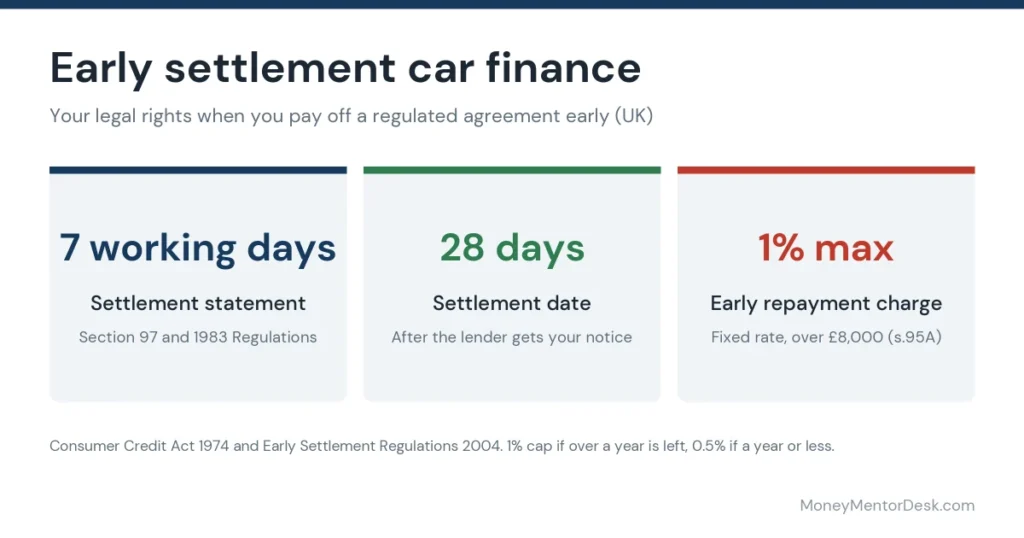
Whichever you choose, compare quotes on the total amount payable rather than the monthly figure, and check the APR rather than a flat rate or a representative rate. See early settlement of car finance for your rights if you want to clear it sooner.
Types of car finance: FAQs
What are the main types of car finance in the UK?
u003cpu003eFive: personal contract purchase (PCP), hire purchase (HP), conditional sale (CS), personal contract hire (PCH, which is leasing) and a personal loan. The first three end with you owning the car, leasing never does, and a personal loan means you own it from the start.u003c/pu003e
Which type of car finance is cheapest?
u003cpu003eOn total cost, hire purchase or conditional sale among the purchase routes. On a u0026pound;25,000 car over 48 months at 8% APR, hire purchase totals u0026pound;28,724.80 against u0026pound;30,157.76 on a PCP with a u0026pound;10,000 final payment. Leasing can be cheaper per month, but you never own the car.u003c/pu003e
What is the difference between PCP and HP?
u003cpu003eThe final payment. A PCP defers a large optional payment to the end, so monthly payments are lower and the total is higher. Hire purchase spreads the whole price across the monthly payments, so it costs more each month and less overall, and the car is yours at the end.u003c/pu003e
Can I end any car finance agreement early?
u003cpu003eNot all of them. Section 99 of the Consumer Credit Act 1974 covers hire purchase and conditional sale, which includes PCP, and caps what you owe at half the total price under section 100. Leasing is a consumer hire agreement under section 101, where the right only applies after 18 months and not at all where payments exceed u0026pound;1,500 a year, which covers most car leases.u003c/pu003e
Do you own the car on car finance?
u003cpu003eNot during the agreement on PCP, hire purchase or conditional sale. The lender owns it until the conditions are met or the option is exercised. On leasing you never own it. With a personal loan you own the car immediately, because you bought it as a cash buyer.u003c/pu003e
Which type of car finance is best for high mileage?
u003cpu003eHire purchase, conditional sale or a personal loan. PCP and leasing both set annual mileage limits with a charge per mile over, because the lender needs the car to hold its value for when it comes back.u003c/pu003e
Is a personal loan better than car finance?
u003cpu003eIt depends on the rate and what you want. A personal loan is unsecured, so rates are often higher for the same borrower, but you own the car outright with no mileage limits or condition standards, and you can sell it whenever you like. For private purchases it is usually the only option.u003c/pu003e
Sources
- Consumer Credit Act 1974: section 99 and section 100 (terminating hire-purchase and conditional sale agreements, and the half rule), section 101 (terminating consumer hire agreements, the 18-month rule and the £1,500 a year exclusion in subsection (7)), section 94 (early settlement), legislation.gov.uk, checked 1 October 2026
- Worked example calculated by MoneyMentorDesk using the standard amortising formula, with the APR treated as an effective annual rate
This guide is general information, not financial advice. Your own agreement decides what applies to you, including the APR, the total amount payable, any final payment, the mileage limit and the fees.
Written by Nimra Saleem for MoneyMentorDesk.com. Last reviewed on 1 October 2026 against the Consumer Credit Act 1974 on legislation.gov.uk.
Pingback: PCP vs HP: Which Is Cheaper? 5 Differences + Real Costs