
Part of our guide: PCP vs HP: Which Is Cheaper? 5 Key Differences (UK)
PCP vs CS comes down to one question: do you want to own the car at the end, or keep the option to walk away from it? A conditional sale (CS) always ends in ownership once you have made every payment. A PCP defers a large optional final payment, so you can pay it and keep the car, or hand the car back instead.
Dealers write it either way round, so CS vs PCP and PCP vs conditional sale are the same comparison. That single difference drives everything else: the monthly payment, the total cost, whether mileage limits apply, and how soon you can hand the car back under your statutory rights.
PCP vs CS: the short answer
| PCP | CS (conditional sale) | |
|---|---|---|
| Do you end up owning the car? | Only if you pay the final payment | Yes, automatically, once all payments are made |
| Monthly payment | Lower | Higher |
| Final payment | Large and optional | None |
| Total cost if you keep the car | Higher | Lower |
| Can you hand the car back at the end? | Yes | No, you are buying it |
| Mileage limit | Yes, and it matters if you hand the car back | No |
| Option-to-purchase fee | Usually charged | Not part of the structure |
| Voluntary termination under s.99 | Yes | Yes |
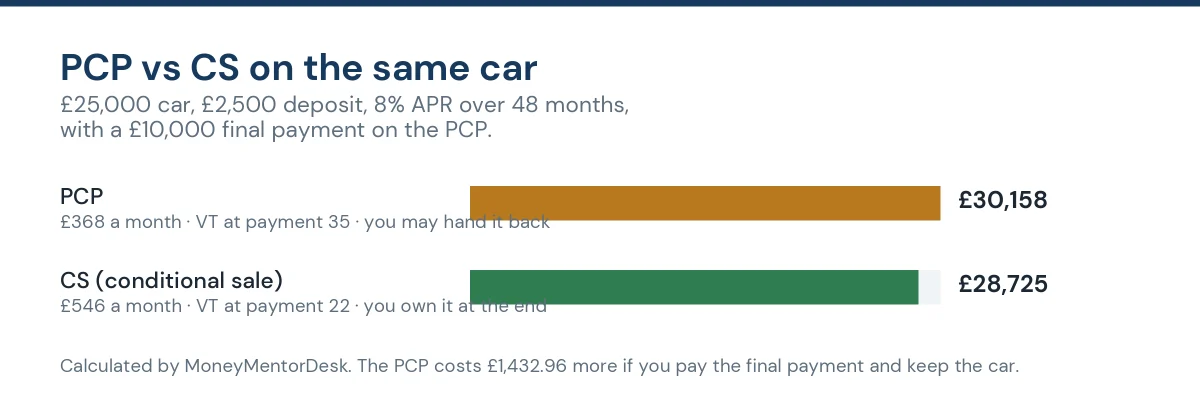
PCP vs CS: the difference in pounds, on the same car
Take a £25,000 car with a £2,500 deposit over 48 months at 8% APR. The PCP has a £10,000 final payment; the conditional sale spreads the whole amount:
| PCP | CS | |
|---|---|---|
| Monthly payment | £367.87 | £546.35 |
| 48 monthly payments | £17,657.76 | £26,224.80 |
| Final payment | £10,000.00 | None |
| Total paid, including deposit | £30,157.76 | £28,724.80 |
| Interest | £5,157.76 | £3,724.80 |
The PCP costs £178.48 a month less. If you pay the final payment and keep the car, it costs £1,432.96 more in total, because you owe that £10,000 for the whole four years and interest runs on it throughout. Put the same numbers into the UK car finance calculator to see it with your own deposit and rate.
Difference 1: how you become the owner
On a conditional sale the transfer is automatic. Once the conditions in the agreement are met, normally meaning every payment has been made, the car becomes yours. There is nothing to opt into and no separate fee to pay.
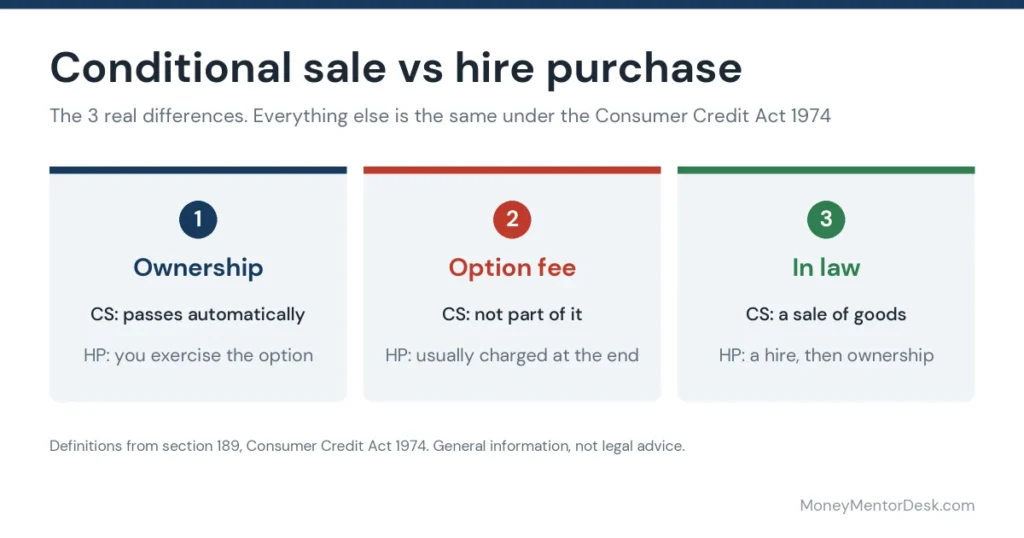
A PCP is normally structured as a hire purchase agreement, so ownership passes when you exercise the option to purchase, which in practice means paying the final payment and usually an option-to-purchase fee. Until then the finance company owns the car. Our guide to conditional sale vs hire purchase covers that structural difference in detail.
Difference 2: the exit at the end
The exit route is the reason most people choose one over the other.
At the end of a PCP you have three routes: pay the final payment and keep the car, hand the car back and owe nothing more provided you are within the mileage limit and the car is in the agreed condition, or part-exchange it and put any value above the final payment towards the next car.
A conditional sale has one route. You are buying the car, and at the end you own it. If you want out before then, your options are to settle early or to use voluntary termination, both covered below.
Difference 3: mileage and condition
A PCP sets an annual mileage limit and a condition standard, because the lender has guaranteed a future value for the car. Go over the mileage and you pay the excess rate in the agreement; damage beyond fair wear and tear is chargeable too. Both only bite if you hand the car back. Pay the final payment and neither applies.
A conditional sale has no mileage limit and no end-of-agreement inspection, because nobody is taking the car back. If you drive a lot, that alone can settle the PCP vs CS question.
Difference 4: when you reach the voluntary termination halfway point
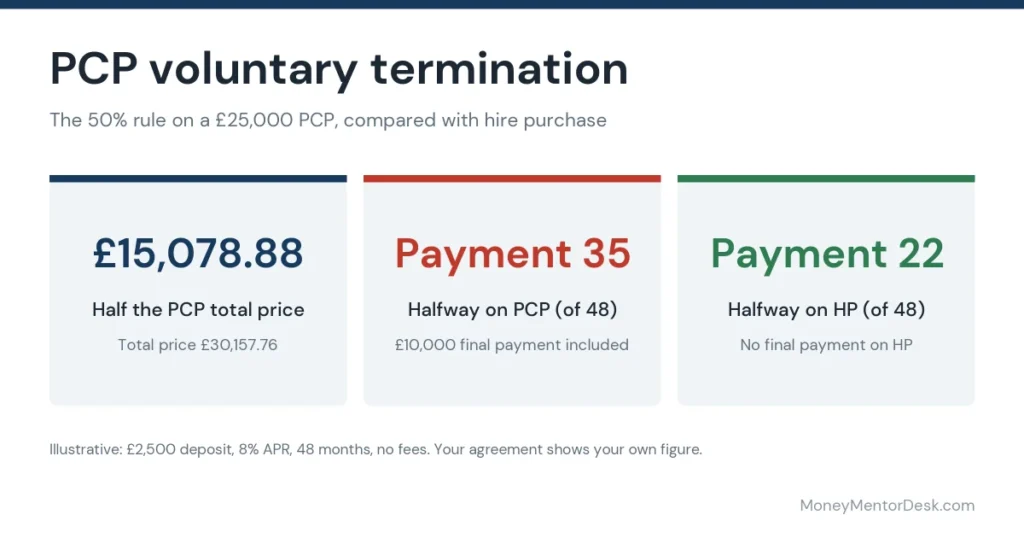
Both agreements carry the same statutory right. Section 99 of the Consumer Credit Act 1974 says that “at any time before the final payment by the debtor under a regulated hire-purchase or regulated conditional sale agreement falls due, the debtor shall be entitled to terminate the agreement”. Section 100 caps what you owe at half the total price, less what you have already paid.
The right is identical. When you reach it is not. Because the PCP total price includes that £10,000 final payment, half of the PCP total is a bigger number than half of the CS total, and your lower monthly payments take longer to get there.
| PCP | CS | |
|---|---|---|
| Total price | £30,157.76 | £28,724.80 |
| Half the total price | £15,078.88 | £14,362.40 |
| Reached after | payment 35 | payment 22 |
Thirteen months of difference on the same car. If the ability to hand the car back partway through matters to you, the conditional sale gets you there sooner. Our guide to PCP voluntary termination walks through the process and the paperwork.
One narrow point specific to conditional sale: section 99(4) says that where the goods have become yours and are then transferred to someone who is not the debtor under the agreement, you lose the right to terminate. In plain terms, pass the car on once it is yours and voluntary termination is no longer available.
What works the same on both
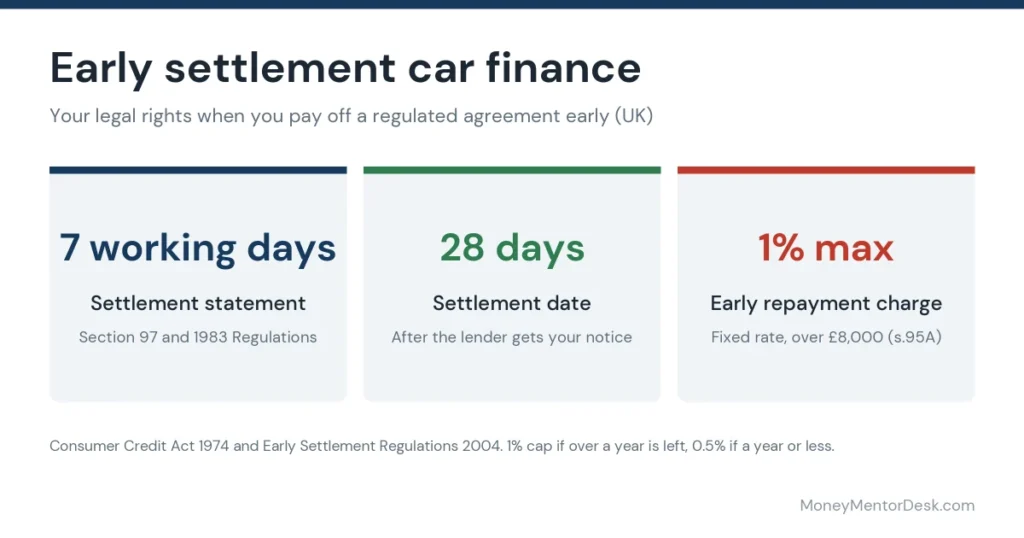
- Early settlement. Section 94 lets you settle at any time with a rebate of future interest. See early settlement of car finance.
- Protection from repossession. Under section 90, once you have paid at least a third of the total price the lender needs a court order to take the car.
- The 14-day right to withdraw from the credit agreement under section 66A.
- Faulty car rights. The Consumer Rights Act 2015 applies, and your claim is against the finance company rather than the dealer.
- You cannot sell the car mid-agreement until ownership has passed or the agreement is settled.
Which should you choose?
On the PCP vs CS question, the answer usually follows from what you want at the end. A conditional sale suits you if you want to own the car and keep it, you want the lowest total cost, you drive high mileage, or you want to reach the voluntary termination halfway point sooner.
A PCP suits you if you want the lowest monthly payment for a given car, you change cars every three or four years, your mileage is predictable, and you want the option to walk away at the end without having to sell the car yourself.
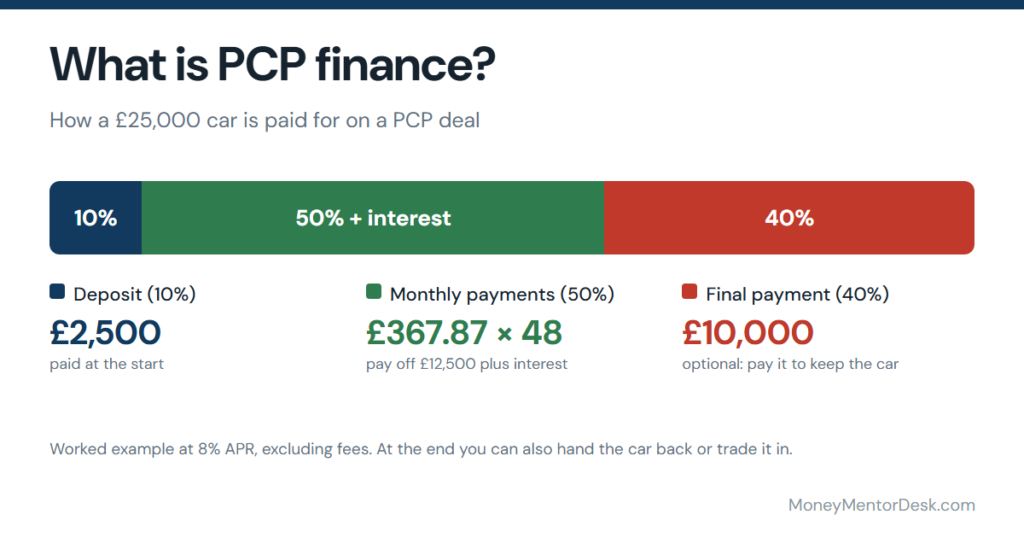
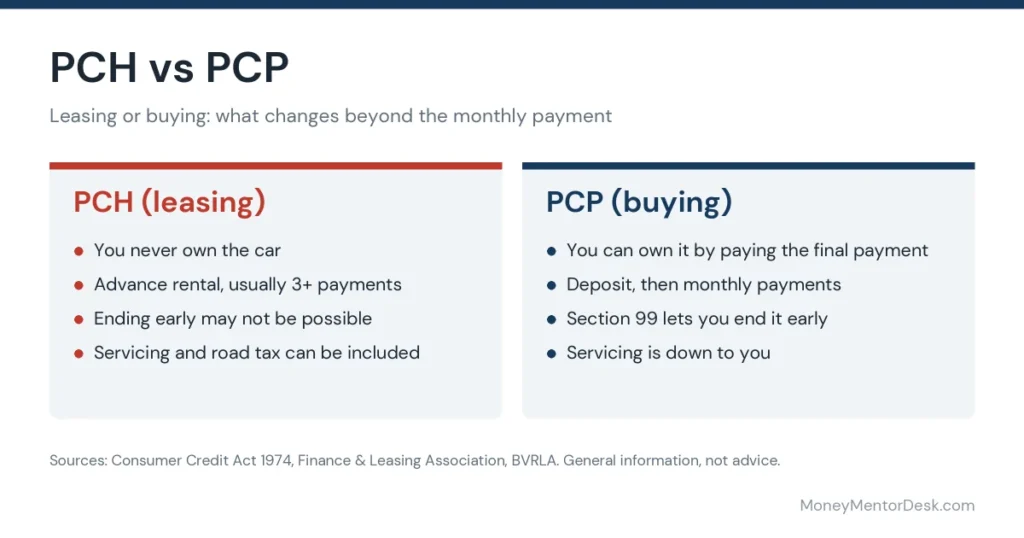
Comparing against hire purchase instead? See PCP vs HP. If you never want to own the car at all, PCH vs PCP covers leasing. And for how a PCP is put together in the first place, see what PCP finance is.
For the final payment itself, including what to do if you cannot pay it, see balloon payment car finance.
PCP vs CS: who carries the depreciation risk
Depreciation risk is the difference that matters most and gets discussed least. On a PCP the final payment is a guaranteed minimum future value, which means the lender has committed to that figure. On a conditional sale nobody has guaranteed anything, because you are buying the car outright.
Take the £25,000 car with a £10,000 final payment and imagine two endings:
| The car is worth | On the PCP | On the conditional sale |
|---|---|---|
| £12,000 | Pay £10,000 and keep £2,000 of equity, or part-exchange and use it as a deposit | You own a car worth £12,000 |
| £10,000 | Break even either way | You own a car worth £10,000 |
| £7,000 | Hand it back and walk away. The £3,000 shortfall is the lender’s | You own a car worth £7,000, having paid in full |
The PCP is more expensive in total precisely because of that last row. You are paying for an option: the right to walk away if the car has lost more value than expected. A conditional sale is cheaper because you are carrying that risk yourself.
So the question is not only which is cheaper. It is whether you would rather pay about £1,433 for protection against depreciation, or keep the money and accept the risk.
Getting out early: three routes compared
| Route | How it works | PCP | CS |
|---|---|---|---|
| Settle early (s.94) | Pay the settlement figure, with a rebate of future interest | Includes the final payment in the figure | No final payment to include, so usually lower |
| Voluntary termination (s.99, s.100) | Hand the car back once you have paid half the total price | Halfway at payment 35 on our example | Halfway at payment 22 |
| Sell or part-exchange | Settle the finance from the proceeds | Possible once the settlement figure is covered | Same, and simpler once ownership has passed |
The right route depends on what the car is worth against the settlement figure. If it is worth more, selling or part-exchanging usually beats voluntary termination, because you keep the difference. If it is worth less, voluntary termination caps your exposure at half the total price.
How to tell which one you have been offered
Dealers use the abbreviations casually, and the monthly payments can look similar. Four checks settle it from the paperwork alone.
- Read the document title. It will name the agreement type, and that is what governs, not what was said in the showroom.
- Look for an optional final payment. A large final figure described as optional, alongside a mileage limit, means PCP.
- Look for an option-to-purchase fee. Conditional sale does not have one, because ownership passes automatically.
- Check for a mileage limit and a condition standard. Both point to PCP, because the lender may be taking the car back.
If a quote shows a large final payment and no mileage limit, ask directly whether that payment is optional. A compulsory final payment means you are committed to buying the car, whatever the agreement is called.
PCP vs CS FAQs
What is the difference between CS and PCP?
A conditional sale always ends with you owning the car once every payment is made. A PCP defers a large optional final payment, so you choose at the end whether to pay it and keep the car or hand the car back. That is why PCP monthly payments are lower and the total cost is higher if you keep the car.
Is CS or PCP cheaper?
PCP is cheaper monthly, CS is cheaper overall. On a £25,000 car with a £2,500 deposit over 48 months at 8% APR with a £10,000 final payment, PCP costs £178.48 a month less but £1,432.96 more in total if you pay the final payment and keep the car.
Can you hand a conditional sale car back?
Not at the end, because you are buying it. During the agreement you can use voluntary termination under section 99 of the Consumer Credit Act 1974, which caps what you owe at half the total price under section 100, or settle early under section 94.
Does a conditional sale have a mileage limit?
No. Mileage limits and condition standards exist on PCP because the lender has guaranteed a future value for the car it may take back. A conditional sale has neither, which makes it the better fit for high-mileage drivers.
Do you own the car on a conditional sale?
Yes, once the conditions are met, which normally means all payments have been made. Ownership passes automatically and there is no option-to-purchase fee, unlike hire purchase and PCP where you exercise an option to become the owner.
When can I voluntarily terminate a PCP compared with a CS?
Later on a PCP. The halfway point under section 100 is based on the total price, and the PCP total includes the optional final payment. On the same car in our example, half is reached after payment 22 on the conditional sale and payment 35 on the PCP, a difference of 13 months.
Comparing more than these two? Types of car finance in the UK sets out all five.
Sources
- Consumer Credit Act 1974: section 99 (right to terminate hire-purchase and conditional sale agreements, including subsection (4)), section 100 (the half rule), section 90 (protected goods), section 94 (early settlement), section 66A (withdrawal), legislation.gov.uk, checked 27 September 2026
- Consumer Rights Act 2015, section 3 (contracts to supply goods, including hire purchase and conditional sale), checked 27 September 2026
- Worked example and the halfway calculation produced by MoneyMentorDesk, using the same method as our UK car finance calculator
This guide is general information, not financial or legal advice. Check the agreement in front of you, including the APR, the total amount payable, the final payment, the mileage limit and any fees.
Written by Nimra Saleem for MoneyMentorDesk.com. Last reviewed on 27 September 2026 against the Consumer Credit Act 1974 on legislation.gov.uk.
Pingback: Balloon Payment Car Finance: 5 Options at the End
Pingback: Car Finance Calculator UK: Compare PCP vs HP in 4 Steps
Pingback: Conditional Sale vs Hire Purchase: The 3 Key Differences
Pingback: PCP vs HP: Which Is Cheaper? 5 Differences + Real Costs