
Part of our guide: PCP vs HP: Which Is Cheaper? 5 Key Differences (UK)
This car finance calculator UK drivers can use compares PCP and HP side by side on the same car, so you can see the monthly payment, the final balloon payment and what each one costs in total. Enter the price, your deposit, the APR and the term, then add the final payment from your PCP quote. Leave that box blank and it works as an HP car finance calculator; fill it in and it works as a PCP car finance calculator, the tool a PCP calculator UK search is usually looking for.
The gap between the two is not the monthly payment. It is the interest charged on the final payment for the whole agreement, which only shows up in the total.
UK Car Finance Calculator: PCP vs HP
Compare the monthly payment, the final balloon payment and the total cost of both.
| PCP | HP | |
|---|---|---|
| Monthly payment | — | — |
| Monthly payments total | — | — |
| Final payment | — | — |
| Total paid, including deposit | — | — |
| Interest | — | — |
Illustrative only, not financial advice. The APR is treated as an effective annual rate and no fees are included, so your agreement will differ. PCP assumes you pay the final payment to keep the car. Mileage limits and condition charges are not modelled. Always compare the total amount payable on your own quote.
How this car finance calculator works
Both agreements finance the same amount: the car price minus your deposit. The difference is what happens to the final payment.
- HP spreads the whole amount across the monthly payments. Once the last one is paid, the car is yours.
- PCP defers a large final payment to the end, so the monthly payments only cover the gap between the amount financed and that final figure, plus interest on everything.
The calculator treats the APR as an effective annual rate and charges interest monthly on the balance outstanding, including on the deferred final payment. It excludes fees, so a real agreement with an option-to-purchase fee or a documentation fee will cost slightly more. Compare the total amount payable on your own quote, which lenders must show you.
A worked example: £25,000 car at 8% APR
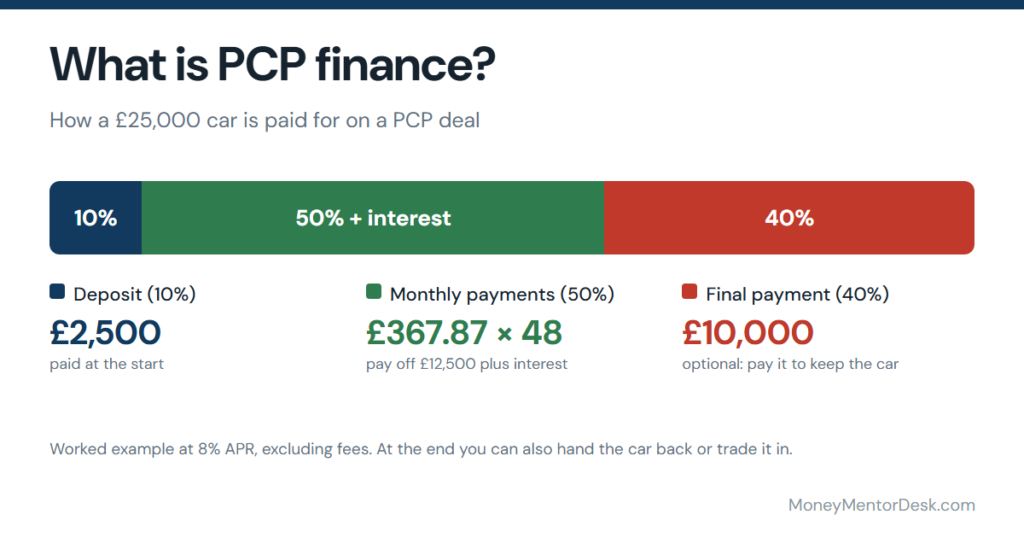
A £25,000 car with a £2,500 deposit over 48 months at 8% APR, with a £10,000 final payment on the PCP:
| PCP | HP | |
|---|---|---|
| Monthly payment | £367.87 | £546.35 |
| 48 monthly payments | £17,657.76 | £26,224.80 |
| Final payment | £10,000.00 | None |
| Total paid, including deposit | £30,157.76 | £28,724.80 |
| Interest | £5,157.76 | £3,724.80 |
PCP costs £178.48 a month less. If you pay the final payment and keep the car, it costs £1,432.96 more in total. That is the price of the lower monthly payment: you owe the £10,000 for the full four years and interest runs on it throughout.
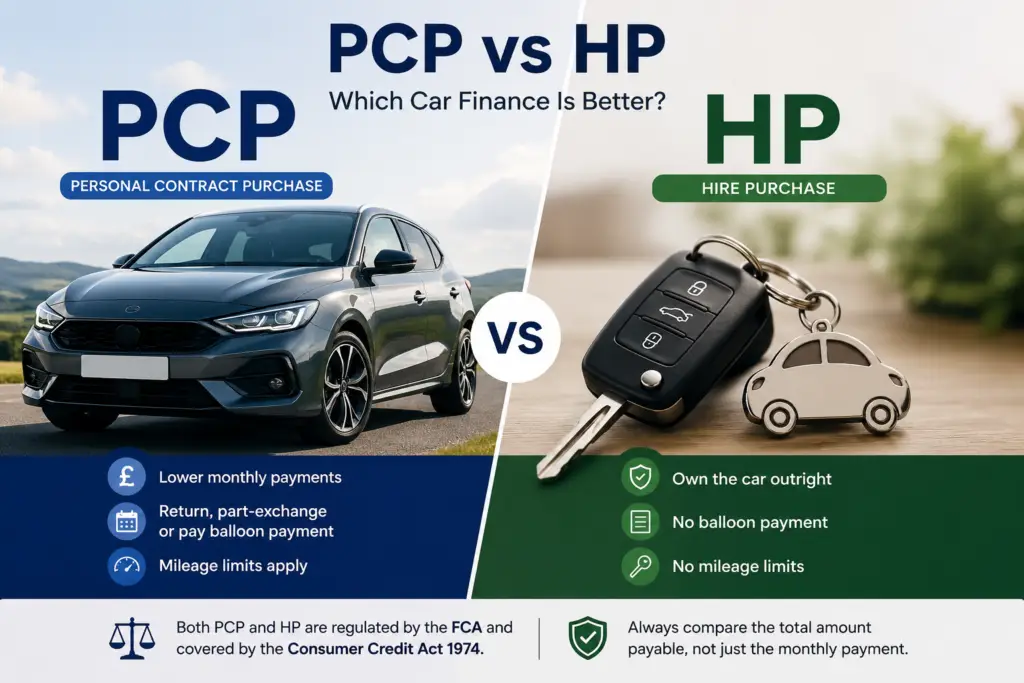
Hand the PCP car back instead and you have paid £20,157.76 for four years of use and own nothing. On HP you have paid £28,724.80 and own a four-year-old car. Neither is automatically better. Our full comparison of PCP vs HP works through which suits which driver.
Car finance calculator UK: what the figures exclude
Treat the car finance calculator UK figures above as a like-for-like comparison of two structures, not as a quote. These are the parts it leaves out.
- Fees. Option-to-purchase and documentation fees are common on PCP and are not modelled here.
- Mileage and condition. PCP sets an annual mileage limit and a condition standard. They only bite if you hand the car back, but excess mileage charges can be significant.
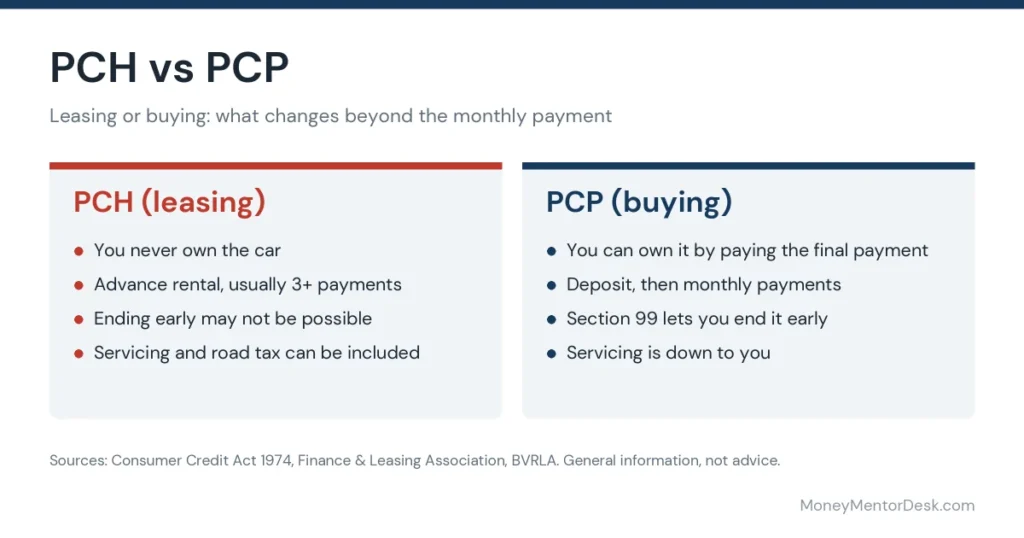
- Servicing, road tax and insurance. Neither agreement includes them. If you want those bundled and never want to own the car, that is personal contract hire, compared in PCH vs PCP.
- Negative equity carried over from an existing agreement.
Your rights on both agreements
PCP and HP are normally regulated agreements under the Consumer Credit Act 1974, so the same statutory rights apply to both:
- Withdraw within 14 days under section 66A, then repay the credit plus interest for the days you had it.
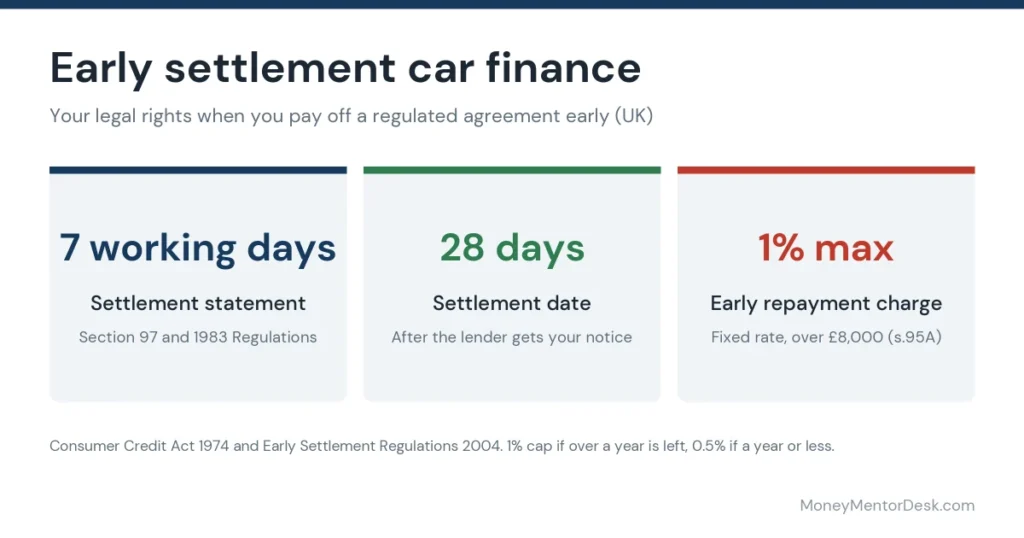
- Settle early at any time under section 94, with a rebate of future interest. See early settlement of car finance.
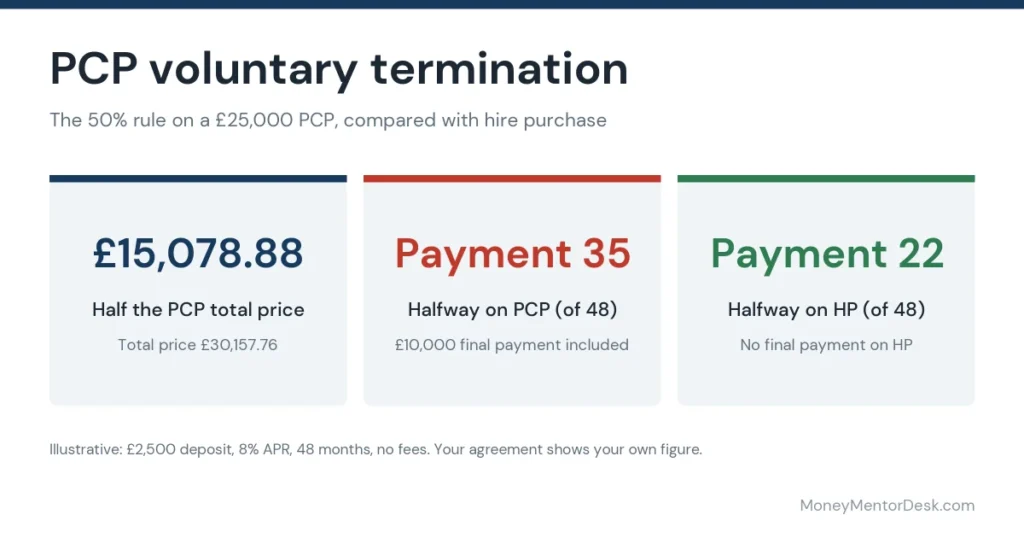
- End the agreement and hand the car back under section 99, with what you owe capped at half the total price under section 100. Because the PCP total includes the final payment, you reach halfway much later on PCP. See PCP voluntary termination.
- Protection from repossession under section 90 once you have paid a third of the total price.
If you are comparing a US car loan instead, our early payoff calculator and the car loan payoff guide cover the American side, where the rules are different.
Comparing a conditional sale as well? See PCP vs CS.
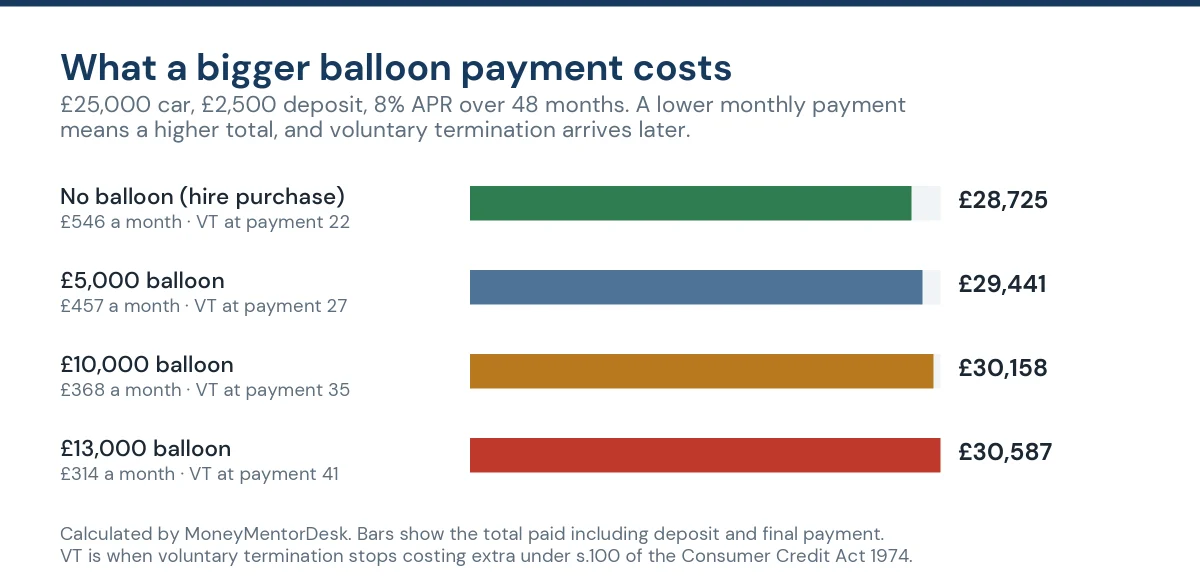
What a bigger balloon payment actually does
Dealers can move the monthly payment a long way by changing the final payment. It is worth seeing what that trade really costs, on the same car at the same rate and term:
| Final payment | Monthly | Total paid | Interest | Halfway point reached |
|---|---|---|---|---|
| £0 (an HP agreement) | £546.35 | £28,724.80 | £3,724.80 | payment 22 |
| £2,500 | £501.73 | £29,083.04 | £4,083.04 | payment 24 |
| £5,000 | £457.11 | £29,441.28 | £4,441.28 | payment 27 |
| £7,500 | £412.49 | £29,799.52 | £4,799.52 | payment 31 |
| £10,000 | £367.87 | £30,157.76 | £5,157.76 | payment 35 |
| £13,000 | £314.32 | £30,587.36 | £5,587.36 | payment 41 |
Two things move in opposite directions. Raising the final payment from nothing to £13,000 cuts the monthly payment by £232 a month, and adds £1,862 to the total if you keep the car.
The third column is the one nobody shows you. Under section 100 of the Consumer Credit Act 1974, voluntary termination caps what you owe at half the total price. Because a bigger final payment makes the total price bigger while making your monthly payments smaller, the right to hand the car back without owing more moves from payment 22 to payment 41. On a 48-month agreement, a £13,000 balloon means you are more than four fifths of the way through before that option is worth using.
So a low monthly payment is not free, and it is not only paid for in interest. It is also paid for in flexibility. Our guide to PCP voluntary termination covers how the half rule works in practice.
Where your final payment figure comes from
On a PCP the final payment is set at the start as a guaranteed minimum future value: the lender’s estimate of what the car will be worth when the agreement ends, which it commits to honour if you hand the car back. Three things drive it.
- How long the agreement runs. A longer term means an older car at the end and a lower final payment.
- The mileage you agree to. A higher annual limit means more wear and a lower guaranteed value, which is why raising your mileage allowance raises the monthly payment.
- How well that model is expected to hold its value. Two cars at the same price can carry very different final payments.
This is also why the guarantee matters. If the car turns out to be worth less than the final payment at the end, you can hand it back and the shortfall is the lender’s problem, not yours. If it is worth more, that surplus is yours to use as a deposit on the next car. A conditional sale or hire purchase agreement carries no such guarantee, because you are buying the car outright either way.
What a car finance calculator cannot see
The figures above compare two structures cleanly. A real quote has four things bolted on that the calculator does not know about.
- Fees. PCP and HP agreements commonly carry an option-to-purchase fee at the end, and sometimes a documentation fee at the start. They are small next to the interest, but they belong in the comparison.
- Excess mileage. Only relevant if you hand the car back, and it is charged per mile over the limit. Take the rate in your agreement and multiply: at 10p a mile, 5,000 miles over costs £500 and 10,000 over costs £1,000. At 14p those become £700 and £1,400. Check your own rate, because they vary widely.
- Damage beyond fair wear and tear, assessed when the car goes back.
- Negative equity carried over from an agreement you are ending early. If the settlement figure on your current car is higher than its value, that shortfall is usually added to the new agreement, and every figure in the calculator then understates what you are really paying.
How to check the calculator against a real quote
Run your quote through the car finance calculator UK tool above, then compare it line by line with the paperwork. Four checks catch most problems.
- Find the total amount payable. This is the figure to compare between quotes, not the monthly payment. If the calculator’s total and the quote’s total differ by more than a few pounds, something is in the quote that you have not entered.
- Check the APR is the APR. A flat rate looks lower for the same cost. The APR is the comparable figure, and it must be disclosed.
- Treat a representative APR as an advertisement, not an offer. It is the rate offered to a proportion of successful applicants, so yours may be higher. Use the rate on your own quote.
- Confirm the term and the final payment match what you entered. Dealers often quote a longer term or a larger balloon to hit a monthly figure you mentioned.
If the numbers still do not reconcile, ask for the pre-contract credit information, which sets out the total amount payable, the APR, the duration and every fee in one place.
Which agreement is cheaper for you
The answer depends entirely on what you intend to do at the end, so decide that first and read the car finance calculator UK figures accordingly.
- If you will keep the car: compare the totals. On our example, HP costs £28,724.80 against £30,157.76 on the PCP, so HP is £1,432.96 cheaper. The PCP’s lower monthly payment is a loan you repay at the end.
- If you will hand the car back: compare what you will have spent. On the PCP that is £20,157.76 for four years of use, with nothing to show at the end. On HP you would have paid £28,724.80 and own a four-year-old car, which you would then have to sell yourself.
- If you do not know yet: the PCP keeps the decision open, and the calculator shows what that option costs. On our example it is £1,432.96, or about £30 a month.
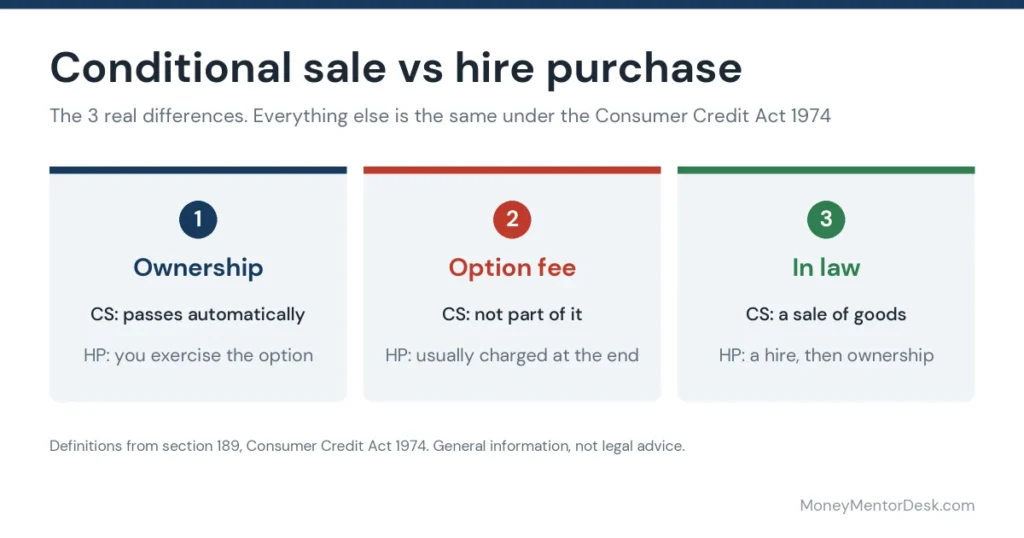
Comparing a conditional sale instead of hire purchase? See PCP vs CS, where the same figures apply but ownership passes automatically.
Not sure what the final payment on your quote really is? Our guide to balloon payment car finance covers where the figure comes from and your five options when it falls due.
Car finance calculator FAQs
Is this a car finance calculator UK drivers can rely on?
u003cpu003eIt follows how UK PCP and HP agreements are structured, including the optional final payment, and it quotes figures in pounds. It is illustrative rather than a quote: it excludes fees, mileage limits and condition charges, so compare the total amount payable on your own agreement.u003c/pu003e
How is UK car finance calculated?
u003cpu003eBoth PCP and HP finance the car price minus your deposit. Interest is charged on the balance outstanding each month. On HP the monthly payments clear the whole amount. On PCP a large final payment is deferred to the end, so the monthly payments cover the gap, but interest still runs on the deferred amount for the full term.u003c/pu003e
Is PCP cheaper than HP?
u003cpu003eMonthly, yes. In total, usually not. On a u0026pound;25,000 car with a u0026pound;2,500 deposit over 48 months at 8% APR and a u0026pound;10,000 final payment, PCP costs u0026pound;178.48 a month less but u0026pound;1,432.96 more overall if you pay the final payment and keep the car.u003c/pu003e
What is the balloon payment on a PCP?
u003cpu003eIt is the optional final payment, set at the start based on what the lender expects the car to be worth at the end. It is also called the guaranteed future value. You pay it to keep the car, or hand the car back instead, subject to the mileage limit and condition standard.u003c/pu003e
Does this car finance calculator UK tool include fees?
u003cpu003eNo. It excludes option-to-purchase fees, documentation fees, servicing, road tax and insurance, so a real agreement will cost slightly more. Compare the total amount payable on your quote, which the lender has to show you.u003c/pu003e
Can I settle UK car finance early?
u003cpu003eYes. Section 94 of the Consumer Credit Act 1974 lets you settle a regulated agreement at any time with a rebate of future interest. You can also end the agreement and hand the car back under section 99, with what you owe capped at half the total price under section 100.u003c/pu003e
What APR should I put in the calculator?
u003cpu003eUse the APR on your quote rather than a typical or representative rate, because advertised representative APRs are only offered to a proportion of successful applicants. The calculator treats the figure you enter as an effective annual rate.u003c/pu003e
Not sure which agreement you are being offered? Start with types of car finance in the UK.
Sources
- Consumer Credit Act 1974: section 66A (withdrawal), section 90 (protected goods), section 94 (early settlement), section 99 and section 100 (voluntary termination), legislation.gov.uk
- Worked example calculated by MoneyMentorDesk using the standard amortising formula, with the APR treated as an effective annual rate
This calculator is illustrative and is not financial advice. Your agreement decides what you pay. Check the APR, the total amount payable, the final payment, the mileage limit and any fees before you sign.
Built and checked by Nimra Saleem for MoneyMentorDesk.com on 26 September 2026. The worked example matches the figures in our PCP vs HP guide.
Pingback: PCP vs CS: Conditional Sale or PCP? 4 Key Differences
Pingback: PCP vs HP: 5 Differences and a Worked Cost Example (UK)