Part of our guide: PCP vs HP: Which Is Cheaper? 5 Key Differences (UK)
Lease vs. Buy Car Calculator
Compare the real cost of leasing and buying a car — monthly payments, upfront cash, financing, mileage and resale value — over the same time period.
Option A — Lease
More lease options
Option B — Buy (finance)
More buying options
| Over the comparison period | Lease | Buy |
|---|---|---|
| Monthly payment | — | — |
| Cash due upfront | — | — |
| Resale equity kept | — | — |
| Net cost (after equity) | — | — |
Illustrative only, not financial advice. Results are estimates based on the figures you enter, not a dealer or lender quote. The lease payment is estimated from the cap cost, residual and money factor (or your own quote); the buy side amortises the loan, credits resale value minus the balance still owed, and both options are measured over the same number of months. State sales-tax rules vary (some tax the lease payment, some the whole price; some credit a trade-in against tax) and can change the result — always confirm with the dealer and your state.
Worked example — a $30,000 car over 36 months
Leasing a $30,000 car (MSRP $32,000) at a 0.0018 money factor and 55% residual vs. buying it with a 60-month, 6.5% APR loan, compared over the 36-month lease term:
| Estimated lease payment | ~$385/mo |
| Estimated loan payment | ~$625/mo |
| Buy: resale equity at 36 months (resale − balance owed) | credited back |
| Which is cheaper over 36 months | depends on resale value |
Leasing almost always has the lower monthly payment. Whether it is cheaper overall hinges on the car’s resale value — strong resale value swings the math toward buying, because you get that equity back. Enter your own numbers above.
Our free lease vs. buy car calculator settles the question most car shoppers get stuck on: is it cheaper to lease or buy? Leasing almost always wins on the monthly payment, but that is not the whole story. This lease vs. buy car calculator compares both options over the same time period, credits the car’s resale value when you buy, and folds in the fees, taxes and mileage charges that quietly change the answer — so you see the real cost, not just the sticker payment.
Is it better to lease or buy a car?
There is no single right answer — it depends on how long you keep a car, how many miles you drive, and how much the car holds its value. In broad strokes:
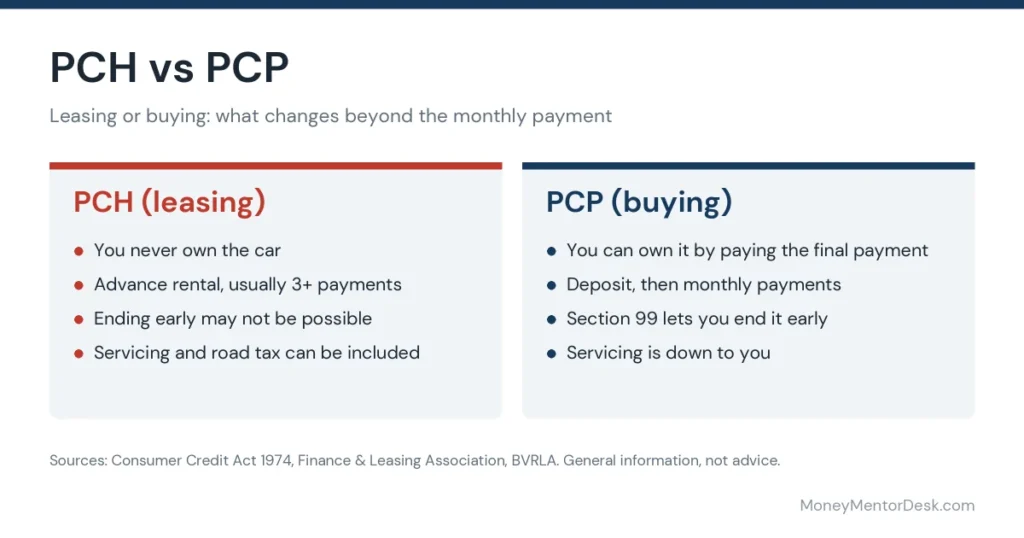
- Leasing usually means a lower monthly payment and a new car every few years, but you never build equity, you face mileage limits, and if you lease forever you pay forever.
- Buying costs more per month, but once the loan is paid off the payments stop and the car is an asset you own. Over a long horizon, buying and keeping a car is almost always cheaper.
The deciding factor is usually resale value and how long you keep the car. The calculator above makes that trade-off concrete for your numbers.
How does the lease vs. buy calculator work?
It compares the two options over one matched time period (by default, the length of the lease) so you are never comparing a 3-year lease against 5 years of ownership.
- Buying: it finances the price plus tax and fees (minus your down payment and any trade-in), works out the monthly loan payment, and tracks how much you still owe at the comparison date. It then credits the car’s resale value minus the remaining loan balance as equity you keep, and adds estimated maintenance.
- Leasing: it estimates the payment from the cap cost, residual value and money factor (or uses the quote you already have), then adds the cash due at signing, the acquisition and disposition fees, and any excess-mileage charges. A refundable security deposit is shown as upfront cash but not counted in the net cost, because you get it back.
The result is the net cost of each option over the same months, plus a plain-English verdict. For the maths behind an auto loan payment, see our car finance calculator.
Leasing vs. buying: a cost comparison
Take a $30,000 car kept for three years. A lease might run about $385 a month; a 60-month loan on the same car about $625 a month. Leasing clearly wins month to month. But at the end of three years the buyer still owns a car worth, say, $18,000, against a loan balance of roughly $13,000 — about $5,000 of equity that offsets the higher payments. Whether leasing or buying wins overall comes down to that resale number, which is why the calculator asks for it explicitly.
Advantages and disadvantages of leasing
- Pros: lower monthly payment, a new car every 2–3 years, usually under warranty, less cash upfront, and you hand the car back instead of worrying about resale.
- Cons: no ownership or equity, mileage limits with per-mile penalties, wear-and-tear and disposition fees, and endless payments if you keep leasing.
Advantages and disadvantages of buying
- Pros: you own an asset, payments eventually stop, no mileage limits, and you can sell or trade whenever you like.
- Cons: higher monthly payment, more cash upfront, you carry depreciation and resale risk, and out-of-warranty repairs are yours.
What affects the cost of leasing or buying?
- Depreciation and resale value — the single biggest driver. A car that holds its value favours buying; one that drops fast favours leasing.
- Money factor and APR — the financing rate on each side. (Multiply a money factor by 2,400 for a rough APR equivalent.)
- Term and how long you keep the car — the longer you keep a bought car after payoff, the cheaper buying becomes.
- Mileage — high-mileage drivers get penalised on a lease.
- Fees and taxes — acquisition, disposition, dealer and registration fees, and state-specific sales-tax rules.
Frequently asked questions
Is it financially better to lease or buy a car?
It depends on how long you keep the car and its resale value. Leasing is usually cheaper month to month and over a single short term, but buying and keeping a car past the loan payoff is almost always cheaper in the long run, because the payments stop and you own an asset. Run your own numbers in the calculator above to see which wins for you.
What is the lease payment on a $30,000 car?
As a rough guide, a well-priced lease is often around 1% of the car’s MSRP per month, so a $30,000 car might lease for roughly $300–$450 a month depending on the term, money factor, residual value and down payment. The exact figure depends on the deal — estimate it with the calculator above.
What is the biggest downside to leasing a car?
You never build equity. At the end of a lease you hand the car back with nothing to show for the payments, and if you keep leasing you keep paying. Mileage limits and wear-and-tear charges are the other common downsides.
Is it better to lease or buy a car in 2026?
The same principles apply: leasing for a lower short-term payment, buying to own and save over the long run. In any given year the answer turns on interest rates, how well a specific model holds its value, and lease incentives — so compare an actual quote against a finance offer rather than relying on a general rule.
What is the 1.5% rule when leasing a car?
It is an informal shopper’s rule of thumb, not an official standard: divide the monthly lease payment by the car’s MSRP, and if the result is around 1.5% or less, the lease is considered a reasonable deal. A stricter version, the 1% rule, looks for a payment at or below 1% of MSRP (about $400 a month on a $40,000 car). Treat both as quick sniff tests, not guarantees.
What is the 90% rule in leasing?
There is no widely recognised “90% rule” in car leasing. The commonly cited lease rules of thumb are the 1% and 1.5% rules above, which compare the monthly payment to the MSRP. If a salesperson or post cites a “90% rule,” ask them to define it before relying on it.
What is the 20% rule for buying a car?
It is part of the informal 20/4/10 rule: put at least 20% down, finance for no more than 4 years (48 months), and keep total vehicle costs (payment plus insurance and running costs) under 10% of your gross income. It is a budgeting guideline, not a lending requirement, but it is a sensible guard against an over-long, over-large car loan.
Related calculators: Car finance calculator, refinance auto loan calculator, car loan early payoff calculator, and our full list of finance calculators. For a plain-English overview, see Consumer Financial Protection Bureau guidance on auto loans.