
Part of our guide: What Is a 10-Day Payoff Quote? Auto Loan Payoff Explained
Can you pay off a car loan early? Yes, and federal law requires the lender to refund the unearned part of your interest charge when you do. What varies is whether your contract adds a penalty on top, and how much of the interest you actually get back.
Almost every guide on this question explains how to pay faster. Far fewer say what the lender is legally allowed to charge you for it. These are the five rules that decide the cost, and where to check each one.
Can you pay off a car loan early? The short answer
| Question | Answer |
|---|---|
| Can you pay off early? | Yes. No federal law stops you |
| Do you get unearned interest back? | Yes, on full prepayment. 15 U.S.C. § 1615 requires it |
| Can a lender charge a penalty? | Sometimes. It depends on your contract and your state |
| Does the contract have to tell you? | Yes. Regulation Z requires a prepayment disclosure |
| Do you get every unpaid dollar of interest back? | Not always. Some states let the lender keep a set amount |
| Does paying extra monthly always help? | No. On a precomputed loan it does not |
Rule 1: Federal law gives you a refund, and sets how it is calculated
When you clear the balance in full, 15 U.S.C. § 1615 says that “if a consumer prepays in full the financed amount under any consumer credit transaction, the creditor shall promptly refund any unearned portion of the interest charge to the consumer.”
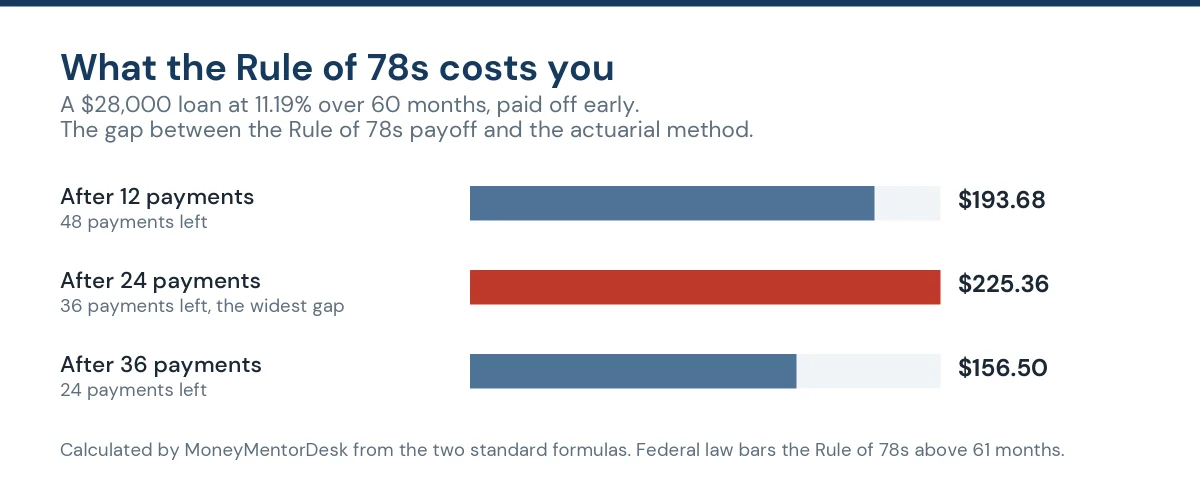
The same section controls the method. For credit with a term longer than 61 months, the creditor must use a method “at least as favorable to the consumer as the actuarial method”. That rules out the Rule of 78s, an older front-loaded formula that treats more of your early payments as interest, on any loan above 61 months. A 60-month contract can still use it where state law allows.
So on a 72-month loan you have a federal floor on how the refund is worked out. On a 60-month loan you may not.
Rule 2: A penalty is possible, and your contract has to disclose it
An early car loan payoff penalty is legal at the federal level, so nothing stops a lender writing one into the contract. A prepayment penalty car loan contract is less common than it used to be, but it still exists. The CFPB describes them as charges “generally used to discourage you from paying off your loan early as it reduces the amount of interest a lender collects on your loan”, and notes that “some states, however, prohibit prepayment penalties for certain loans”.
You do not have to guess whether yours has one. Regulation Z § 1026.18(k) requires every contract to carry a prepayment disclosure, and the wording tells you which kind of loan you hold:
| What the Prepayment box says | What it means |
|---|---|
| Whether “a charge may be imposed for paying all or part of a loan’s principal balance before the date on which the principal is due” | Interest is charged on your unpaid balance, so this is a simple-interest loan. A penalty, if there is one, is disclosed here |
| Whether “the consumer is entitled to a rebate of any finance charge if the obligation is prepaid in full or in part” | The finance charge was precomputed. Your gain from early payoff is the rebate |
If you have not signed yet, the CFPB says a penalty clause is negotiable: ask for it to be removed, or ask for a different loan.
Rule 3: Your state may override the contract entirely
Some states put the right to prepay directly into statute, where no contract term can take it away.
California is the clearest example. Civil Code § 2982(l) opens: “Notwithstanding any provision of a contract to the contrary, the buyer may pay at any time before maturity the entire indebtedness evidenced by the contract without penalty.” The phrase “notwithstanding any provision of a contract to the contrary” is doing real work. A penalty clause in a California vehicle contract does not survive it.
Texas takes a different route. Finance Code § 348.119 entitles a buyer who prepays in full to “a refund credit as provided by Section 348.120 or 348.121, as applicable”. Then § 348.120 sets the minimum for a monthly contract by “subtracting an acquisition cost of $25 from the original time price differential” before applying the refund percentage.
That $25 is the gap between “I get my unearned interest back” and “I get all of it back”. Your state may have a similar deduction written into its own formula.
Two states, two mechanisms. Check your own state’s motor vehicle installment act rather than assuming either applies to you.
Rule 4: The military rule, and the exclusion almost every guide misses
The Military Lending Act bans prepayment penalties for covered borrowers. 32 CFR § 232.8(h) prohibits credit where “the covered borrower is prohibited from prepaying the consumer credit or is charged a penalty fee for prepaying all or part of the consumer credit”.
The MLA’s own definition of “consumer credit” at § 232.3(f)(2) excludes “any credit transaction that is expressly intended to finance the purchase of a motor vehicle when the credit is secured by the vehicle being purchased”.
Read the two together and the protection is narrower than it looks. The loan you used to buy the car, secured by that car, sits outside the MLA. The protection is written for other credit, and the exclusion is limited to purchase financing, so credit that is not financing a purchase can fall inside it.
If you are active duty and a lender has quoted you a prepayment penalty, the question to ask is whether that specific loan is purchase money secured by the vehicle. Do not assume the MLA covers it simply because you are a service member.
Rule 5: On a precomputed loan, paying extra changes nothing
The interest type on your contract decides whether extra payments are worth making at all.
The CFPB explains that precomputed interest results in the total interest “being calculated immediately” and “then spread equally among monthly payments”, while simple interest is charged “on the outstanding balance of the loan either on a daily or monthly basis”. On a precomputed loan, it says plainly, extra payments “does not reduce the principal amount (or interest) owed”.
So on a precomputed contract, sending an extra $100 a month buys you nothing except being ahead of schedule. The only move that saves money is settling the whole balance, which triggers the refund in rule 1. Simple interest is the far more common arrangement, but check before you start.
Our guide to how to pay off a car loan early shows how to make sure extra money reaches the principal on a simple-interest loan, which does not happen automatically.
How to check whether you can pay off your car loan early
So, can you pay off a car loan early on your particular agreement? Five minutes with the contract will tell you.
- Open your contract and find the Prepayment box. The wording tells you whether it is simple or precomputed, and whether a charge applies.
- Search the contract for “prepayment”, “penalty” and “rebate”.
- Look up your state’s motor vehicle installment act, or call your state’s consumer credit regulator.
- Ask the lender directly: “Is there any charge for paying this off in full, and how is the unearned interest calculated?”
- Get the figure in writing before you send anything.
Then work out whether it is worth doing. Our should I pay off my car loan early test compares your APR against the rate your cash earns, and the early payoff calculator shows the interest and months you would save.
What to do when you are ready to clear it
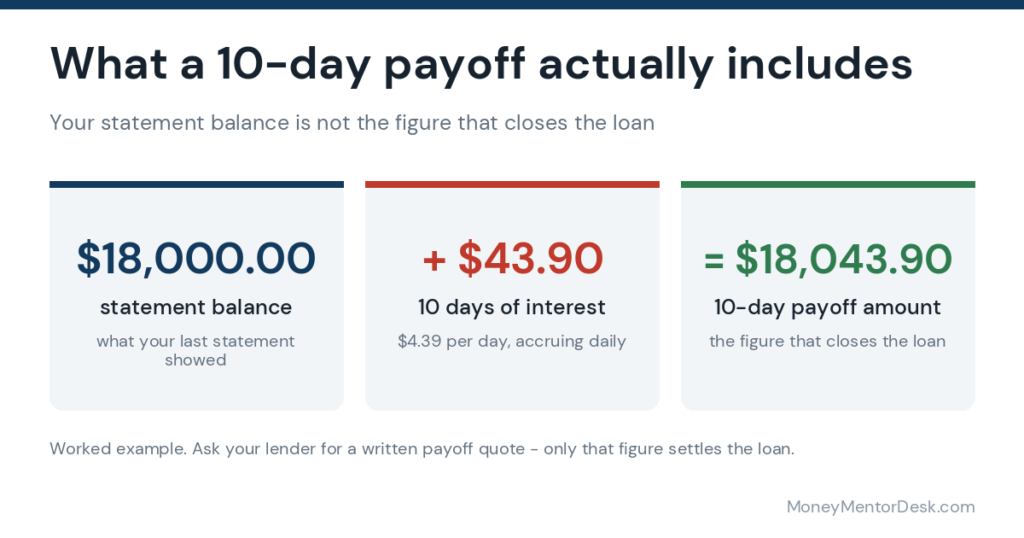
Once you have established that you can pay off a car loan early without a penalty, ask for a payoff quote rather than paying the balance shown in your app, because interest accrues daily until the money arrives. See what a 10-day payoff quote is. Afterwards, chase the lien release and title, which do not turn up on their own.
Working through the whole process? Our complete car loan payoff guide maps every stage, from deciding whether early payoff pays to chasing the title.
Clearing the loan also touches your credit file. Our guide to whether paying off a car loan helps credit explains which categories move.
Can you pay off a car loan early in your state? How to find the rule
California and Texas show two different approaches, but you need yours. The rules sit in a state’s motor vehicle retail installment sales act, and there are three reliable ways to reach it.
- Search your state’s legislature site for “motor vehicle retail installment” plus “prepayment” or “refund credit”. Statutes are published free by every state.
- Contact your state’s consumer credit regulator, often the department of financial institutions, banking or consumer affairs. They answer this question routinely.
- Ask the lender in writing which state’s law governs your contract and whether a prepayment charge applies. The answer in writing is worth more than a phone call.
Two things to watch. The governing law is the one named in the contract, which is not always the state you live in. And a rule that bans penalties on one kind of credit may not cover another, which is why the CFPB says some states prohibit them “for certain loans” rather than all.
What the lender can and cannot add at payoff
When you ask for a payoff figure, it will be higher than the balance in your app. That is normal, and it should be made up of identifiable parts rather than a round number.
| Line | Legitimate? | What to check |
|---|---|---|
| Principal balance | Yes | Should match your statement |
| Interest to the payoff date | Yes | Balance x APR ÷ 365, multiplied by the days |
| Fees already due, such as a late charge | Yes, if genuinely owed | Ask what it is for and when it was incurred |
| A lien release or title fee | Often | Usually a small state-set charge |
| A prepayment charge | Only if your contract discloses one and your state allows it | Check the Prepayment box, then your state law |
| Unearned interest on a precomputed loan | No | Federal law requires it to be refunded, using a method at least as favourable as the actuarial method above 61 months |
If a figure does not reconcile, ask for it in writing broken down by line. Our guide to calculating your 10-day payoff amount includes a calculator so you can check the interest portion yourself before you query it.
If the lender will not explain a charge, the CFPB accepts complaints about auto loan servicing, and putting the question in writing first gives you the record you would need.
FAQs
Can you pay off a car loan early without penalty?
Usually yes, and in some states always. There is no federal ban on prepayment penalties, but the CFPB notes that some states prohibit them for certain loans, and states such as California put the right to prepay without penalty directly into statute. Your contract’s Prepayment box discloses whether a charge applies.
Is there a penalty for paying off a car loan early?
Only if your contract says so and your state permits it. Check the Prepayment disclosure that Regulation Z requires on every contract. If you have not signed yet, the CFPB says you can negotiate to have a penalty clause removed.
Do you get interest back if you pay off a car loan early?
On full prepayment, yes. Federal law requires the creditor to refund the unearned portion of the interest charge. How much you get back depends on the method used, and some states let the lender deduct a set amount first. Texas, for example, subtracts a $25 acquisition cost before applying the refund percentage.
Can the military stop a prepayment penalty on a car loan?
Not usually on the loan that bought the car. The Military Lending Act bans prepayment penalties for covered borrowers, but its definition of consumer credit excludes credit that finances the purchase of a motor vehicle and is secured by that vehicle. Other credit can fall inside the protection.
Does paying a car loan off early save interest?
On a simple-interest loan, yes, because interest is charged on the balance you still owe. On a precomputed loan the CFPB says extra payments do not reduce the principal or interest owed, so the saving comes only from settling in full and receiving the refund.
What is the Rule of 78s and can it still be used?
It is a front-loaded formula for working out how much interest a lender has earned, which leaves a smaller refund when you prepay. Federal law bars it on consumer credit with a term over 61 months, where the refund method must be at least as favourable as the actuarial method. Shorter contracts can still use it where state law allows.
How do I know if my car loan is simple or precomputed interest?
Read the Prepayment box. A simple-interest contract states whether a charge may be imposed for paying the principal early. A precomputed contract states whether you are entitled to a rebate of the finance charge. The two disclosures are written differently on purpose.
Sources
- 15 U.S.C. § 1615: Refund of unearned portion of interest charge (refund on prepayment; actuarial method required above 61 months), checked 26 September 2026
- Regulation Z § 1026.18(k), Prepayment disclosures, checked 26 September 2026
- CFPB: Can I prepay my loan at any time without penalty?, checked 26 September 2026
- CFPB: simple interest vs precomputed interest on an auto loan, checked 26 September 2026
- California Civil Code § 2982(l) (prepayment without penalty, Automobile Sales Finance Act), checked 26 September 2026
- Texas Finance Code § 348.119 and § 348.120 (refund credit on prepayment; $25 acquisition cost), checked 26 September 2026
- 32 CFR § 232.8 (Military Lending Act, prohibited terms) and § 232.3 (definition of consumer credit and its exclusions), checked 26 September 2026
This guide is general information, not legal or financial advice. Statutes are quoted as published on the dates above, and state law changes. Your own contract and your state’s law decide what applies to you.
Written by Nimra Saleem for MoneyMentorDesk.com. Last reviewed on 26 September 2026 against the United States Code, the Code of Federal Regulations, Regulation Z, the California Civil Code, the Texas Finance Code and CFPB guidance.


Pingback: Refinance Auto Loan Calculator: Saving vs Total Cost
Pingback: Does Paying Off a Car Loan Help Credit? 5 Things That Change
Pingback: Car Loan Payoff: The Complete Guide in 4 Stages