
Part of our guide: What Is a 10-Day Payoff Quote? Auto Loan Payoff Explained
To pay off a car loan early, confirm the loan charges simple interest, check the Prepayment box on your contract for a penalty, then send extra money with clear instructions to apply it to the principal. On a $28,000 loan at 11.19% over 72 months, an extra $100 a month clears the loan 15 months early and saves $2,347 in interest.
One thing most guides leave out: if your loan uses precomputed interest, extra payments don’t reduce what you owe at all. Step 1 is how to tell which kind you have.
This guide is for US car loans. In the UK the rules are statutory and different. See early settlement of car finance.
The short answer: 6 steps
Here is how to pay off a car loan early, in the order the steps actually matter.
- Check whether your loan uses simple or precomputed interest.
- Read the Prepayment box on your contract for a penalty or a rebate clause.
- Pick a method: extra monthly principal, a lump sum, rounding up or biweekly payments.
- Make sure the extra money is applied to the principal, not to next month’s payment.
- Get a payoff quote before you send the final payment.
- Collect the lien release and the title, then review your insurance.
Step 1: Check whether your loan uses simple or precomputed interest
Whether paying extra saves you anything depends on which kind of interest your car loan charges. There are two, and only one of them rewards early payments.
The Consumer Financial Protection Bureau explains that precomputed interest results in “the total interest due under the loan being calculated immediately”, which “is then spread equally among monthly payments”, while simple interest “calculates the interest based on the outstanding balance of the loan either on a daily or monthly basis”.
The difference decides what an extra dollar buys you. On a simple-interest loan, every extra dollar cuts the balance that tomorrow’s interest is charged on, so you pay less. On a precomputed loan, the CFPB says making extra payments “does not reduce the principal amount (or interest) owed”. You are only paying ahead of schedule.
| Simple interest | Precomputed interest | |
|---|---|---|
| How interest is worked out | On the balance you still owe, daily or monthly | Totalled at the start and divided across the payments |
| Does an extra $100 save interest? | Yes | No |
| Does paying off in full early help? | Yes. Interest stops | Only through a refund of “unearned” interest |
| How common on car loans | The CFPB calls it “far more common” | Less common, but it exists |
Simple interest is the usual case, so most readers can move to step 2. If your contract mentions a precomputed finance charge, a “rebate of unearned finance charge”, or the Rule of 78s, read the rest of this step first.
What you get back on a precomputed loan
Federal law protects you here. Under 15 U.S.C. § 1615, “if a consumer prepays in full the financed amount under any consumer credit transaction, the creditor shall promptly refund any unearned portion of the interest charge to the consumer.”
The same section limits how that refund is worked out. For consumer credit with a term of more than 61 months, the creditor must use a method “at least as favorable to the consumer as the actuarial method”. That closes the door on the Rule of 78s, a front-loaded formula that treats more of your early payments as interest, but only above 61 months. A 60-month precomputed contract can still use it where state law allows.
Here is what that difference costs, on a $28,000 loan at 11.19% over 60 months (payment $611.44, total finance charge $8,686.66):
| You pay the loan off after | Payoff under the Rule of 78s | Payoff under the actuarial method | The Rule of 78s costs you |
|---|---|---|---|
| 12 payments | $23,767.08 | $23,573.40 | $193.68 |
| 24 payments | $18,850.62 | $18,625.26 | $225.36 |
| 36 payments | $13,250.62 | $13,094.12 | $156.50 |
Calculated by us from the two standard formulas. The gap is widest around the middle of the term, which is exactly when most people decide to clear the loan.
Step 2: Read the Prepayment box on your contract
Your contract has to tell you where you stand, and the wording itself reveals which type of loan you have. Regulation Z § 1026.18(k) requires two different disclosures:
| What the Prepayment section says | What it tells you |
|---|---|
| “whether or not a charge may be imposed for paying all or part of a loan’s principal balance before the date on which the principal is due” | The finance charge is applied to your unpaid balance, so this is a simple-interest loan. This sentence is where a prepayment penalty would be disclosed. |
| “whether or not the consumer is entitled to a rebate of any finance charge if the obligation is prepaid in full or in part” | The finance charge was computed some other way, which is the precomputed pattern. Your gain from early payoff is the rebate rather than day-to-day interest. |
On penalties, the CFPB is direct: they are “generally used to discourage you from paying off your loan early as it reduces the amount of interest a lender collects on your loan”, and “some states, however, prohibit prepayment penalties for certain loans”. If you already have the loan, “check your contract to see whether it contains a prepayment penalty clause” or “check your state law to see whether it’s prohibited”. If you haven’t signed yet, the CFPB says you can negotiate to have it removed or ask for a different loan.
Two things worth knowing before you panic about penalties:
- A penalty is a fixed cost you can compare against your interest saving. If clearing a loan two years early saves $1,800 in interest and the penalty is $300, the maths still works.
- A penalty on a simple-interest loan is not the same as the rebate rules on a precomputed one. Read which sentence your contract uses.
Step 3: Pick a method, and know what it actually saves
Take a $28,000 loan at 11.19% APR over 72 months. That APR is Experian’s average for used-car borrowers in the second quarter of 2026. The scheduled payment is $535.68, and paying exactly that costs $10,569.18 in interest.
| Method | Loan cleared in | Months saved | Total interest | Interest saved |
|---|---|---|---|---|
| Scheduled payment only | 72 months | n/a | $10,569.18 | n/a |
| Add $50 a month to principal | 64 months | 8 | $9,244.76 | $1,324.41 |
| Add $100 a month to principal | 57 months | 15 | $8,221.97 | $2,347.21 |
| Round the payment up to $600 | 62 months | 10 | $8,926.19 | $1,642.99 |
| One extra payment a year (the biweekly trick) | 65 months | 7 | $9,370.16 | $1,199.02 |
| A single $2,000 lump sum in month 12 | 66 months | 6 | $9,165.38 | $1,403.80 |
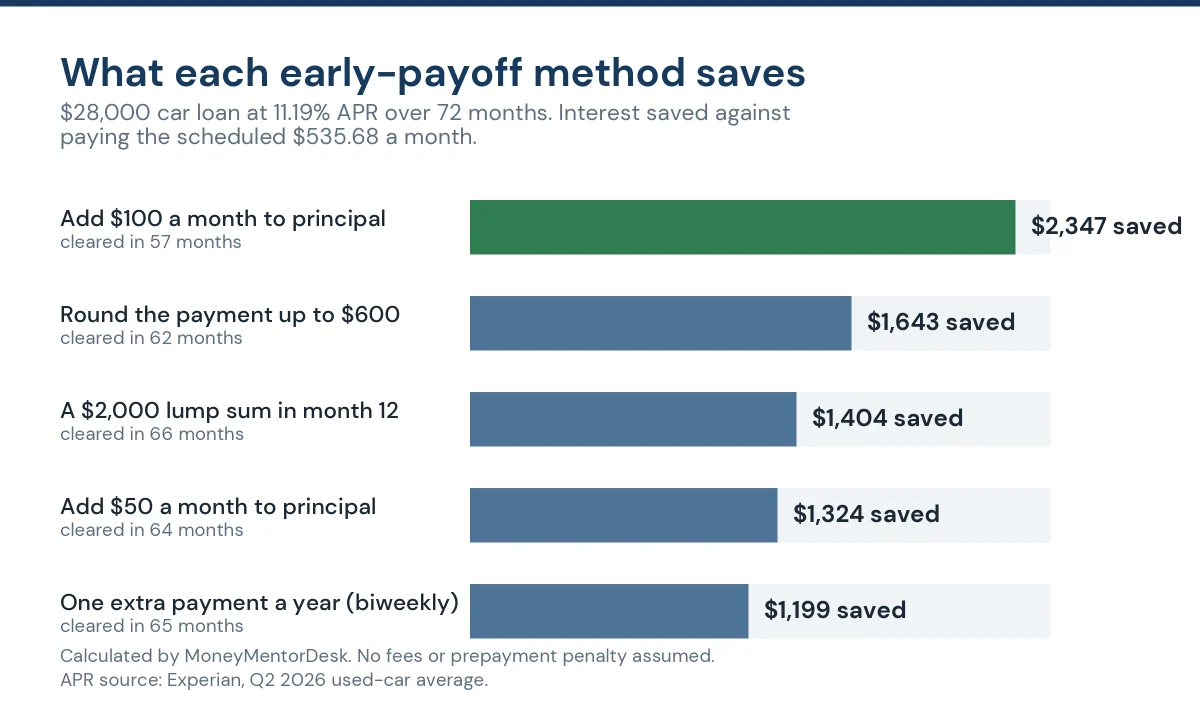
Our calculations, using the standard amortizing loan formula with interest charged monthly, no fees and no penalty. Rounded to the cent. Your own contract governs.
Read the last two rows next to the second one. Biweekly payments are the advice almost every guide leads with, and on these numbers they save the least of any method here: $1,199 against $2,347 for a flat extra $100 a month. Biweekly works by squeezing in one extra payment a year; a monthly principal payment you choose yourself is both larger and easier to control.
Two practical notes:
- Biweekly needs your lender’s cooperation. Some servicers hold a half payment until the second half arrives, which means the money sits there earning you nothing instead of cutting your balance.
- A lump sum early beats a lump sum late. The $2,000 above saves $1,403 in month 12. The same $2,000 in the final year saves very little, because there is barely any interest left to avoid.
If your rate is the real problem rather than the term, compare this against refinancing. If you’re unsure whether your rate is high for your credit score, our guide to APR on a car loan has the current averages by tier.
Step 4: Make sure the extra money lands on the principal
Extra money only cuts your car loan balance if the servicer applies it to principal, and that is not automatic. The CFPB explains the order: “your monthly payment generally will first be applied to any fees due – for example, late fees. Next, the remaining money from your payment will be applied to any interest due.” Interest and fees “are generally paid before your payments go towards your loan’s principal”.
So extra money doesn’t automatically attack the balance. The CFPB adds that “you may be able to request that your lender or servicer apply more of your payment to your loan’s principal”, and tells you to “check your loan documents first”.
What to do, in order:
- Ask how your servicer handles extra money. Some apply it to principal, some advance your due date, some hold it as unapplied funds.
- Send the extra separately from the scheduled payment, and mark it as a principal-only payment if the payment screen offers that option.
- Put it in writing. One line is enough: “Please apply the enclosed $100 to the principal balance of account [number]. Do not advance my due date.”
- Check the next statement. The principal balance should have fallen by your scheduled principal portion plus the extra. If instead your next due date has jumped forward a month, the money was applied as a payment ahead of schedule, not to principal. Call and have it reallocated.
- Keep paying on time anyway. Being “paid ahead” does not protect you if a later payment is missed.
Step 5: Get a payoff quote before you send the final payment
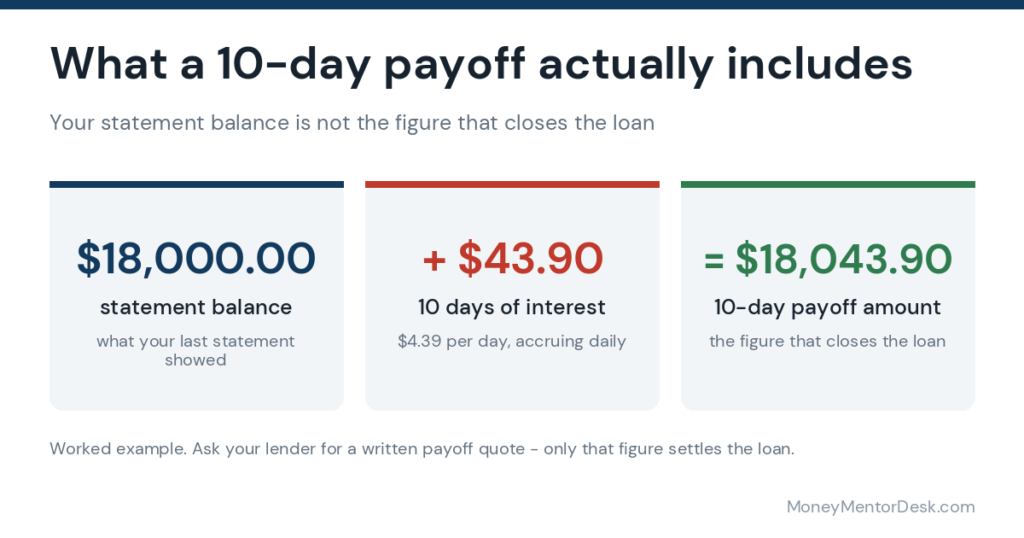
A payoff quote is the exact amount that closes your car loan on a stated date, and it is usually higher than the balance shown in your banking app. Interest keeps accruing daily until the money reaches the lender, and there can be a lien or title fee to settle. Most payoff quotes are good for a set number of days, usually ten.
Our guides cover the three things people get stuck on: what a 10-day payoff quote is, how to calculate the payoff amount yourself so you can check theirs, and how to request the payoff letter fast.
Pay the exact figure they quote. Underpay by a few dollars and the loan stays open; overpay and you wait for a refund.
Step 6: Collect the lien release and the title
Your car loan is not finished until the lender releases its lien and the title is issued in your name. That paperwork is the last step, and it is the one people forget to chase. Timescales and paperwork vary by state, and some states hold titles electronically. Our step-by-step guide to the lien release after a car payoff covers what to ask for and how long to wait before chasing.
Then review your insurance. Your lender’s requirement to carry comprehensive and collision cover ends with the loan, though your state’s liability minimum still applies and dropping physical damage cover means repairs come out of your pocket.
When paying off a car loan early isn’t the right move
- Your rate is 0% to 1.9%. Promotional financing costs you almost nothing; cash in your own account is worth more than the interest you’d avoid.
- You have no emergency fund. Money sent to a lender cannot be taken back. A paid-down car loan doesn’t cover a broken furnace.
- You carry higher-rate debt. A credit card at 22% costs you twice what a car loan at 11% does.
- You have a precomputed loan and aren’t clearing it in full. Extra monthly payments buy you nothing (step 1). Save the money and settle the whole balance in one go instead.
- The penalty outweighs the saving. Compare the two numbers before you act.
- You’re applying for a mortgage in the next few weeks. Clearing the loan lowers your debt-to-income ratio, which helps, but it can also cost you credit-score points at the worst moment. See below.
Does paying off a car loan early hurt your credit?
Paying off a car loan early can cost you a few credit-score points, temporarily, if it was your last active installment loan. Here is why that happens.
FICO’s own guidance says “paying off the last of your active installment loans can result in a loss of points”, and explains that “having a low installment loan balance to loan amount ratio is even less risky than having no active installment loans at all”. In other words, a car loan you have nearly finished paying is a better score ingredient than no car loan at all.
The dip is not permanent. FICO adds that “even after a consumer has paid off their installment debt(s), it is still possible to have a very high FICO Score, by actively and responsibly managing other types of accounts”.
A temporary dip of a few points is not a reason to pay thousands in avoidable interest. But if you have a mortgage application in the next month or two, ask your loan officer whether they’d rather see the car loan gone or the score untouched.
Not sure the loan is worth clearing at all? Work through should I pay off my car loan early first: it compares your APR against the rate your cash earns, and gives the break-even figure.
Want the figures for your own loan? Our car loan early payoff calculator shows the interest and the months you would save.
Wondering whether your lender is even allowed to charge you for it? See can you pay off a car loan early, which covers the federal refund rule, prepayment penalties and what your state adds.
Working through the whole process? Our complete car loan payoff guide maps every stage, from deciding whether early payoff pays to chasing the title.
Worried about your score? Does paying off a car loan help credit covers what changes on your file and what stays exactly where it is.
Tempted to clear it with a card instead? See paying off a car loan with a credit card before you do.
FAQs
Can you pay off a car loan early without a penalty?
Usually, yes. Prepayment penalties exist but aren’t universal, and the CFPB notes that some states prohibit them for certain loans. Check the Prepayment section of your contract, or your state’s law. Before signing, the CFPB says you can negotiate to have a penalty clause removed.
Does paying off a car loan early save interest?
On a simple-interest loan, yes. Interest is charged on what you still owe, so a smaller balance costs less. On a precomputed loan, the CFPB says extra payments don’t reduce the principal or interest owed; your saving comes only from the refund of unearned interest when you clear the whole balance, which federal law requires the lender to pay.
What is the best way to pay off a car loan early?
A fixed extra amount applied to the principal every month. On a $28,000 loan at 11.19% over 72 months, an extra $100 a month saves $2,347 and 15 months, against $1,199 for the biweekly method most guides recommend first.
Does paying off a car loan early hurt your credit score?
It can cost a few points if it was your last active installment loan, because FICO treats a well-paid-down installment loan as a positive. FICO says the effect isn’t permanent and a high score is still achievable with your other accounts.
Do extra payments go to the principal automatically?
No. The CFPB says payments go first to fees due, then to interest, then to principal, and that you may need to request that more of your payment be applied to the principal. Check your next statement to confirm the balance dropped rather than your due date moving forward.
Can you pay off a 72-month car loan early?
Yes, and the saving is larger than on a short loan because there is more interest ahead of you. A 72-month loan is also long enough that federal law requires any precomputed refund to be at least as favorable as the actuarial method, which rules out the Rule of 78s.
Is it better to pay off a car loan early or invest the money?
It depends on your rate. Clearing an 11% loan is a guaranteed 11% saving; an investment return is not guaranteed. At a promotional 0% to 1.9%, the argument flips. Clear high-rate debt and build an emergency fund before either.
What happens after you pay off your car loan?
The lender releases its lien and the title is issued in your name, which can take a few weeks depending on your state. Your lender’s requirement to carry comprehensive and collision cover ends, and the account is reported as closed and paid.
Sources
- Consumer Financial Protection Bureau: What’s the difference between a simple interest rate and precomputed interest on an auto loan?, checked 25 September 2026
- Consumer Financial Protection Bureau: Is it better to pay off the interest or principal on my auto loan?, checked 25 September 2026
- Consumer Financial Protection Bureau: Can I prepay my loan at any time without penalty?, checked 25 September 2026
- 15 U.S.C. § 1615: Refund of unearned portion of interest charge (actuarial method required above 61 months), checked 25 September 2026
- Regulation Z § 1026.18(k), Prepayment disclosures, checked 25 September 2026
- myFICO: Can paying off loans lower your FICO Score?, checked 25 September 2026
- Experian: Average car loan interest rates by credit score (Q2 2026 used-car average, used as the example APR), checked 25 September 2026
This guide is general information, not financial advice. Your own contract and your state’s law decide what applies to you.
Written by Nimra Saleem for MoneyMentorDesk.com. Last reviewed on 25 September 2026 against CFPB guidance, 15 U.S.C. § 1615, Regulation Z § 1026.18 and FICO’s published guidance. The worked examples were calculated for this article.


Pingback: Can You Pay Off Car Loan With Credit Card? 4 Routes
Pingback: Does Paying Off a Car Loan Help Credit? 5 Things That Change
Pingback: How Long Should a Car Loan Be? 5 Terms Compared (2026)
Pingback: Early Settlement Car Finance: 6 Steps to Pay Off Early (UK)