
Part of our guide: What Is a 10-Day Payoff Quote? Auto Loan Payoff Explained
Should I pay off my car loan early? Yes, if the APR is higher than what your cash earns after tax, you already have an emergency fund, and nothing else you owe costs more. For most people that means yes, because the average US savings account pays 0.37% and the average used-car loan charges 11.19%.
The comparison is not as simple as “my loan is 6% and my savings pay 4%, so it’s a wash”. Your loan balance shrinks every month while your cash keeps earning on the whole amount, so the loan rate has to be roughly double the savings rate before the two break even. At today’s Treasury rates that break-even is 7.49%, not 3.85%.
So the honest answer to should I pay off my car loan early is that it depends on five things, and the first two can settle it before any maths. Work through the questions below in order.
Should I pay off my car loan early? The short answer
| Your situation | Pay it off early? |
|---|---|
| No emergency fund | No. Build the fund first |
| Credit card balance at a higher rate | No. Clear that first |
| Loan APR above your break-even rate | Yes |
| Loan APR below your break-even rate | No, on the maths alone |
| Promotional 0% to 1.9% financing | Almost never |
| Precomputed-interest loan, paying extra monthly | No. It changes nothing unless you settle in full |
| Mortgage application within weeks | Ask your loan officer first |
Question 1: Do you have an emergency fund?
Money sent to a car lender cannot be taken back. Once the loan is paid, that cash is locked in the car, and getting it out again means selling the car or borrowing against it at a worse rate.
A paid-off car does not fix a boiler, cover a deductible or pay rent during a gap between jobs. If clearing the loan would empty your savings, the answer is no, whatever the interest rate says. Build the cash buffer first, then come back to this question.
This is also the reason the “pay off everything immediately” advice on forums is often wrong for the person asking. They have the lump sum, but it is the only lump sum they have.
Question 2: Is anything else costing you more?
Pay the most expensive debt first. A credit card at 22% costs you twice as much per dollar as a car loan at 11%, so a spare $5,000 does twice the work against the card.
Order of attack, when the money is limited:
- Anything above 15%: credit cards, store cards, payday or title loans
- Your car loan, if its APR clears the break-even rate in question 3
- Student loans and mortgages, which usually sit below it
Question 3: Does your loan’s APR beat your break-even rate?
Most guides compare the loan rate straight against the savings rate, and that comparison is not like for like. Your loan balance falls every month as you pay it down, so the interest you avoid is charged on a shrinking balance. Cash you keep instead earns on the full amount the whole time.
The result: your APR must be about double the rate your cash earns before keeping the cash wins.
Here is the break-even APR at each remaining term, measured against the 13-week Treasury bill, which paid a 3.85% coupon equivalent on 27 August 2026:
| Months left on the loan | Break-even APR |
|---|---|
| 12 | 7.16% |
| 24 | 7.49% |
| 36 | 7.65% |
| 48 | 7.75% |
| 60 | 7.84% |
Above that rate, paying off wins. Below it, the cash is worth more where it is.
What that looks like in dollars
Take a $12,000 balance with 24 months left, against keeping the same $12,000 in Treasury bills at 3.85%:
| Your APR | Interest you would still pay | Interest the cash would earn | Paying off now leaves you |
|---|---|---|---|
| 1.9% | $238.94 | $958.91 | $719.97 worse off |
| 4.0% | $506.38 | $958.91 | $452.53 worse off |
| 6.35% (average new-car rate) | $809.80 | $958.91 | $149.10 worse off |
| 9.0% | $1,157.21 | $958.91 | $198.30 better off |
| 11.19% (average used-car rate) | $1,448.48 | $958.91 | $489.57 better off |
| 15.0% | $1,964.15 | $958.91 | $1,005.25 better off |
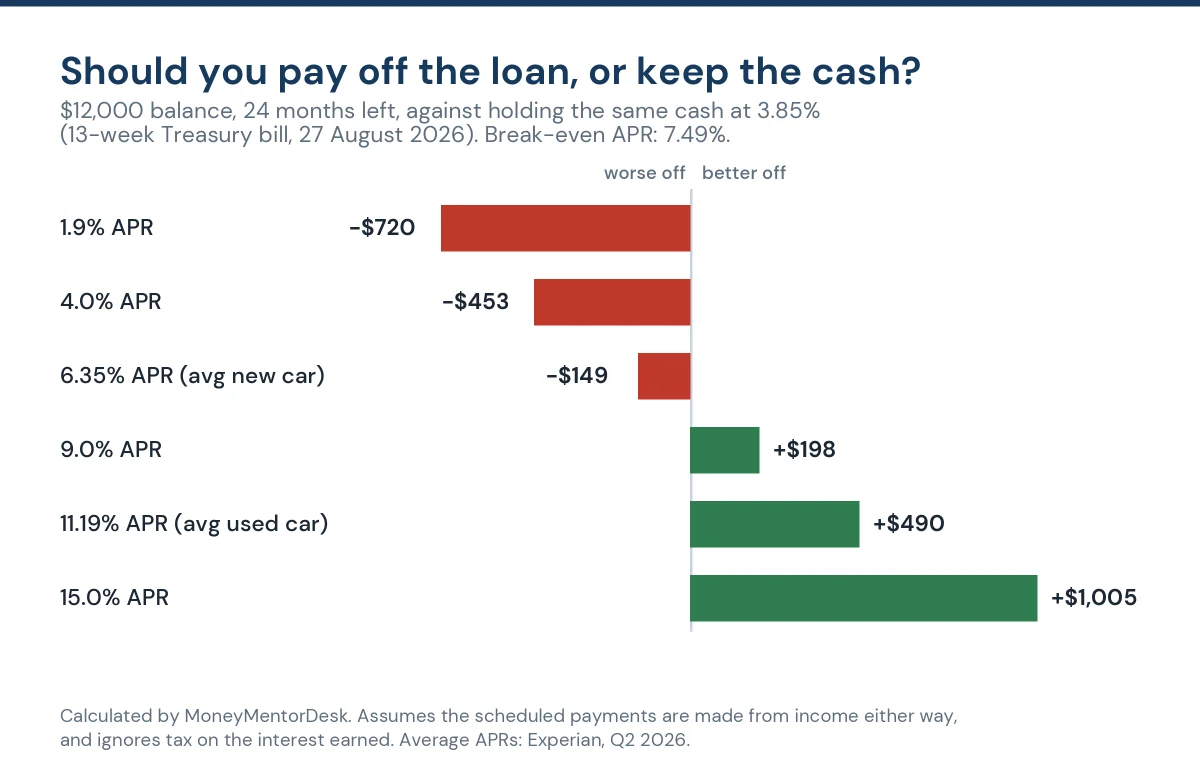
Our calculations. Assumes you keep making the scheduled payments from income either way, and ignores tax on the interest earned. The two average APRs are Experian’s Q2 2026 figures for new and used car loans.
Rather than work through the five questions on paper, you can answer them here. The tool uses the same break-even method as the table above, so the figures will match.
Should I Pay Off My Car Loan Early?
Answer the five questions from this guide and see the break-even rate your APR has to beat.
Educational guidance only, not financial advice. The figures assume a fixed rate, level monthly payments, and that you keep paying from income either way. They ignore tax on the interest your cash earns, which lowers the break-even rate. Confirm your loan terms with your lender.
Two things that push the break-even lower
Tax. The interest your cash earns is taxable income; the interest you avoid on a loan is not. Treasury bills are exempt from state tax but not federal, so at a 22% federal rate, 3.85% becomes 3.00% in your pocket and the 24-month break-even drops from 7.49% to 5.83%.
Where your money actually sits. The break-even figures above assume you are earning a market rate. Most people are not. The FDIC put the national average savings account at 0.37% and money market accounts at 0.63% in its rates published on 21 September 2026. Against 0.37%, the 24-month break-even is 0.71%. For anyone whose money sits in an ordinary savings account, that means paying off almost any car loan wins on arithmetic alone.
So answer this question with the rate your money is actually earning right now, not the rate it could earn somewhere else.
Question 4: Is your loan simple or precomputed interest?
On a precomputed loan, the total interest is worked out at the start and split across the payments, and the CFPB says extra payments "does not reduce the principal amount (or interest) owed". Paying extra every month achieves nothing. Only settling the balance in full triggers a refund of unearned interest, which federal law requires the lender to pay.
Check the Prepayment section of your contract before you send anything. Our guide to how to pay off a car loan early shows exactly which sentence tells you which loan you have, and how to make sure extra money reaches the principal.
While you are in the contract, check for a prepayment penalty. The CFPB notes that some states prohibit them for certain loans, and that a penalty is negotiable before you sign. If one applies, subtract it from the interest saving before you decide.
Question 5: Are you applying for a mortgage soon?
This question cuts both ways, which is why it comes last.
Clearing the car loan removes its monthly payment from your debt-to-income ratio. The CFPB defines DTI as "all your monthly debt payments divided by your gross monthly income", and a $560 car payment coming off a $6,000 monthly income moves your DTI by more than nine points.
But paying off the loan can also cost you credit-score points at exactly the wrong moment, for the reason in the next section.
If your mortgage application is weeks away, ask your loan officer which they would rather see. They can tell you whether your file is tight on DTI or tight on score, and that answer decides it.
What paying off early does to your credit score
FICO's own guidance is blunt: "paying off the last of your active installment loans can result in a loss of points". The reason is that FICO reads a well-managed, partly-paid installment loan as a positive signal, and explains that "having a low installment loan balance to loan amount ratio is even less risky than having no active installment loans at all".
The effect is not permanent. FICO adds that "even after a consumer has paid off their installment debt(s), it is still possible to have a very high FICO Score, by actively and responsibly managing other types of accounts".
In proportion, a temporary dip of a few points is not a reason to hand a lender hundreds of dollars in avoidable interest. It only matters if you are about to be scored, which is what question 5 is for.
Should you pay off 99% and keep the loan open?
This comes up constantly on forums, and it follows logically from what FICO says: if a low balance-to-loan ratio scores better than no installment loan at all, then leaving a small balance outstanding should score better than closing the account.
In practice it rarely earns its keep:
- You keep paying interest on the remaining balance, small though it is
- You keep a monthly payment on your credit file, which counts against your DTI
- Many lenders will not hold an account open at a token balance, and some close it once the balance is negligible
- A missed payment on that trivial balance damages your file far more than the few points you were protecting
If you are days away from a mortgage decision, it is worth asking your loan officer. Otherwise, pay the loan off and let the score recover.
When you should pay off your car loan early
- Your APR is above the break-even rate for your remaining term, and your cash sits in an ordinary savings account
- You have an emergency fund you are not touching to do this
- No higher-rate debt is outstanding
- Your contract charges simple interest with no prepayment penalty
- The car payment is the thing standing between you and a monthly budget that works
When you should not pay off your car loan early
- Promotional financing at 0% to 1.9%. The money is nearly free; keep it working elsewhere
- Paying off would leave you without a cash buffer
- A credit card or personal loan is charging more
- Your loan is precomputed and you are only planning to pay a bit extra each month
- You are mid-mortgage-application and your file is tight on score rather than DTI
If the answer came out as no on rate alone, but the payment still bothers you, refinancing is the middle path: it cuts the rate or the payment without spending your savings.
Ready to do it?
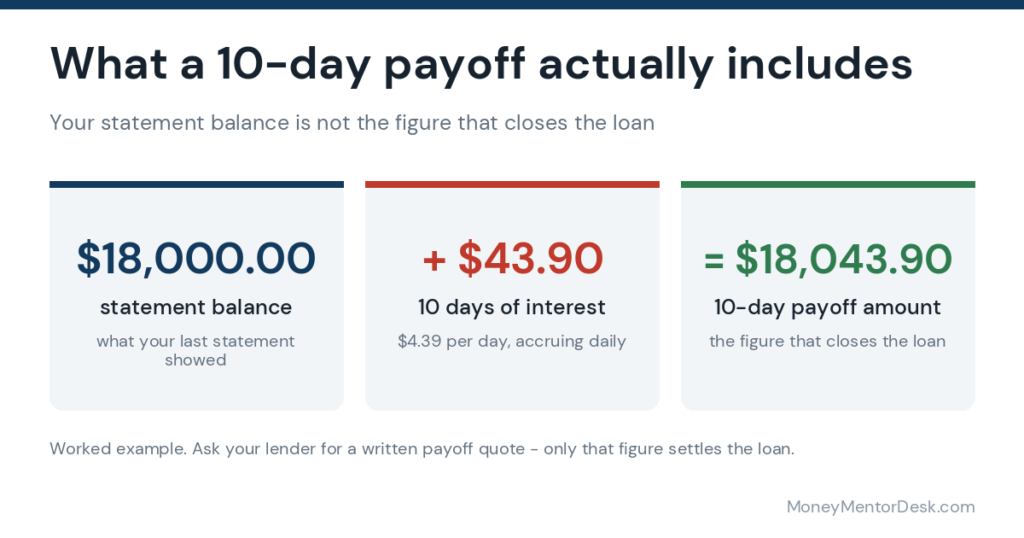
If you have worked through the five questions and decided you should pay off your car loan early, the mechanics matter next. Get a payoff quote rather than guessing from your app balance, because interest accrues daily until the money lands: see how to calculate your 10-day payoff amount and what a 10-day payoff quote is. Afterwards, chase the lien release and the title, which do not arrive automatically.
To put numbers on your own loan, use the car loan early payoff calculator.
Working through the whole process? Our complete car loan payoff guide maps every stage, from deciding whether early payoff pays to chasing the title.
For the full picture on scoring, see does paying off a car loan help credit, which breaks down which FICO categories actually move and by how much.
FAQs
Should I pay off my car loan early?
Yes, if your APR is above the break-even rate for your remaining term, you have an emergency fund, and nothing else you owe costs more. At a 3.85% cash rate the 24-month break-even is 7.49%, and against an ordinary savings account paying 0.37% it is 0.71%, which is why paying off usually wins in practice. The exceptions are promotional financing at 0% to 1.9%, a precomputed loan you are not settling in full, and a mortgage application in the next few weeks.
Is it better to pay off a car loan early or invest the money?
Compare your APR against the break-even rate, not against the headline savings rate. At a 3.85% Treasury yield the 24-month break-even is 7.49%, because your loan balance shrinks while the cash earns on the full amount. Above that, paying off wins; below it, investing does. Tax on the interest earned lowers the break-even to about 5.83% for a 22% federal bracket.
Is it smart to pay off a car loan early?
It is if the APR clears your break-even rate, you keep an emergency fund and nothing else you owe costs more. It is not if the loan is promotional financing at 0% to 1.9%, or if paying it off would leave you with no cash.
Does paying off a car loan early hurt your credit score?
It can cost a few points, mainly if it was your last active installment loan. FICO says a low installment balance-to-loan ratio is read as less risky than having no installment loan at all, and that the effect is not permanent.
Is it good to pay off a car loan early if I have a low interest rate?
Usually not, on the maths. A 1.9% loan costs you $238.94 over a final 24 months on a $12,000 balance, while the same cash in Treasury bills would earn $958.91. Keeping the money ahead makes you better off by about $720.
Will I save money by paying off my car loan early?
On a simple-interest loan, yes, because interest is charged on what you still owe. On a precomputed loan the CFPB says extra payments do not reduce the principal or interest owed, so the only saving comes from settling in full and receiving the refund of unearned interest.
Should I pay off my car loan before buying a house?
It depends on whether your mortgage file is tight on debt-to-income or on credit score. Clearing the loan improves DTI by removing the payment, but can cost score points. Ask your loan officer which they would rather see before you act.
Is it better to pay off a car loan or a credit card first?
The credit card, in nearly every case. Card rates are typically far above car loan rates, so the same money removes more interest there.
How much does paying off a car loan early actually save?
It depends on the rate and how much time is left. On a $12,000 balance with 24 months to run, clearing it saves $809.80 at 6.35%, $1,448.48 at 11.19% and $1,964.15 at 15%.
Sources
- Consumer Financial Protection Bureau: What's the difference between a simple interest rate and precomputed interest on an auto loan?, checked 25 September 2026
- Consumer Financial Protection Bureau: Can I prepay my loan at any time without penalty?, checked 25 September 2026
- Consumer Financial Protection Bureau: What is a debt-to-income ratio?, checked 25 September 2026
- 15 U.S.C. § 1615: Refund of unearned portion of interest charge, checked 25 September 2026
- myFICO: Can paying off loans lower your FICO Score?, checked 25 September 2026
- FDIC national rates and rate caps (savings 0.37%, money market 0.63%, published 21 September 2026), checked 25 September 2026
- US Treasury daily Treasury bill rates (13-week coupon equivalent 3.85%, 27 August 2026), checked 25 September 2026
- Experian: Average car loan interest rates by credit score (Q2 2026 averages), checked 25 September 2026
This guide is general information, not financial advice. It does not account for your tax position, and nobody here is a licensed adviser.
Written by Nimra Saleem for MoneyMentorDesk.com. Last reviewed on 25 September 2026 against CFPB guidance, FICO's published guidance, FDIC national rate data and US Treasury bill rates. The break-even calculations were produced for this article.


Pingback: Car Loan Payoff: The Complete Guide in 4 Stages
Pingback: Does Paying Off a Car Loan Help Credit? What Changes
Pingback: Can You Pay Off Car Loan With Credit Card? 4 Real Options