
Part of our guide: What Is a 10-Day Payoff Quote? Auto Loan Payoff Explained
Can you pay off car loan with credit card balances? Rarely in one step, because most auto lenders do not take credit cards for a payoff. There are four workarounds, three of them expensive. The Federal Reserve puts the average credit card rate at 21.58% against 8.16% on a 60-month new car loan, so moving the debt usually means paying nearly three times the rate on money that was already cheap.
There is one case where it works, and it is narrower than the offers suggest. The test is whether a one-off transfer fee is smaller than the interest you would otherwise pay before the promotional rate ends.
Can you pay off car loan with credit card? The four routes
| Route | Does it work? | What it costs |
|---|---|---|
| Paying the lender directly by card | Usually not offered | n/a |
| Cash advance | Yes | A fee, plus interest from day one at a higher rate. The worst option |
| Balance transfer to your bank account, then pay the loan | Sometimes | A transfer fee, then the promotional rate, then the full card rate |
| Third-party payment processor | Sometimes | A percentage fee on every payment |

Why your lender will not just take the card
Card payments cost the business receiving them a percentage of every transaction. Lenders are not willing to absorb that on a five-figure payoff, so card payment is commonly excluded from the payment options, or routed through a third party that passes the cost to you. Check your own lender’s payment page before assuming either way, because policies differ and some accept cards for a regular monthly payment but not for a full payoff.
Route 1: The cash advance, and why it is the worst one
A cash advance turns your credit limit into money you can pay the lender with. It is also the most expensive way to borrow on a card, for three reasons the CFPB sets out plainly.
- A fee up front. “The fees for a cash advance can be substantial. Depending on your credit card terms, the company may charge a flat fee for withdrawing money, or they’ll charge you a percentage of the cash advance.”
- No grace period. “Unlike other purchases that have a grace period before they start to accrue interest, interest on a cash advance starts as soon as you withdraw your money.”
- A higher rate than purchases. “In most cases, you’ll also commonly pay a higher interest rate for a cash advance than you would for a typical credit card purchase.”
So you pay a fee to move secured debt at roughly 8% onto an unsecured balance charging more than the standard card rate, with interest running from the first day. There is no version of the arithmetic where that helps.
The arithmetic, using the Federal Reserve’s own rates
The Federal Reserve publishes what banks actually charge. These are its 2024 figures, the most recent complete year in the series:
| Type of credit | Rate | Interest on $10,000 over 24 months |
|---|---|---|
| New car loan, 60 months | 8.16% | $872.07 |
| New car loan, 72 months | 8.29% | — |
| Credit cards, all accounts | 21.58% | $2,401.04 |
| Credit cards, accounts assessed interest | 22.89% | $2,556.49 |
Moving $10,000 from the car loan to a card at the average rate costs $1,528.96 more over two years, before fees. That is the whole case against doing this, and it is why the routes below only matter if you can avoid paying card interest entirely.
Route 2: The balance transfer, and the one case it wins
Some card issuers let you move a promotional balance into your own bank account rather than to another card. The money lands in your account, you pay the lender, and you owe the card instead. If the promotional rate is 0%, you are no longer paying interest on that money at all, and the only cost is the transfer fee.
Here is the test, in one line: a transfer fee beats the loan if the fee is smaller than the interest you would have paid during the promotional window.
On $10,000 at 8.16%, the interest over 18 months is about $658. A 4% transfer fee on the same amount is $400. Clear the balance inside the 18 months and you are roughly $258 better off. Miss the window and the remaining balance reverts to the full card rate, which is where the $1,528.96 above comes back into play.
So this route needs three things at once: a genuine 0% offer, a transfer fee below the interest you would otherwise pay, and a realistic plan to clear the whole balance before the promotion ends. Two out of three is a loss.
Route 3: Third-party payment processors
Services exist that charge your card and send the lender a bank payment, taking a percentage of the amount as their fee. The card is charged as a purchase rather than a cash advance, so your grace period survives, but the processor’s fee applies to every payment and not all lenders accept payments this way.
If you are looking at how to pay off car loan with credit card balances this way, run the same test as above: the fee is only worth paying if it buys you something worth more, such as clearing a high-rate loan or meeting a sign-up bonus you would have earned anyway. Paying 3% to move 8% debt onto a 21% card is not a saving.
The cost nobody mentions: your credit utilisation
Shifting a car loan onto a card does not just change the rate. It changes the type of debt on your credit file, and scoring models treat the two very differently.
Amounts owed is 30% of a FICO score, and the part that moves hardest is revolving utilisation, the share of your card limits you are using. A $10,000 installment balance sitting on a car loan barely registers there. The same $10,000 sitting on a card with a $12,000 limit is over 80% utilisation, which is the kind of change that moves a score sharply and immediately. Our guide to whether paying off a car loan helps credit breaks down the categories and their weights.
There is one genuine argument the other way. A car loan is secured on the car, so falling behind can cost you the vehicle, while card debt is unsecured. If the point of the exercise is to get the car out of the lender’s hands, that is a real trade, but it is a trade made at roughly 13 percentage points of extra interest.
Cheaper things to do instead
- Pay extra to the principal. No fee and no new account. See how to pay off a car loan early for making sure the money lands where you intend.
- Refinance. If the rate is the problem, a better rate solves it without moving to revolving credit. Our auto refinance calculator shows the monthly and the lifetime effect.
- Check whether early payoff is even worth it. The five-question test compares your APR against what your cash earns.
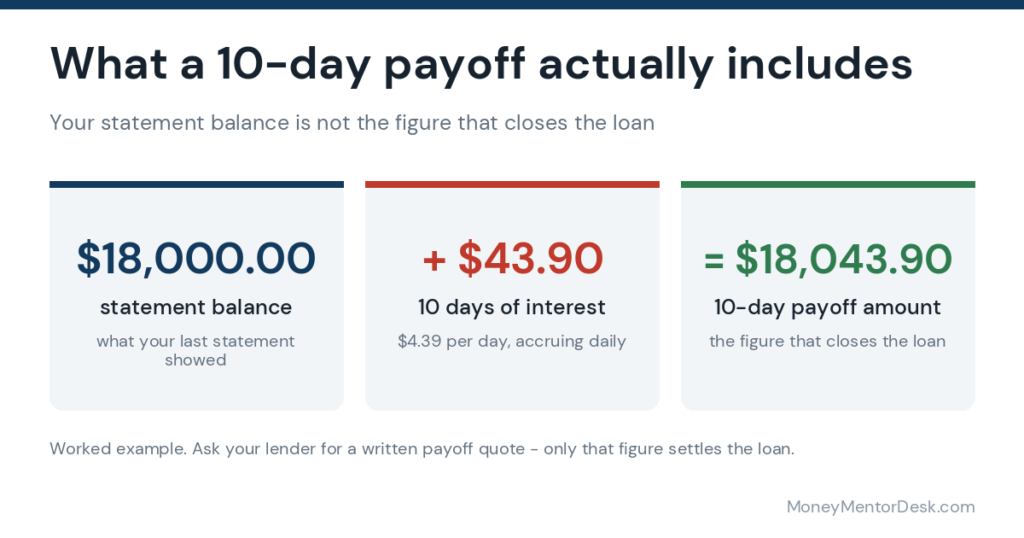
- Get the payoff figure right before you send anything, using the car loan payoff guide.
Can you pay off car loan with credit card rewards covering the fee?
The usual argument for paying a car loan by card is the points. Run it as arithmetic and it collapses, because processor fees are set above cashback rates on purpose.
| On a $10,000 payment | Fee paid | Rewards earned | Net |
|---|---|---|---|
| 2.9% fee, 2% cashback | $290 | $200 | $90 loss |
| 2.9% fee, 1.5% cashback | $290 | $150 | $140 loss |
| 2.5% fee, 2% cashback | $250 | $200 | $50 loss |
There is one exception worth naming. If the spending unlocks a sign-up bonus worth more than the fee, and you were going to hit that bonus anyway, the maths can flip. That is a bonus-hunting decision, not a car finance one, and it only works if the balance is cleared in full before interest starts.
What happens when the promotional rate ends
A 0% balance transfer is only 0% for a stated window. Whatever is left when it ends reverts to the card’s standard rate, and on the Federal Reserve’s 2024 figures that averages 21.58%.
So the plan has to be arithmetic, not intention. Divide the transferred balance by the number of promotional months and check you can genuinely pay that every month. Ten thousand dollars over eighteen months is about $556 a month, every month, on top of everything else. If that is not realistic, the transfer converts a car loan at roughly 8% into card debt at more than 21%.
Two further points people miss. The promotional rate usually applies only to the transferred balance, so new spending on that card can be charged at the standard rate. And the fee is charged up front, which means you owe more than you transferred from day one.
The one case where the card genuinely wins
Strip away the rewards and the wishful thinking and one scenario survives in which you can pay off car loan with credit card money and come out ahead: you have a real 0% offer, the transfer fee is smaller than the interest you would otherwise pay across the promotional window, and you will clear the balance inside it.
The test takes ten seconds. Work out the interest your car loan would charge over the promotional period, then compare it with the fee. On $10,000 at 8.16%, eighteen months of interest is about $658, so any fee below that leaves you ahead, and a typical 4% fee of $400 leaves you about $258 better off.
Miss the window and that $258 gain becomes the $1,529 loss in the table above. The upside is small and capped; the downside is large and open-ended. That asymmetry is the real reason this is rarely worth doing.
Paying a car loan with a credit card: FAQs
Can you pay off car loan with credit card directly?
Usually not. Most auto lenders do not accept credit cards for a payoff, because card acceptance costs them a percentage of the transaction. Some accept cards for a regular monthly payment but not for the full balance. Check your lender’s payment options rather than assuming.
Can I pay off car loan with credit card using a cash advance?
You can, and it is the most expensive route. The CFPB says cash advance fees can be substantial, interest starts as soon as you take the money with no grace period, and the rate is usually higher than the purchase rate. You would be moving roughly 8% secured debt onto a balance charging more than 21%.
Is it ever worth paying a car loan with a credit card?
Only with a genuine 0% promotional balance transfer where the fee is smaller than the interest you would otherwise pay, and only if you clear the balance before the promotion ends. On $10,000 at 8.16%, 18 months of interest is about $658, so a 4% fee of $400 leaves you around $258 ahead if you finish in time.
Does paying a car loan with a credit card hurt your credit score?
It can, sharply. Amounts owed is 30% of a FICO score and revolving utilisation drives it. A $10,000 balance on a card with a $12,000 limit is over 80% utilisation, whereas the same balance on a car loan barely registers in that category.
How much more does a credit card cost than a car loan?
On the Federal Reserve’s 2024 figures, cards averaged 21.58% against 8.16% on a 60-month new car loan. On $10,000 repaid over 24 months that is $2,401 of interest instead of $872, so about $1,529 more before any fee.
Can you pay a car loan with a credit card through a third-party service?
Sometimes. Payment services charge your card and send the lender a bank transfer, taking a percentage as their fee. The charge counts as a purchase rather than a cash advance, so the grace period survives, but the fee applies to every payment and not all lenders accept payments made this way.
Sources
- Federal Reserve G.19, Consumer Credit, Terms of Credit table (2024: credit cards 21.58% all accounts and 22.89% accounts assessed interest; new car loans 8.16% over 60 months and 8.29% over 72 months), release of 8 September 2026, checked 27 September 2026
- CFPB: can I withdraw money from my credit card at an ATM? (cash advance fees, no grace period, higher rate), checked 27 September 2026
- Interest figures calculated by MoneyMentorDesk on a level monthly repayment, excluding fees
This guide is general information, not financial advice. Card terms vary, and the fee, promotional period and rate on your own offer decide whether any of this works for you.
Written by Nimra Saleem for MoneyMentorDesk.com. Last reviewed on 27 September 2026 against Federal Reserve G.19 data and CFPB consumer guidance.


Pingback: Balloon Payment Car Finance: 5 Options at the End