Part of our guide: What Is a 10-Day Payoff Quote? Auto Loan Payoff Explained
How many missed payments before repossession? There is no national number. Under the Uniform Commercial Code, a lender can repossess your car “after default” — and your loan contract usually defines default as one missed payment. No court order is needed in most states, and many states require no warning either. The “60 days” or “90 days” figures you will read elsewhere describe what lenders typically do, not what the law allows. Those are different things, and the gap between them is where people get caught out.
This article explains how US auto repossession works and cites the law it relies on. It is general information, not legal advice. Repossession rules vary significantly by state. If your car has been taken or you have received a notice, speak to a lawyer — the CFPB lists free and low-cost legal help by state.
The short answer: it is not a number, it is a definition
Ask how many missed payments before repossession and almost everyone expects an answer like “three.” The honest answer is that the number is set by your contract, not by law.
Your auto loan agreement contains a definition of default. On most US auto loans, default is triggered by a single missed payment. Once you are in default, the lender’s right to take the car exists immediately. Whether they use it on day 31 or day 91 is their commercial decision.
| What people assume | What is actually true |
|---|---|
| You get three missed payments | The contract usually defines default as one |
| They must warn you first | Many states require no notice at all |
| They need a court order | Not unless they would breach the peace |
| Handing the car back clears the debt | You usually still owe the deficiency balance |
What the law actually says
Auto loans are secured by the vehicle, which makes them governed by Article 9 of the Uniform Commercial Code, adopted in some form by every US state.
Section 9-609(a) reads: “After default, a secured party: (1) may take possession of the collateral.”
Read it closely. It says after default. It does not say after thirty days, after two payments, or after a warning letter. The trigger is default, and default is whatever your contract says it is.
Section 9-609(b) then sets out how they may do it: “pursuant to judicial process; or without judicial process, if it proceeds without breach of the peace.”
That second route is called self-help repossession. It is why a tow truck can take your car from a car park at 4am with no court involvement whatsoever. The lender never has to sue you first.
So why does everyone say 60 or 90 days?
Because when people ask how many missed payments before repossession, that is roughly when it usually happens in practice, and the two things get confused constantly.
If you are weighing whether to clear the loan instead, our car loan payoff guide walks through the stages. Repossession is expensive for a lender. They pay a recovery agent, storage, and auction fees, and cars almost always sell for less than the loan balance. A borrower who catches up is worth more to them than a car on a lot. So most lenders wait, send letters, and offer payment plans first.
That is a business decision, and it can change without notice. A lender under pressure, or one that has already tried to contact you and failed, can act far sooner. Treating “90 days” as a safety window is the mistake this article exists to prevent.
Does it depend on which lender you have?
People search how many missed payments before repossession alongside a specific lender name — Chase, Capital One, Santander, Ally — hoping one of them is more forgiving than the others. It is a reasonable instinct and a misleading one.
No major lender publishes a repossession timeline, and none of them are bound to one. What governs the legal position is your contract and your state, not the name on the statement. A subprime lender and a credit union can behave very differently on identical paperwork, and the same lender can treat two borrowers differently depending on payment history, loan-to-value, and whether contact was made.
What does vary usefully between lenders is how willing they are to arrange a deferment or a payment plan before things escalate, and how quickly they answer the phone. That is worth testing early. The legal deadline is not something any lender decides for you.
If you have read a figure attached to a particular lender’s name on a forum, treat it as one person’s experience in one state, not as policy.
Does your lender have to warn you first?
It depends entirely on your state. The Consumer Financial Protection Bureau puts it plainly: “In many states, a lender can repossess a vehicle – without a warning or a court order – after you’ve missed payment, but other states require lenders or servicers to send you a notice before repossession, alerting you to what payments have been missed and allowing you time to make them up.”
That notice requirement, where it exists, is usually called a right to cure. It gives you a defined window — commonly 10 to 30 days, depending on the state — to make up what you owe and stop the repossession.
Two things to do rather than guess:
- Read your loan agreement. If your state requires a right to cure, the contract will usually describe it.
- Check your state’s rules directly through your state consumer protection office or state attorney general.
We are not listing a figure for each state here. Those rules change, and a wrong number on this page could cost someone their car.
What counts as “breach of the peace”
This is the single real limit on self-help repossession, and it is worth knowing precisely because it is your strongest protection.
The CFPB gives three concrete examples of conduct that generally breaches the peace:
- Threatening or using physical force
- Removing a vehicle from a closed garage without permission
- Continuing with the repossession after you have resisted or refused to allow it
That third point matters more than people realise. If you are present and you clearly object, continuing may breach the peace. If the agent does breach the peace, the CFPB notes you can contact law enforcement, and it “may also give you a claim for damages or a defense, which may lessen the amount you eventually owe after the sale of the vehicle.”
What it does not mean is that you should physically confront a recovery agent. Objecting clearly and documenting what happened protects you. Escalating it does not.
If you are in the military, the rules are different
This is the most significant exception on this page and it is missing from almost every article on the subject.
Under the Servicemembers Civil Relief Act, if you are on active duty, a lender cannot repossess without a court order on any auto loan you entered into before your military service began.
No self-help. No tow truck at 4am. They must go to court. If you are an active-duty servicemember and your pre-service car loan was repossessed without a court order, that repossession may have been unlawful.
After they take it: cure, reinstate, redeem
These three words get used interchangeably everywhere and they are not the same thing. The difference decides how much you have to find.
| Right | What you pay | Available where |
|---|---|---|
| Cure / reinstate | The overdue payments plus repossession costs | Only in states whose law grants it |
| Redeem | The full remaining loan balance plus costs | Everywhere, before the sale |
Reinstatement is far cheaper and is what most people actually need. The CFPB confirms that “in some states, laws grant you the right to pay to get your vehicle back after it’s been repossessed,” covering overdue payments plus repossession costs.
Redemption exists regardless of state, but requires the entire outstanding balance. For most people in this position, that is not realistic.
You also have the right to be notified before the car is sold. For a public sale, the lender must tell you the date, time and place so you can bid. For a private sale, they must tell you the date after which it could be sold.
The deficiency balance: why handing the keys back does not end it
This is the part that surprises people most, and it is the reason voluntary surrender is rarely the clean exit it appears to be.
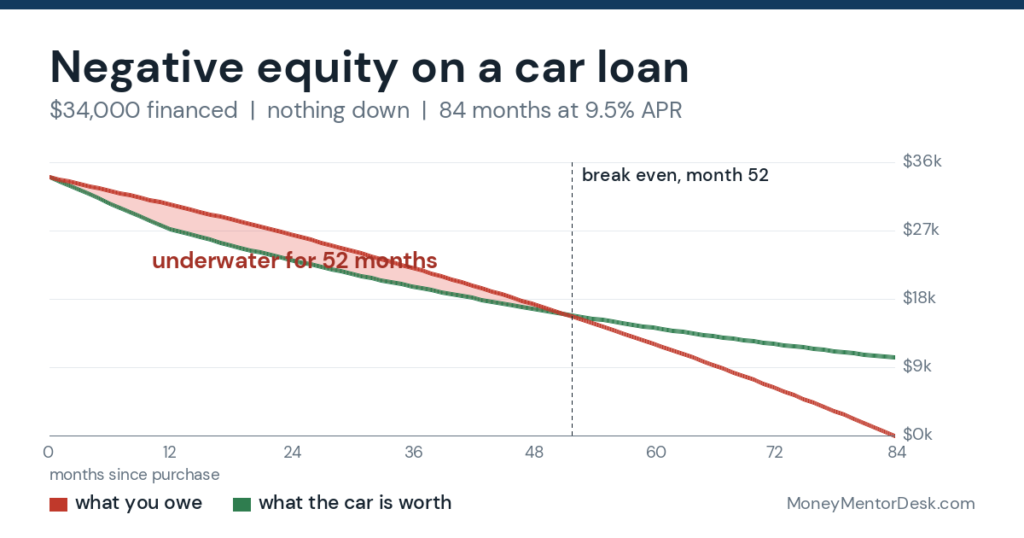
When the lender sells your car, the sale price almost never covers what you owe. You are liable for the difference, plus repossession fees. That shortfall is the deficiency balance, and it is the same arithmetic that creates negative equity on a car loan — you owe more than the car is worth, except now the car is gone.
The CFPB’s own worked example: if you owe $10,000 and the lender sells the car for $7,500, you owe the $2,500 difference plus repossession costs. If you do not pay it, the lender can hire a debt collector to pursue it.

It works the other way too, though it is rare. If the car sells for $12,000 against a $10,000 debt, you are entitled to the surplus once fees are paid.
Two protections worth knowing. The repossession fee “must be reasonable,” with what counts as reasonable determined by a court. And the lender must sell the car “in a commercially reasonable manner” — so it is worth finding out what it actually sold for. If the price looks far below market, that is worth raising with an attorney.
Your belongings inside the car
The lender has a right to the car. They have no right to what is inside it.
Contact the lender immediately to arrange collection, and write down what was in the vehicle and what it was worth before you do. If the repossession company demands payment before returning your property, that is a problem — the CFPB brought a public enforcement action against Nissan Motor Acceptance Corporation for exactly that practice, finding it an unfair act or practice to withhold personal property pending an upfront fee.
What it does to your credit
A repossession can stay on your credit reports for up to seven years. For the opposite case — what happens to your file when a loan ends properly — see does paying off a car loan help credit, and the damage starts before the car is taken — the missed payments themselves are reported. The CFPB also notes it can mean higher insurance premiums.
If the repossession was recorded in error, you can dispute it with the credit reporting companies.
If you are behind right now
In rough order of usefulness:
- Call the lender before the payment is missed, not after. Deferment and payment plans exist, and they are far easier to arrange while the account is current.
- Get any agreement in writing. A verbal promise from a call centre does not stop a recovery agent.
- Read the default clause in your contract so you know what actually triggers it.
- Consider selling the car yourself. A private sale almost always beats an auction price, which shrinks the shortfall. Our guide to selling a financed car covers how the settlement works.
- Check whether your state gives you a right to cure.
- If you are active-duty military, say so immediately — the SCRA may already protect you.
- If something has gone wrong, you can submit a complaint to the CFPB.
So the real answer to how many missed payments before repossession is: as many as your contract allows, which is often one. The thing worth taking from all of this: the protection you have is not a grace period. It is the set of specific rights above. Knowing which ones apply in your state is worth more than any number.
Missed car payments and repossession: common questions
How many missed payments before repossession?
There is no fixed number in law. Under UCC §9-609 a lender may take the car “after default,” and most US auto loan contracts define default as a single missed payment. In practice most lenders wait 60 to 90 days because repossession is expensive for them, but that is their choice, not a legal protection. Some states require a notice and a right to cure first.
What happens if you miss one car payment?
You will normally be charged a late fee, and after 30 days the missed payment is typically reported to the credit bureaus. Legally you may already be in default, which means the lender’s right to repossess exists, even though very few lenders act that quickly. Call the lender before the payment is missed if you can — deferment is far easier to arrange on a current account.
I am two months behind on my car payment. What should I do?
Contact the lender immediately and ask specifically about deferment, a payment plan, or loan extension, and get whatever you agree in writing. Check your contract for a right to cure and check your state’s rules through your state consumer protection office. If you are active-duty military, say so — the Servicemembers Civil Relief Act may require a court order before any repossession on a pre-service loan.
Will my lender send a letter before repossession?
It depends on your state, not on the lender. The CFPB states that in many states a lender can repossess without a warning or a court order, while other states require a notice first. Do not assume a letter is coming. Check your loan agreement and your state’s right-to-cure rules rather than relying on what any particular lender usually does.
Can they take my car without a court order?
In most states, yes. UCC §9-609(b) allows repossession “without judicial process, if it proceeds without breach of the peace.” This is called self-help repossession. The exception is active-duty servicemembers, who are protected by the SCRA on loans taken out before their service began.
Can I get my car back after it is repossessed?
Possibly, through one of two different routes. Reinstatement means paying the overdue payments plus repossession costs, and it is only available in states whose law grants it. Redemption means paying the full remaining balance plus costs before the car is sold, and that right exists everywhere. Reinstatement is far cheaper, so check whether your state offers it.
Do I still owe money after the car is repossessed?
Usually yes. The lender sells the car and you owe the difference between the sale price and your loan balance, plus repossession fees. That is the deficiency balance. The CFPB gives this example: owe $10,000, car sells for $7,500, you owe $2,500 plus costs. The lender must sell the vehicle in a commercially reasonable manner, so it is worth finding out the sale price.
Sources
- Uniform Commercial Code § 9-609 — secured party’s right to take possession after default
- CFPB — What happens if my car is repossessed? (last reviewed 12 September 2023)
- CFPB — auto repossession and the Servicemembers Civil Relief Act
- CFPB enforcement action — Nissan Motor Acceptance Corporation
- CFPB complaint process